
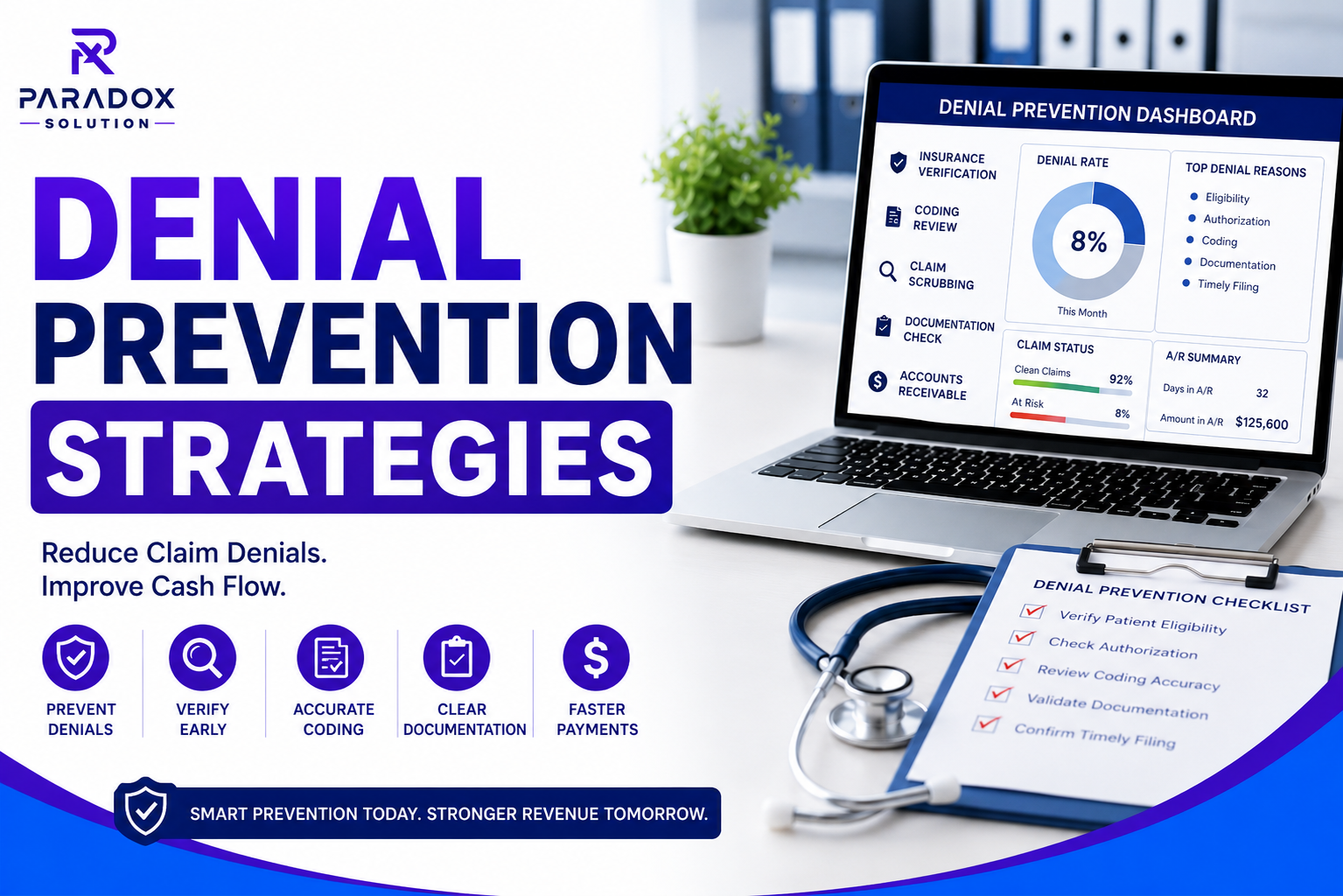
Denial Prevention Strategies: 9 Proven Ways to Reduce Claim Problems
Claim denials are rarely caused by one big mistake. More often, they start with a small issue somewhere in the revenue cycle. A patient insurance detail may be outdated. A prior authorization may not be attached. The diagnosis may not support the service. A modifier may be missing. Or the claim may sit in a work queue until the payer deadline becomes a problem.
That is why strong denial prevention strategies focus on the entire billing process instead of only fixing claims after they are denied.
A good prevention program starts before the patient arrives and continues through documentation, coding, claim submission, payment posting, and accounts receivable follow up. CMS guidance also puts strong emphasis on medical necessity, appropriate coding, accurate documentation, and proper claim requirements.
This guide explains the most practical ways to prevent avoidable denials, how staff should divide responsibilities, where common failures occur, and how different types of medical practices can improve their workflow without creating unnecessary administrative work.
What Are Denial Prevention Strategies?
Denial prevention strategies are the processes a healthcare organization uses to identify and correct billing problems before a payer denies a claim.
A denial happens when an insurance payer processes a claim but refuses payment for all or part of the billed service. The reason might involve eligibility, authorization, coding, documentation, medical necessity, timely filing, coordination of benefits, or another payer requirement.
A rejected claim is slightly different. A rejection usually means the claim did not pass an electronic or front end validation step and was returned before normal adjudication. The billing team can often correct and resubmit it without going through a formal appeal process.
Denial Prevention vs Denial Management
The distinction is important.
| Area | Denial Prevention | Denial Management |
|---|---|---|
| Main goal | Stop problems before submission | Resolve problems after denial |
| Timing | Before or during claim creation | After payer decision |
| Example | Verify eligibility before visit | Appeal a claim denied for eligibility |
| Best result | Clean claim | Recovered payment |
| Workload | Preventive | Reactive |
| Long term value | Reduces repeat issues | Recovers lost revenue |
A practice that only works denials after they happen is constantly cleaning up the same problems.
A stronger approach asks:
Why did this claim fail, and what process allowed the failure to happen?
That question turns one denial into a process improvement opportunity.
Why Denial Prevention Matters to Medical Practices

Denials do more than delay payment.
A billing team must spend time reviewing the explanation of benefits or electronic remittance advice, researching the patient record, checking payer policy, correcting the claim, gathering records, submitting an appeal when appropriate, and following the account again.
That creates administrative work that could often have been avoided.
For example, consider a family medicine clinic that submits 1,000 claims each month. Even if only a small percentage require additional work, the staff time can become significant when every problem needs individual research.
There is also a cash flow issue.
The longer a claim remains unresolved, the longer the practice waits for payment. That can increase accounts receivable, create more follow up work, and make revenue less predictable.
Best practice: Do not measure denial prevention only by the number of denials. Also measure why claims fail, which departments create the problems, how quickly issues are corrected, and whether the same denial repeats.
CMS continues to publish provider compliance resources that identify denial risks, coding requirements, documentation concerns, and ways to prevent incorrect billing.
1. Verify Patient Eligibility Before the Visit
One of the most practical denial prevention strategies is also one of the easiest to overlook.
Insurance verification should happen before the service whenever the workflow allows it.
Eligibility verification confirms whether the patient currently has active coverage and helps the practice understand important benefit information.
Staff should look beyond the simple statement that coverage is active.
What to Verify
| Verification Item | Why It Matters |
| Active coverage | Prevents inactive insurance claims |
| Member ID | Incorrect numbers can cause claim problems |
| Group number | May be required by payer |
| Subscriber information | Helps match the patient to the policy |
| Effective date | Confirms coverage on date of service |
| Termination date | Identifies inactive coverage |
| Copay | Helps front desk collect correctly |
| Deductible | Provides useful patient financial information |
| Coinsurance | Helps estimate patient responsibility |
| Referral requirement | Prevents referral related problems |
| Authorization requirement | Helps avoid avoidable authorization denials |
| Coordination of benefits | Helps identify primary payer |
Example: Family Medicine Clinic
A patient visits a family medicine clinic for an office evaluation.
The front desk sees that insurance information is already stored in the practice management system. No verification is performed.
The payer later returns the claim because the policy terminated several weeks earlier.
The staff then contacts the patient, obtains new insurance information, determines which payer was responsible on the date of service, and rebills the account.
The original problem took less than two minutes to prevent.
The correction took much longer.
Practical Tip
Create a verification workflow for:
-
- New patients
-
- Returning patients with changed insurance
-
- Scheduled high cost procedures
-
- Patients with known authorization requirements
-
- Patients whose coverage has previously caused billing problems
Do not assume that an insurance card from last year is still correct today.
2. Confirm Prior Authorization and Referral Requirements
Prior authorization is approval from an insurance payer before certain services are performed.
Not every service requires authorization, and requirements vary by payer, plan, service, provider, and patient situation.
That variation is why staff should confirm the requirement using current payer information rather than relying on memory.
Common Authorization Problems
| Problem | What Happens |
| Authorization was never obtained | Payer may deny service |
| Wrong procedure authorized | Billed service does not match approval |
| Authorization expired | Service falls outside approved period |
| Wrong provider listed | Authorization may not support billing provider |
| Wrong facility listed | Location may not match approved service |
| Units exceed approval | Payer may deny additional units |
| Authorization number missing | Claim may fail payer edits |
Example: Specialist Practice
A specialist office schedules a diagnostic procedure.
The staff knows the payer often requires authorization, but the request is submitted for the wrong procedure code.
The payer approves the request.
The patient receives the actual procedure.
The claim is later denied because the service billed does not match the authorized service.
The lesson is simple:
Authorization is not only about getting approval. It is about getting the correct approval.
Before the service, compare:
-
- Patient
-
- Payer
-
- Provider
-
- Facility
-
- Procedure
-
- Diagnosis when applicable
-
- Date range
-
- Number of approved units
-
- Authorization number
3. Make Documentation Support the Service Billed
Documentation is one of the most important pieces of the claim.
The medical record should support what actually happened during the patient encounter.
CMS guidance states that medical necessity is central to payment and emphasizes documenting the service during the visit or soon after it is provided.
Medical necessity means that the service was reasonable and necessary for diagnosis or treatment based on applicable requirements.
A Simple Documentation Check
Before coding, ask:
Does the record clearly support the service being billed?
A strong review may include:
| Documentation Element | Review Question |
| Patient complaint | Is the reason for the encounter clear? |
| History | Is relevant clinical information documented? |
| Examination | Is the examination supported by the record? |
| Assessment | What condition is being evaluated or treated? |
| Plan | What did the provider decide or order? |
| Procedures | Is the procedure actually documented? |
| Medical necessity | Does the record support why the service was needed? |
| Medical decision making | Does documentation support reported level? |
| Time | When time based billing applies, is time documented correctly? |
Do not encourage providers to add documentation simply to make a higher code appear justified.
The goal is accurate documentation of the care that was actually provided.
4. Strengthen Coding Accuracy
Coding accuracy is another major area for denial prevention.
Medical coding converts clinical information into standardized codes used for billing and reporting.
This can involve:
-
- ICD 10 diagnosis codes
-
- CPT procedure codes
-
- HCPCS codes
-
- Modifiers
-
- Place of Service codes
Each code must match the service and circumstances documented in the record.
Common Coding Problems
| Coding Issue | Potential Result |
| Incorrect diagnosis code | Medical necessity concern |
| Incorrect CPT code | Incorrect payment or denial |
| Wrong HCPCS code | Claim processing problem |
| Missing modifier | Incorrect claim processing |
| Unsupported modifier | Compliance and denial risk |
| Incorrect Place of Service | Payer processing issue |
| Unbundling | Coding compliance concern |
| Incorrect units | Payment discrepancy |
| Diagnosis does not support service | Medical necessity denial |
CMS maintains the National Correct Coding Initiative, commonly called NCCI, to promote correct coding of Medicare Part B claims.
Practical Coding Workflow
A useful internal workflow is:
Clinical documentation → Code selection → Coding edits → Modifier review → Diagnosis linkage → Claim scrub → Submission
For example, when using a CPT modifier, the billing team should confirm that the modifier is supported by the actual circumstances of the service.
This is where an internal article about CPT modifiers can naturally support the reader who needs deeper coding guidance.
5. Use Claim Scrubbing Before Submission
A claim scrubber is a tool or software function that checks claims for common errors before they are sent to the payer.
A strong claim scrubber can identify issues such as:
-
- Missing required fields
-
- Invalid code combinations
-
- Demographic inconsistencies
-
- Modifier conflicts
-
- Missing diagnosis information
-
- Invalid provider identifiers
-
- Incorrect payer routing
-
- Certain authorization issues
-
- Basic formatting errors
However, claim scrubbing should not replace human review.
Software can identify rules based on configured edits. It cannot always determine whether documentation truly supports a service.
Clean Claim Checklist
| Item | Check |
| Patient name | Matches payer record |
| Date of birth | Correct |
| Member ID | Correct |
| Payer | Correct |
| Provider | Correct |
| NPI | Correct |
| Taxonomy when required | Correct |
| Date of service | Correct |
| CPT or HCPCS | Valid |
| ICD 10 codes | Supported |
| Modifier | Supported |
| Units | Correct |
| Place of Service | Correct |
| Authorization | Present when required |
| Referral | Present when required |
| Diagnosis linkage | Appropriate |
| Claim format | Correct |
| Clearinghouse response | Accepted |
Warning: An accepted claim is not necessarily a payable claim. Clearinghouse acceptance generally means the electronic claim passed certain initial validation checks. The payer still has to adjudicate the claim.
6. Track the Top Denial Reasons
A denial report becomes much more useful when it is analyzed by root cause.
Do not simply record:
“Claim denied.”
Record:
“Claim denied because authorization was missing.”
Then go one level deeper:
“Authorization was missing because the scheduling workflow did not flag the service.”
That is where prevention begins.
Denial Root Cause Table
| Denial Category | Typical Root Cause | Prevention Action |
| Eligibility | Coverage not verified | Verify before visit |
| Authorization | Requirement missed | Add payer rules to workflow |
| Coding | Incorrect code | Improve coding review |
| Modifier | Incorrect or missing modifier | Modifier validation |
| Medical necessity | Diagnosis does not support service | Review payer policy |
| Documentation | Record incomplete | Provider documentation education |
| Timely filing | Claim submitted late | Monitor billing queues |
| Coordination of benefits | Wrong primary payer | Verify payer order |
| Duplicate claim | Claim sent more than once | Review submission status |
| Provider enrollment | Credentialing issue | Maintain enrollment records |
| Place of Service | Incorrect location code | Validate POS before submission |
| Patient demographics | Incorrect information | Front end data verification |
CMS provider compliance resources specifically highlight denial reasons, billing codes, documentation requirements, and prevention steps for certain services.
7. Create Clear Staff Responsibilities
Denial prevention becomes difficult when everyone assumes that someone else is checking the problem.
Each stage should have an owner.
Suggested Responsibility Model
| Workflow Stage | Primary Responsibility |
| Registration | Front desk |
| Insurance verification | Front desk or eligibility team |
| Authorization | Authorization team |
| Clinical documentation | Provider and clinical staff |
| Coding | Certified coder or trained billing staff |
| Charge entry | Billing team |
| Claim edits | Billing team |
| Claim submission | Billing team |
| Payment posting | Payment posting staff |
| Denial review | Denial team or biller |
| Appeals | Assigned billing or coding staff |
| Root cause review | Revenue cycle manager |
This does not mean one department is blamed when a denial happens.
The goal is process ownership.
For example, if a recurring authorization denial originates in scheduling, the billing team can report the pattern. The scheduling team can then update its workflow.
8. Monitor Claims Before They Become Denials
Denial prevention does not end when a claim is submitted.
Claims should be monitored through the billing cycle.
A basic workflow can look like this:
Service date → Documentation → Coding → Claim creation → Claim scrub → Clearinghouse → Payer → Adjudication → Payment or denial → Follow up
Claim Status Review
| Status | What It Means |
| Draft | Claim is still being prepared |
| Ready to submit | Claim passed internal review |
| Submitted | Claim was sent |
| Accepted | Clearinghouse or payer accepted the transmission |
| In process | Payer is adjudicating the claim |
| Paid | Payment was issued |
| Denied | Payer refused all or part of payment |
| Rejected | Claim failed an initial validation |
| Pending information | Payer needs additional information |
| Appeal submitted | Practice challenged a denial |
The exact terminology depends on the payer and billing system.
Why Claim Follow Up Matters
A practice can prevent additional revenue loss by identifying claims that remain unresolved.
The staff should know:
-
- When the claim was submitted
-
- Whether it was accepted
-
- Whether the payer received it
-
- Whether additional documentation is requested
-
- Whether payment was issued
-
- Whether the claim was denied
-
- Whether an appeal deadline applies
-
- Whether timely filing remains available for corrected submission
CMS publishes detailed claim processing instructions through its Medicare Claims Processing Manual and related resources.
9. Train Staff on Repeating Problems
One of the biggest mistakes in denial management is treating education as a one time event.
Payer rules change.
Software workflows change.
Staff members change.
Codes change.
Clinical services change.
A new provider may also document differently from an established provider.
That means training should be connected to actual denial data.
Example
A multi provider clinic notices that many claims are denied because the billed service does not meet payer requirements for the reported diagnosis.
Instead of correcting each denial individually, the revenue cycle manager reviews the pattern with the coding team and providers.
The clinic creates a short education session explaining:
-
- The common denial reason
-
- Which services are affected
-
- What documentation is needed
-
- Which diagnosis relationships need attention
-
- Where payer policy should be checked
-
- Examples of correct documentation
The next step is monitoring.
Education without follow up may not change behavior.
The Complete Denial Prevention Workflow
A strong prevention system connects every stage.
| Stage | Prevention Activity | Main Risk |
| Scheduling | Check service requirements | Authorization |
| Registration | Capture complete demographics | Patient data |
| Eligibility | Confirm active coverage | Eligibility |
| Authorization | Obtain correct approval | Authorization |
| Visit | Document care accurately | Documentation |
| Coding | Select supported codes | Coding |
| Charge entry | Enter charges correctly | Billing |
| Claim scrub | Identify technical errors | Rejection |
| Submission | Submit within payer rules | Timely filing |
| Payer processing | Monitor claim status | Delay |
| Payment posting | Post accurately | Balance errors |
| Denial review | Identify root cause | Lost revenue |
| Appeal | Submit supported correction | Unpaid claim |
| Reporting | Track trends | Repeat problems |
| Education | Train staff and providers | Recurring denials |
This workflow gives practice owners a much better picture of where a denial originated.
Real World Denial Prevention Examples
Solo Physician Practice
A solo physician notices several unpaid claims related to annual wellness services.
The billing staff reviews the accounts and finds that documentation does not consistently support the services reported.
The practice begins using a simple provider documentation checklist.
The lesson is not to add unnecessary documentation.
The lesson is to make sure documentation clearly reflects services actually performed and supports billing.
Family Medicine Clinic
A family medicine office frequently receives eligibility related denials.
The problem is traced to returning patients whose insurance changed but whose registration information was never updated.
The clinic adds an insurance verification step before scheduled visits.
The lesson is simple: old insurance information creates new billing problems.
Pediatric Office
A pediatric office receives recurring denials related to immunization administration billing.
The team discovers that different staff members enter vaccine charges differently.
The practice creates one standardized workflow covering the vaccine product, administration service, documentation, and claim review.
The lesson is consistency.
Specialist Practice
A specialist practice receives denials because authorization details do not match services billed.
The authorization team begins comparing the approved service against the planned procedure before the appointment.
The billing team performs a second review before claim submission.
The lesson is that authorization and billing should not operate as separate silos.
Multi Provider Clinic
A multi provider clinic notices one provider has a much higher denial rate than the others.
Instead of assuming the provider is making coding mistakes, the revenue cycle manager compares:
-
- Payer mix
-
- Service type
-
- Documentation
-
- Coding
-
- Modifier use
-
- Authorization requirements
-
- Place of Service
-
- Claim volume
The data shows that the provider treats a different patient population with more authorization requirements.
The lesson is that denial rates need context.
Urgent Care Center
An urgent care center sees frequent patient demographic errors because walk in patients move quickly through registration.
The center adds a front end verification process and asks patients to confirm key insurance information before the claim is released.
The lesson is that speed should not eliminate basic billing controls.
Hospital Outpatient Department
An outpatient department notices repeated claim issues tied to payer specific billing requirements.
The revenue cycle team builds payer specific claim rules and reviews high risk services before submission.
The lesson is that a single billing workflow may not be enough when payer requirements differ.
Common Denial Prevention Mistakes
Fixing Denials Without Finding the Root Cause
Correcting one claim is necessary.
Stopping the same problem from happening again is better.
Relying Completely on Software
Billing software is helpful, but software cannot replace clinical judgment, documentation review, payer policy review, or staff accountability.
Ignoring Small Dollar Denials
A small denial can expose a large process problem.
If the same $20 issue happens hundreds of times, the total impact may become meaningful.
Waiting Too Long to Review Accounts
A claim that has not been monitored can become harder to resolve as deadlines approach.
Using Old Payer Rules
Payer policies change. Staff should verify current requirements for services that commonly create problems.
Treating Every Payer the Same
Medicare, Medicaid, commercial plans, Medicare Advantage plans, and other payers may have different requirements.
Payer rules should be checked rather than assumed.
Medical Necessity and Denial Prevention
Medical necessity deserves special attention because it connects clinical care, documentation, coding, and payer policy.
CMS states that medical necessity is a central payment criterion and that billed services must meet applicable requirements.
A basic medical necessity review asks:
-
- What service was performed?
-
- Why was it performed?
-
- What diagnosis or clinical condition supports it?
-
- Does the record explain the reason for the service?
-
- Does the payer cover the service under the applicable policy?
-
- Are the codes consistent with the documented service?
Do not confuse medical necessity with simply having a diagnosis on the claim.
The diagnosis should genuinely relate to the service.
HIPAA and Denial Prevention
HIPAA compliance also matters during denial work.
Billing staff often handle protected health information while reviewing claims, contacting payers, preparing appeals, and communicating with providers.
A denial prevention process should therefore protect patient information throughout the workflow.
Practical controls include:
-
- Use approved systems for claim communication.
-
- Limit access according to job responsibilities.
-
- Avoid sending patient information through unsecured channels.
-
- Use appropriate authentication.
-
- Follow organizational privacy and security procedures.
-
- Dispose of sensitive information correctly.
-
- Train staff on privacy requirements.
Prevention should never come at the expense of patient privacy.
Audit Readiness Checklist
A denial prevention system should also make the practice easier to audit.
| Audit Area | Question |
| Documentation | Can the record support the service? |
| Coding | Do codes match documentation? |
| Medical necessity | Is the service supported? |
| Authorization | Was required authorization obtained? |
| Eligibility | Was coverage verified? |
| Provider enrollment | Was the provider properly enrolled where required? |
| Claim submission | Was the claim submitted correctly and on time? |
| Payment posting | Was payment recorded accurately? |
| Denial handling | Was the denial reviewed and corrected appropriately? |
| Appeals | Is supporting documentation available? |
| Policies | Are current payer policies available to staff? |
| Training | Are recurring problems addressed through education? |
CMS provides medical record documentation guidance and emphasizes accurate, supportive records as part of provider compliance.
How to Measure Denial Prevention
You cannot improve what you do not measure.
A useful denial dashboard does not need dozens of metrics.
Start with a manageable set.
Recommended KPIs
| KPI | What It Shows |
| Denial rate | Overall frequency of denials |
| Rejection rate | Front end claim problems |
| Top denial reason | Main source of payment problems |
| Initial denial dollar value | Financial impact |
| Repeat denial rate | Whether prevention works |
| Days to denial resolution | Staff efficiency |
| Clean claim rate | Front end quality |
| AR days | Revenue cycle health |
| Timely filing losses | Submission control |
| Appeal success rate | Quality of denial recovery |
The Most Important Question
Do not ask only:
“How many claims were denied?”
Also ask:
“Which preventable process failure caused these denials?”
That question creates a useful improvement cycle.
Denial Prevention Checklist for Medical Practices
Use this checklist during a monthly revenue cycle review.
Front End
-
- Verify patient demographics.
-
- Verify active insurance.
-
- Check primary and secondary coverage.
-
- Identify referral requirements.
-
- Check authorization requirements.
-
- Confirm provider and location requirements.
Clinical
-
- Document services accurately.
-
- Support medical necessity.
-
- Complete orders and referrals when required.
-
- Avoid copying irrelevant information into the record.
-
- Ensure procedures are clearly documented.
Coding
-
- Validate ICD 10 codes.
-
- Validate CPT codes.
-
- Validate HCPCS codes.
-
- Review modifiers.
-
- Check units.
-
- Confirm Place of Service.
-
- Review payer specific coding rules.
Billing
-
- Run claim edits.
-
- Review high risk claims.
-
- Submit claims promptly.
-
- Monitor clearinghouse responses.
-
- Track rejected claims.
-
- Confirm payer receipt.
Follow Up
-
- Review unpaid claims.
-
- Work denials promptly.
-
- Track appeal deadlines.
-
- Document payer conversations.
-
- Identify repeated denial patterns.
-
- Report root causes to the correct department.
How Often Should a Practice Review Denials?
There is no universal schedule that works for every organization.
A small solo practice may review denial trends weekly and perform a deeper monthly analysis.
A large multi provider organization may need daily work queues, weekly operational reports, and monthly root cause meetings.
The important point is consistency.
A Practical Review Schedule
| Frequency | Recommended Activity |
| Daily | Review rejected and high priority claims |
| Weekly | Review open denials and aging accounts |
| Monthly | Analyze denial categories |
| Quarterly | Review payer trends and workflow problems |
| Annually | Update policies, training, and technology |
Higher risk services may require more frequent review.
When Outsourcing May Help
Some practices manage billing internally. Others use a billing company or combine internal staff with an outside revenue cycle team.
The right model depends on practice size, payer mix, staff experience, technology, specialty, claim volume, and management resources.
| Factor | In House Billing | Outsourced Billing |
| Direct control | High | Shared |
| Staff management | Internal | Vendor managed |
| Specialized expertise | Depends on staff | May provide broader expertise |
| Technology | Practice responsibility | Often provided or supported |
| Denial analysis | Internal | Often included |
| Training | Internal | May be shared |
| Cost structure | Payroll and systems | Contract or percentage based |
| Scalability | Depends on staffing | Often easier to scale |
The important question is not simply whether billing is outsourced.
Final Denial Prevention Checklist
A practice with a strong prevention culture should be able to answer yes to most of these questions:
| Question | Yes or No |
| Do we verify insurance before services? | |
| Do we identify authorization requirements? | |
| Do providers document services clearly? | |
| Does coding reflect actual documentation? | |
| Are modifiers reviewed? | |
| Are Place of Service codes checked? | |
| Are high risk claims scrubbed? | |
| Are rejected claims reviewed quickly? | |
| Are payer requirements monitored? | |
| Do we track denial reasons? | |
| Do we identify root causes? | |
| Do we train staff based on denial trends? | |
| Do we monitor appeal deadlines? | |
| Do we measure repeat denials? | |
| Do we review the process regularly? |