
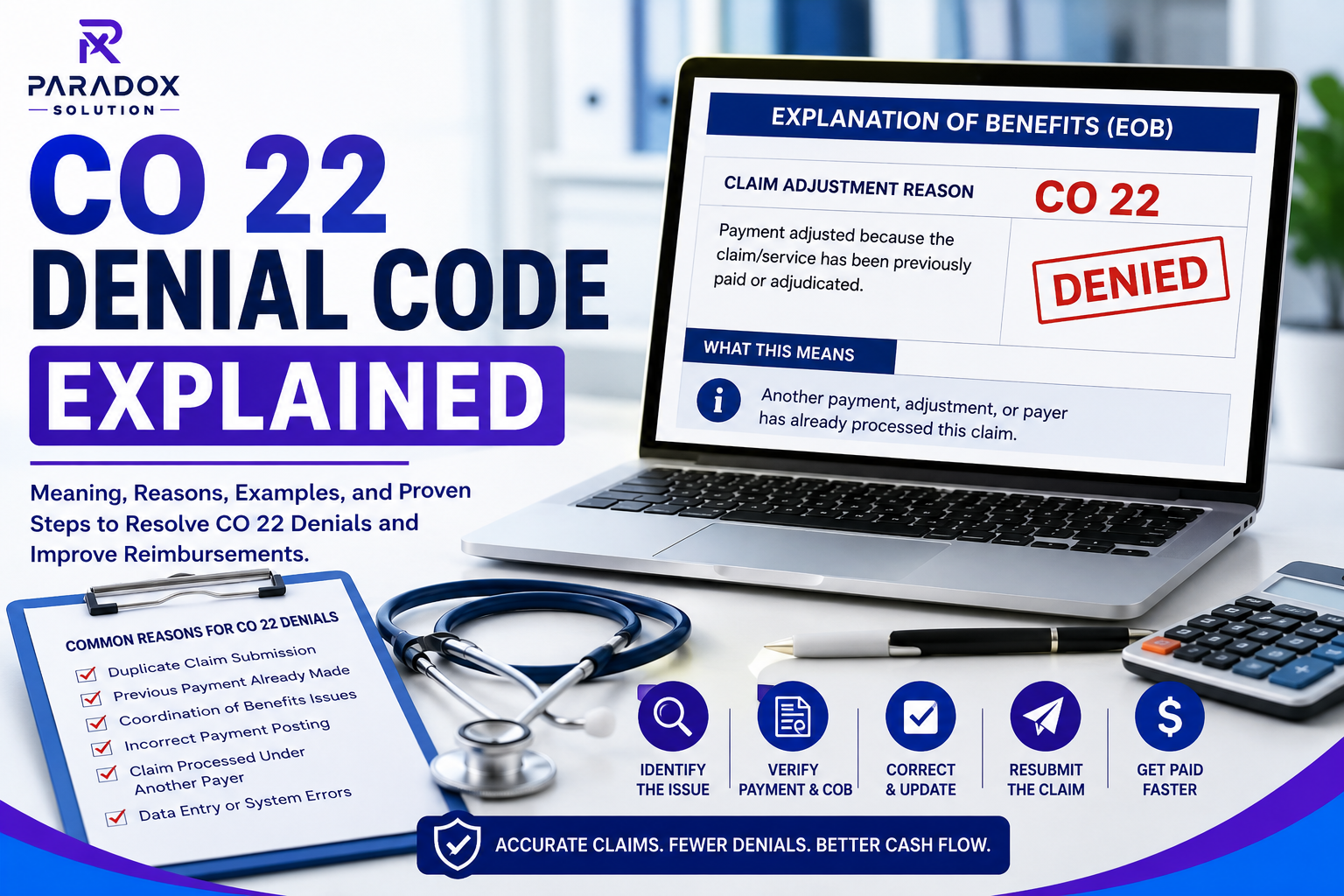
CO 22 Denial Code Explained: A Practical Guide for Medical Billing Success
Medical claim denials are frustrating, especially when the reason is not immediately clear. One denial that often creates confusion is CO 22 Denial Code Explained. If your practice receives this denial, it usually means the insurance payer believes another payment or adjustment has already satisfied the claim or that coordination between payers has affected reimbursement. Understanding exactly why it happened can save your staff hours of unnecessary follow up and help protect your revenue.
Whether you work in a small family practice, a specialty clinic, an urgent care center, or a large healthcare organization, knowing how to investigate and resolve this denial is an important part of effective revenue cycle management. The good news is that most CO 22 denials can be prevented with stronger insurance verification, accurate payment posting, and careful claim review before submission.
This guide explains what the denial means, why it occurs, how to fix it step by step, and what your team can do to prevent it from happening again. Along the way, you will find practical examples, helpful checklists, workflow tables, and compliance tips based on real medical billing practices.
What Is CO 22 Denial Code?
The CO 22 denial code is a Claim Adjustment Reason Code (CARC) used by insurance companies to explain why part or all of a claim payment has been adjusted.
Simply put, this denial indicates that the payer believes the service has already been paid, adjusted, or considered under another payment arrangement. The adjustment may involve another insurance company, a previous payment, or a contractual agreement.
The letters CO stand for Contractual Obligation.
A contractual obligation means the provider cannot bill the patient for the denied amount unless payer rules specifically allow it. Instead, the provider must review the claim, determine why the adjustment occurred, and correct the issue if necessary.
Understanding the Components
| Component | Meaning |
|---|---|
| CO | Contractual Obligation |
| 22 | Payment adjusted because another payer or previous payment affects reimbursement |
| Responsible Party | Usually the provider must investigate rather than bill the patient |
| Common Area | Coordination of Benefits, payment posting, duplicate processing |
Why this matters
Misunderstanding a contractual denial can lead to incorrect patient billing, unnecessary appeals, and compliance concerns.
Why Does CO 22 Denial Code Happen?
Several situations can trigger this denial. While the wording may differ slightly among insurance companies, the underlying issue usually falls into one of several common categories.
Previous Payment Already Exists
Sometimes the claim was processed before, and the insurance company has already issued payment.
This often happens when:
-
- A claim is accidentally submitted twice.
-
- Staff members resend a claim before checking claim status.
-
- The clearinghouse retransmits a claim.
Example
A pediatric clinic submits a claim on Monday.
By Friday, the office has not checked the payer portal and assumes the claim was lost. Staff submit the claim again.
The insurance company processes the second submission and issues a CO 22 denial because payment already exists.
Lesson learned
Always verify claim status before sending another claim.
Coordination of Benefits Problems
Coordination of Benefits (COB) determines which insurance company pays first when a patient has more than one health plan.
If primary and secondary insurance information is incorrect, the payer may deny the claim using CO 22.
Example
A patient has:
-
- Employer insurance
-
- Medicare
The office accidentally bills Medicare first.
Since the employer plan should pay first, Medicare adjusts the claim and issues the denial.
Incorrect Payment Posting
Payment posting is the process of recording insurance payments into the practice management system.
Errors during payment posting may create the appearance that claims remain unpaid, causing duplicate billing.
Examples include:
-
- Wrong patient account
-
- Wrong claim number
-
- Wrong date of service
-
- Duplicate payment entries
Contractual Adjustments
Many providers participate in insurance networks.
Their contracts specify:
-
- Allowed amount
-
- Provider discount
-
- Patient responsibility
-
- Payment calculation
If staff misunderstand contractual adjustments, they may incorrectly resubmit claims that have already been processed correctly.
Duplicate Claim Submission
Duplicate submissions remain one of the most common reasons for this denial.
Typical causes include:
-
- Manual resubmission
-
- Clearinghouse duplication
-
- Billing software errors
-
- Multiple employees working the same account
-
- Lack of claim tracking
Common Causes of CO 22 Denials
| Cause | What Happens | Prevention |
|---|---|---|
| Duplicate claim | Claim submitted twice | Check payer status first |
| Incorrect COB | Wrong payer billed first | Verify insurance at every visit |
| Previous payment | Claim already reimbursed | Review payment history |
| Posting error | Incorrect payment entry | Daily reconciliation |
| Contract adjustment | Payment already calculated | Review payer contract |
How the CO 22 Denial Fits Into the Revenue Cycle
Understanding where this denial occurs helps staff identify workflow weaknesses.
| Revenue Cycle Stage | Possible CO 22 Risk |
|---|---|
| Patient registration | Incorrect insurance information |
| Eligibility verification | Missing secondary insurance |
| Coding | Rare cause but possible if duplicate encounter created |
| Claim submission | Duplicate transmission |
| Clearinghouse review | Duplicate file sent |
| Insurance adjudication | Previous payment detected |
| Payment posting | Posting error creates confusion |
| AR follow up | Duplicate rebilling |
Step by Step Process to Investigate a CO 22 Denial
Instead of immediately appealing the denial, follow a structured investigation.
Step 1. Review the Explanation of Benefits
The Explanation of Benefits (EOB) explains how the payer processed the claim.
Look for:
-
- Payment date
-
- Claim number
-
- Adjustment reason
-
- Previous payment references
-
- Coordination of Benefits notes
Never assume the denial means the payer made a mistake.
Step 2. Verify Payment History
Check your billing software.
Confirm:
-
- Was payment already received?
-
- Was payment posted?
-
- Was payment reversed?
-
- Was another claim processed?
Many denials are resolved at this stage without contacting the payer.
Step 3. Review Insurance Coverage
Confirm:
-
- Primary insurance
-
- Secondary insurance
-
- Effective dates
-
- Policy numbers
-
- Group numbers
-
- Coordination of Benefits information
Patients frequently change insurance without notifying the practice.
Step 4. Compare Claim Numbers
Compare:
-
- Original claim
-
- Resubmitted claim
-
- Clearinghouse confirmation
-
- Payer acknowledgment
This helps identify duplicate submissions.
Step 5. Contact the Insurance Company
If records do not explain the denial, call the payer.
Have ready:
-
- Patient name
-
- Member ID
-
- Date of service
-
- Claim number
-
- Tax ID
-
- NPI
-
- Previous payment information
Ask the representative:
-
- Why was CO 22 assigned?
-
- Which claim received payment?
-
- Is additional documentation required?
-
- Should the claim be corrected or appealed?
Documentation Checklist Before Calling the Payer
| Document | Why You Need It |
|---|---|
| EOB | Understand adjustment details |
| Claim form | Compare submitted information |
| Payment record | Confirm reimbursement |
| Eligibility verification | Validate insurance coverage |
| Coordination of Benefits record | Identify primary payer |
| Clearinghouse report | Check transmission history |
| Patient registration form | Verify demographic accuracy |
Real World Example 1: Solo Family Medicine Practice
A family medicine physician noticed several CO 22 denials after switching billing software.
The billing specialist assumed the software migration had erased claim history and began resubmitting outstanding claims.
After reviewing the payer portal, the office discovered that most claims had already been paid before the software conversion. The duplicate submissions triggered CO 22 adjustments.
What fixed the problem?
-
- Payment history was imported correctly.
-
- Staff reviewed payer portals before rebilling.
-
- Duplicate claim alerts were enabled in the billing system.
Result
The practice significantly reduced unnecessary denials and saved many hours of follow up each week.
Best Practice Reminder: Before resubmitting any unpaid claim, always verify its status through the payer portal or clearinghouse. A few minutes of checking can prevent days of denial management work.
Real World Example 2: Multi Provider Specialty Clinic
An orthopedic clinic experienced recurring CO 22 denials for patients covered by both commercial insurance and Medicare.
During an internal audit, the billing manager discovered that patient insurance information had not been updated after annual eligibility changes. Claims were being sent to the secondary payer first instead of the primary payer.
How the issue was resolved
| Action Taken | Outcome |
|---|---|
| Verified insurance eligibility before every visit | Correct payer identified |
| Updated Coordination of Benefits records | Claims routed correctly |
| Retrained front desk staff | Fewer registration errors |
| Added billing quality checks | Reduced preventable denials |
Within two billing cycles, the clinic saw a noticeable decline in CO 22 denials and faster reimbursement from both primary and secondary insurers.
How to Correct a CO 22 Denial Code
Receiving a CO 22 denial does not always mean you should file an appeal. In many cases, the claim has already been processed correctly, and the real issue is duplicate billing, payment posting, or insurance coordination.
The goal is to identify the root cause before taking action.
Step 1. Determine Whether Payment Was Already Made
Start by reviewing your practice management system and the payer portal.
Check the following:
-
- Date of service
-
- Patient name
-
- Claim number
-
- Payment amount
-
- Check or EFT number
-
- Explanation of Benefits (EOB)
-
- Electronic Remittance Advice (ERA)
If payment already exists, compare it with the billed amount.
Sometimes staff members only notice a balance due without realizing that contractual adjustments have already reduced the remaining balance.
Quick Tip: Never assume an unpaid patient balance means the insurance company denied the claim.
Step 2. Review Coordination of Benefits
If the patient has more than one insurance plan, verify that claims were sent in the correct order.
Confirm:
-
- Primary insurance
-
- Secondary insurance
-
- Tertiary insurance, if applicable
-
- Effective dates
-
- Policy termination dates
-
- Medicare eligibility
-
- Employer coverage
Incorrect payer order is one of the easiest mistakes to fix, but it is also one of the most common.
Step 3. Identify Duplicate Claims
Look for duplicate claim activity.
Review:
| Review Area | What to Check |
|---|---|
| Claim history | Was the same claim submitted twice? |
| Clearinghouse reports | Multiple transmissions |
| Billing software | Duplicate encounters |
| Payment records | Previous reimbursement |
| Staff notes | Manual rebilling |
Many practices discover duplicate claims after reviewing clearinghouse acceptance reports.
Step 4. Decide the Correct Next Action
Your next step depends on what you find.
| Situation | Recommended Action |
|---|---|
| Claim already paid correctly | Close the account |
| Wrong insurance billed | Correct insurance and rebill |
| Duplicate claim submitted | Do not resubmit again |
| Payment posting error | Correct posting records |
| Payer processed claim incorrectly | Contact payer or file appeal |
Following a consistent workflow prevents unnecessary work for both your staff and the insurance company.
Corrected Claim or Appeal?
Many new billers immediately think every denial requires an appeal.
That is not true.
Understanding the difference saves valuable time.
When to Submit a Corrected Claim
Submit a corrected claim if information on the original claim was inaccurate.
Examples include:
-
- Incorrect insurance
-
- Wrong member ID
-
- Incorrect provider
-
- Missing modifier
-
- Wrong diagnosis code
-
- Incorrect place of service
-
- Incorrect billing provider
Corrected claims replace the original claim with accurate information.
When an Appeal Makes Sense
Appeals are appropriate when you believe the payer made an incorrect decision despite receiving accurate information.
Examples include:
-
- Payment exists but was applied incorrectly.
-
- Coordination of Benefits was handled incorrectly by the payer.
-
- The payer overlooked documentation already submitted.
-
- Contract terms were not followed.
Always include supporting documentation with an appeal.
Documentation That Supports Resolution
Good documentation often makes the difference between a quick resolution and weeks of follow up.
Keep copies of:
| Required Document | Purpose |
|---|---|
| Original claim | Verify billed information |
| Corrected claim | Show updated information |
| EOB or ERA | Review payer decision |
| Insurance cards | Verify coverage |
| Eligibility verification | Confirm active coverage |
| Medical record | Support medical necessity if needed |
| Payment history | Confirm prior reimbursement |
| Call reference numbers | Track payer conversations |
Organized records also improve audit readiness.
Common Staff Mistakes That Lead to CO 22 Denials
Even experienced billing teams occasionally make preventable mistakes.
The most common include:
-
- Skipping eligibility verification.
-
- Resubmitting claims without checking payer status.
-
- Posting payments to the wrong patient.
-
- Forgetting to update insurance after annual enrollment.
-
- Ignoring Coordination of Benefits changes.
-
- Working duplicate work queues.
-
- Failing to reconcile ERA files daily.
These small errors often create larger revenue cycle problems.
Real World Example: Pediatric Practice
A pediatric office noticed several CO 22 denials during the first month of the school year.
Many parents had changed insurance after changing jobs.
The front desk continued using insurance information from the previous year.
Claims reached the wrong payer, resulting in adjustments and delays.
What the practice changed
-
- Insurance cards were scanned at every visit.
-
- Eligibility was verified before appointments.
-
- Front desk staff received refresher training.
-
- Billing staff reviewed claims before submission.
Within one quarter, insurance related denials dropped significantly.
Lesson learned
Insurance verification is much less expensive than denial recovery.
Real World Example: Urgent Care Center
An urgent care center frequently submitted claims within hours of patient visits.
Speed improved cash flow, but duplicate claims became common.
When staff believed electronic submissions had failed, they manually resent claims.
The clearinghouse had actually accepted the original claims.
Insurance companies later processed the duplicates and assigned CO 22.
Solution
The practice introduced a simple workflow.
-
- Check clearinghouse status.
-
- Review payer acknowledgment.
-
- Verify claim status online.
-
- Only resubmit after confirming rejection.
Duplicate claim denials decreased considerably over the following months.
Compliance Considerations
Every medical billing office should remember that payer policies differ.
A process that works for one insurance company may not work for another.
Keep these compliance principles in mind.
Follow CMS Guidance
For Medicare claims, always follow current CMS billing requirements, including:
-
- Proper claim submission
-
- Correct Coordination of Benefits rules
-
- Accurate patient information
-
- Timely filing limits
-
- Documentation standards
Commercial insurance companies often have similar requirements but may use different workflows.
Maintain HIPAA Compliance
The Health Insurance Portability and Accountability Act (HIPAA) protects patient information.
When investigating CO 22 denials:
-
- Share patient information only with authorized individuals.
-
- Secure electronic claim records.
-
- Protect printed EOBs.
-
- Limit access based on staff responsibilities.
Compliance is part of good billing practice, not just an IT responsibility.
Accurate Documentation Matters
Strong documentation supports every stage of the revenue cycle.
Document:
-
- Insurance verification
-
- Eligibility confirmation
-
- Patient communication
-
- Payment posting corrections
-
- Claim corrections
-
- Appeal submissions
-
- Payer reference numbers
These records become valuable if questions arise months later.
Staff Responsibilities for Preventing CO 22 Denials
| Team Member | Primary Responsibility |
|---|---|
| Front desk | Verify insurance and demographics |
| Scheduler | Confirm payer participation |
| Medical coder | Assign accurate diagnosis and procedure codes |
| Medical biller | Review claims before submission |
| Payment posting specialist | Post payments accurately |
| AR follow up specialist | Investigate denials promptly |
| Practice manager | Monitor denial trends and staff performance |
Everyone plays a role in reducing claim denials.
Clean Claim Checklist
Before submitting a claim, verify the following.
| Checklist Item | Completed |
|---|---|
| Patient demographics verified | ✔ |
| Insurance eligibility confirmed | ✔ |
| Coordination of Benefits updated | ✔ |
| Provider credentials active | ✔ |
| Diagnosis codes reviewed | ✔ |
| Procedure codes accurate | ✔ |
| Modifiers verified | ✔ |
| Place of service confirmed | ✔ |
| Duplicate claim check completed | ✔ |
| Documentation supports services | ✔ |
A clean claim has a much better chance of being paid correctly the first time.
Audit Readiness Checklist
Practices should periodically review their billing processes.
| Audit Area | Review Frequency |
|---|---|
| Eligibility verification | Daily |
| Payment posting | Daily |
| Duplicate claims | Weekly |
| Denial trends | Monthly |
| Staff education | Quarterly |
| Internal billing audit | Quarterly |
| Payer policy updates | As released |
Regular audits help identify issues before they become recurring denial patterns.
Long Term Strategies to Prevent CO 22 Denials

Fixing one denial is helpful, but preventing dozens of future denials has a much bigger impact on your practice. The most successful medical offices treat denial management as an ongoing process rather than a task performed only after claims are rejected.
Below are strategies that consistently reduce CO 22 denials across different practice types.
Verify Insurance at Every Visit
Insurance information can change at any time.
Patients may:
-
- Change employers.
-
- Switch health plans.
-
- Become eligible for Medicare.
-
- Add secondary insurance.
-
- Lose coverage.
Never rely on insurance information collected months ago.
Best Practice: Ask patients to present their insurance card at every visit, even if they have been coming to your practice for years.
Verify Coordination of Benefits Annually
Many practices only update Coordination of Benefits (COB) when a patient mentions new insurance.
Instead, make COB verification part of your annual registration process and whenever a patient reports any insurance change.
This simple step prevents claims from being sent to the wrong payer.
Reconcile Payments Daily
Daily payment reconciliation helps identify problems before staff begin working unnecessary denials.
Compare:
-
- Electronic Remittance Advice (ERA)
-
- Explanation of Benefits (EOB)
-
- Electronic Funds Transfer (EFT)
-
- Practice management reports
-
- Bank deposits
This process reduces posting errors that may later trigger duplicate claim activity.
Monitor Denial Trends
One CO 22 denial may be an isolated issue.
Twenty similar denials usually indicate a workflow problem.
Track trends such as:
-
- Denials by payer
-
- Denials by provider
-
- Denials by location
-
- Denials by registration staff
-
- Denials by billing specialist
-
- Denials by claim type
Patterns often reveal opportunities for staff education or process improvements.
Key Performance Indicators to Monitor
Successful practices measure billing performance instead of relying on assumptions.
| KPI | Why It Matters | Goal |
|---|---|---|
| First pass claim acceptance | Indicates claim quality | As high as possible |
| Denial rate | Measures billing accuracy | Keep consistently low |
| CO 22 denial count | Tracks duplicate payment issues | Declining trend |
| Days in Accounts Receivable | Measures collection speed | Monitor monthly |
| Clean claim rate | Shows submission quality | Continuous improvement |
| Appeal success rate | Evaluates denial resolution | Improve over time |
| Eligibility verification completion | Prevents payer errors | Every patient |
Review these indicators monthly with both billing and front office teams.
In House vs Outsourced Denial Management
Every practice handles denials differently. Some manage everything internally, while others partner with a medical billing company.
| Factor | In House Team | Outsourced Billing Company |
|---|---|---|
| Direct control | High | Moderate |
| Staff training responsibility | Practice | Billing company |
| Staffing costs | Higher | Usually predictable |
| Technology investment | Practice pays | Often included |
| Scalability | Limited | Easier to expand |
| Denial expertise | Depends on staff experience | Often specialized |
| Reporting | Internal | Depends on service agreement |
There is no universal answer. The best approach depends on practice size, claim volume, staffing, and available resources.
Related Areas That Influence CO 22 Denials
Although CO 22 focuses on payment adjustments, other parts of the revenue cycle have a direct effect on how often this denial occurs.
Related topics include:
-
- Insurance Verification to confirm active coverage before the visit.
-
- Eligibility Verification to confirm benefits on the date of service.
-
- Medical Coding to ensure services are billed correctly.
-
- ICD 10 Coding to support medical necessity.
-
- HCPCS Codes when billing supplies and certain services.
-
- CPT Modifiers when additional claim information is required.
-
- Place of Service Codes to identify where care was provided.
-
- Credentialing to ensure providers are enrolled with payers.
-
- Prior Authorization for services that require payer approval.
-
- Payment Posting to accurately record reimbursements.
-
- Accounts Receivable Follow Up to resolve unpaid claims promptly.
-
- Medical Billing Software to automate claim tracking and reduce duplicate submissions.
-
- Revenue Cycle Management to connect every step from patient registration through final payment.
Improving these areas strengthens the entire billing process and helps prevent avoidable denials.
Lessons Learned From Real Practices
After working with many healthcare organizations, several patterns appear repeatedly.
Practices that experience fewer CO 22 denials usually:
-
- Verify insurance before every visit.
-
- Check claim status before resubmitting.
-
- Reconcile payments every day.
-
- Train staff regularly.
-
- Monitor denial reports every month.
-
- Document payer conversations.
-
- Keep billing software updated.
-
- Review payer policy changes regularly.
Practices with frequent denials often skip one or more of these steps.
The difference is rarely one major mistake. It is usually several small workflow issues that gradually increase denial rates.
Conclusion
Understanding CO 22 Denial Code Explained is about more than learning a billing definition. It is about improving the entire claim process so your practice spends less time fixing avoidable errors and more time caring for patients.
Most CO 22 denials happen because of duplicate claim submissions, payment posting mistakes, or Coordination of Benefits issues. Fortunately, these problems are largely preventable with accurate documentation, insurance verification, careful payment reconciliation, and consistent staff training.
A reliable revenue cycle depends on teamwork. Front desk staff, coders, billers, payment posting specialists, and practice managers all contribute to clean claims and timely reimbursement.
Remember that payer rules and claim processing requirements may vary. Always review current payer policies, follow CMS guidance when applicable, maintain HIPAA compliance, submit claims on time, and document every correction or payer communication.
When your team follows a consistent workflow and regularly reviews denial trends, CO 22 denials become easier to resolve and far less likely to happen again.