
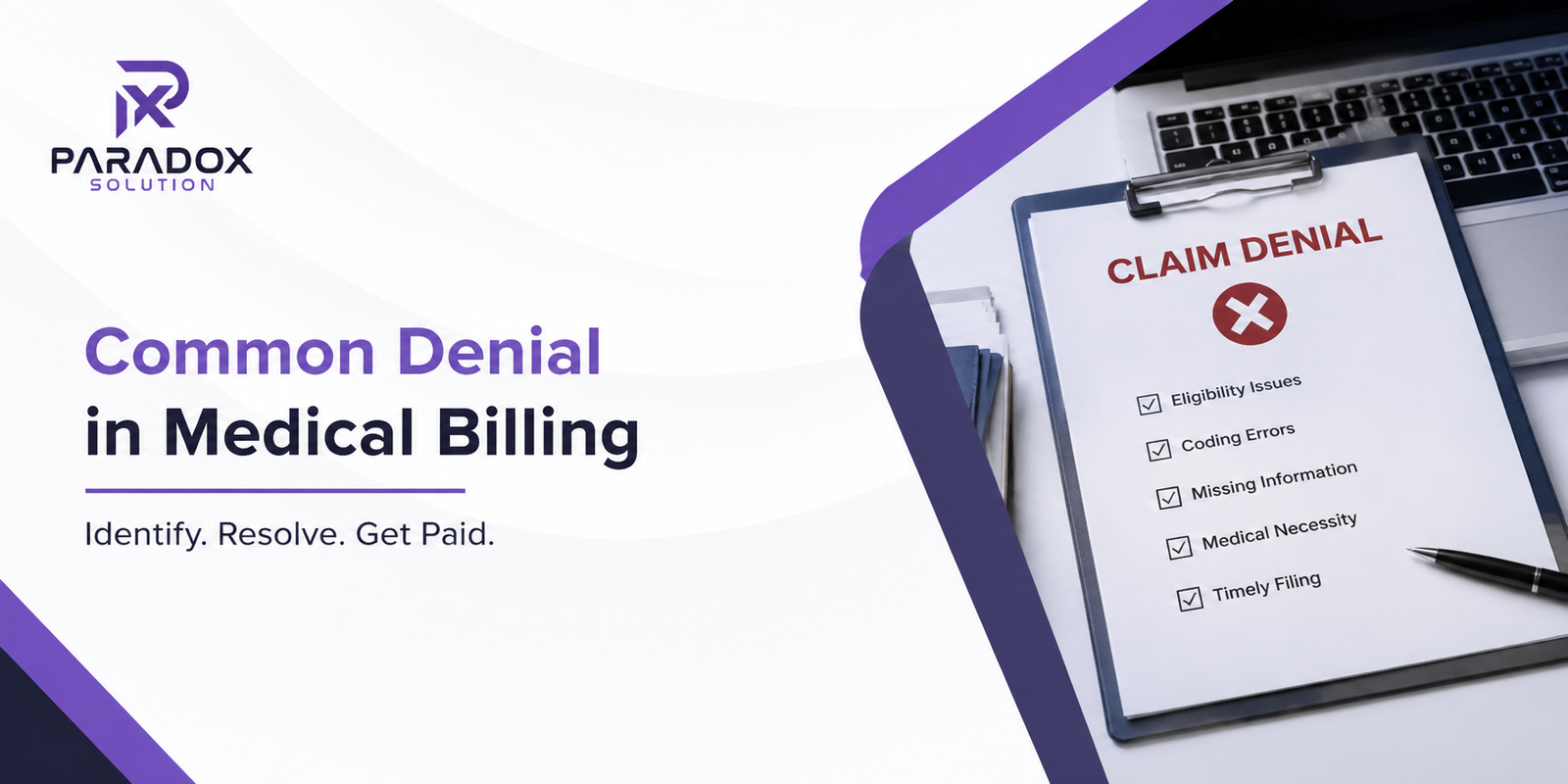
Common Denials in Medical Billing: Causes and Solutions
Healthcare providers work hard to deliver quality patient care, but getting paid correctly is another challenge altogether. One denied claim can create hours of extra work, delayed payments, frustrated staff, and unnecessary revenue loss. That is why understanding every common denial in medical billing is one of the most valuable skills for any medical practice.
Whether you run a small physician office or a large multi specialty clinic, claim denials affect cash flow and operational efficiency. The good news is that many denials are completely preventable when your billing team follows the right processes.
In this guide, we’ll break down the most frequent denial reasons, explain the most common denial codes in medical billing, share practical prevention strategies, and provide simple solutions that practices can apply immediately to reduce denials and improve collections.
Why Medical Billing Denials Matter
A denied claim is a claim that an insurance company refuses to pay after reviewing the submitted information. Unlike a rejected claim, which never enters the processing system because of errors, a denied claim is processed but payment is refused.
Every denial means additional work.
Your staff must:
- Investigate the reason.
- Correct documentation.
- Gather missing information.
- Appeal when appropriate.
- Resubmit the claim.
- Follow up until payment is received.
All of this increases administrative costs while delaying revenue.
The Hidden Cost of Denials
| Impact | Result |
|---|---|
| Delayed reimbursement | Reduced cash flow |
| Extra staff time | Higher operating costs |
| Patient confusion | Lower satisfaction |
| Missed appeal deadlines | Permanent revenue loss |
| Increased accounts receivable | Slower financial performance |
Understanding the Difference Between Rejections and Denials
Many practices confuse claim rejections with denials.
| Claim Rejection | Claim Denial |
|---|---|
| Occurs before claim processing | Occurs after claim processing |
| Usually caused by formatting errors | Usually caused by coverage or documentation issues |
| Easy to correct | May require appeals |
| Faster resolution | Can take weeks or months |
Knowing the difference helps billing teams respond faster.
Top 10 Denials in Medical Billing
These are the top 10 denials in medical billing that affect practices across nearly every specialty.
| Rank | Denial Reason | Preventable |
|---|---|---|
| 1 | Missing patient eligibility | Yes |
| 2 | Authorization not obtained | Yes |
| 3 | Incorrect patient information | Yes |
| 4 | Duplicate claims | Yes |
| 5 | Coding errors | Yes |
| 6 | Lack of medical necessity | Often |
| 7 | Timely filing exceeded | Yes |
| 8 | Non covered services | Sometimes |
| 9 | Missing documentation | Yes |
| 10 | Coordination of benefits issues | Yes |
These remain some of the common denials in medical billing seen by providers nationwide.
Understanding these denial codes medical professionals see every day helps billing staff resolve problems faster.
Most Common Denial Codes in Medical Billing
Insurance companies often communicate denials through standardized adjustment codes.
Here are some of the most common denial codes in medical billing.
| Denial Code | Meaning |
|---|---|
| CO 16 | Missing or invalid information |
| CO 18 | Duplicate claim |
| CO 22 | Coordination of benefits issue |
| CO 29 | Timely filing exceeded |
| CO 50 | Medical necessity not established |
| CO 96 | Non covered charges |
| CO 97 | Included in another service |
| CO 109 | Claim not covered by payer |
| CO-4 | inconsistent modifier |
| CO-27 | Expenses incurred after coverage terminated |
Understanding these denial codes medical professionals see every day helps billing staff resolve problems faster.
1. Eligibility Verification Failures
One of the biggest reasons claims are denied is incomplete insurance verification.
Common problems include:
- Coverage expired
- Wrong insurance entered
- Inactive policy
- Incorrect payer selection
- Wrong member ID
Best Practice
Always verify insurance before every visit instead of relying on previous records.
Real Example
A patient visited twice within six months.
The office assumed the insurance remained unchanged.
The employer had switched insurance carriers.
The claim was denied because coverage had ended.
Five minutes of verification could have prevented weeks of follow up.
2. Missing Prior Authorization
Many services require approval before treatment.
Examples include:
- MRI
- CT scans
- Specialty medications
- Certain surgeries
- Physical therapy visits
Without authorization, payment is often denied regardless of medical necessity.
Prevention Checklist
| Task | Complete |
|---|---|
| Verify authorization requirement | ✔ |
| Obtain approval number | ✔ |
| Confirm service dates | ✔ |
| Document authorization | ✔ |
3. Incorrect Patient Demographics
Simple typing mistakes create expensive delays.
Common errors include:
- Wrong birth date
- Misspelled name
- Incorrect member ID
- Wrong address
- Invalid insurance number
Front desk accuracy plays a major role in successful billing.
4. Coding Errors
Coding mistakes remain one of the largest causes of top denials in medical billing.
Examples include:
- Incorrect CPT code
- Wrong ICD diagnosis
- Missing modifier
- Invalid code combination
- Outdated codes
Accurate coding requires regular education because coding guidelines change every year.
5. Medical Necessity Denials
Insurance companies only pay when services meet established medical necessity guidelines.
Documentation should clearly answer:
- Why was the service needed?
- What symptoms existed?
- What diagnosis supports treatment?
- Why was this procedure appropriate?
Poor documentation often leads to unnecessary denials.
6. Timely Filing Denials
Every insurance company has filing deadlines.
Missing those deadlines usually means permanent denial.
| Payer Type | Common Filing Window |
|---|---|
| Commercial | 90 to 180 days |
| Medicare | 12 months |
| Medicaid | Varies by state |
Practices should submit claims daily whenever possible.
7. Duplicate Claims
Submitting the same claim twice can trigger automatic denials.
Duplicate claims often happen because:
- Staff assume claims were never received.
- Clearinghouse delays create confusion.
- Multiple employees submit the same encounter.
Always verify claim status before resubmitting.
8. Non Covered Services
Some services simply are not covered under a patient’s policy.
Examples include:
- Cosmetic procedures
- Experimental treatments
- Certain preventive services
- Frequency limitations
Patients should be informed before treatment whenever possible.
9. Missing Documentation
Documentation supports every billed service.
Missing documentation may include:
- Progress notes
- Operative reports
- Referral forms
- Laboratory reports
- Physician signatures
Without supporting records, even correctly coded claims may be denied.
10. Coordination of Benefits Problems
Patients with multiple insurance plans often experience coordination issues.
Common causes include:
- Wrong primary insurance
- Secondary payer billed first
- Old insurance information
- Missing coordination updates
Verifying insurance annually helps reduce these denials.
Top 10 Denial Codes in Medical Billing Explained
Below are some of the top 10 denial codes in medical billing that every billing professional should recognize.
| Code | Meaning | Solution |
|---|---|---|
| CO 16 | Missing information | Correct claim |
| CO 18 | Duplicate claim | Verify before resubmission |
| CO 22 | Coordination issue | Update insurance order |
| CO 29 | Timely filing | Appeal if applicable |
| CO 50 | Medical necessity | Submit documentation |
| CO 96 | Non covered service | Verify benefits |
| CO 97 | Bundled service | Review coding |
| CO 109 | Not covered | Confirm payer policy |
| CO-4 | inconsistent modifier | Correct modifier use |
| CO-27 | Expenses incurred after coverage terminated | Verify Eligibility |
Common Denials in Medical Billing by Department
Different specialties experience different denial trends.
| Specialty | Frequent Denials |
|---|---|
| Family Practice | Eligibility, coding |
| Cardiology | Authorization |
| Orthopedics | Medical necessity |
| Radiology | Authorization |
| Physical Therapy | Visit limits |
| Behavioral Health | Coverage limitations |
How to Build a Strong Denial Management Process
Successful practices follow a structured workflow.
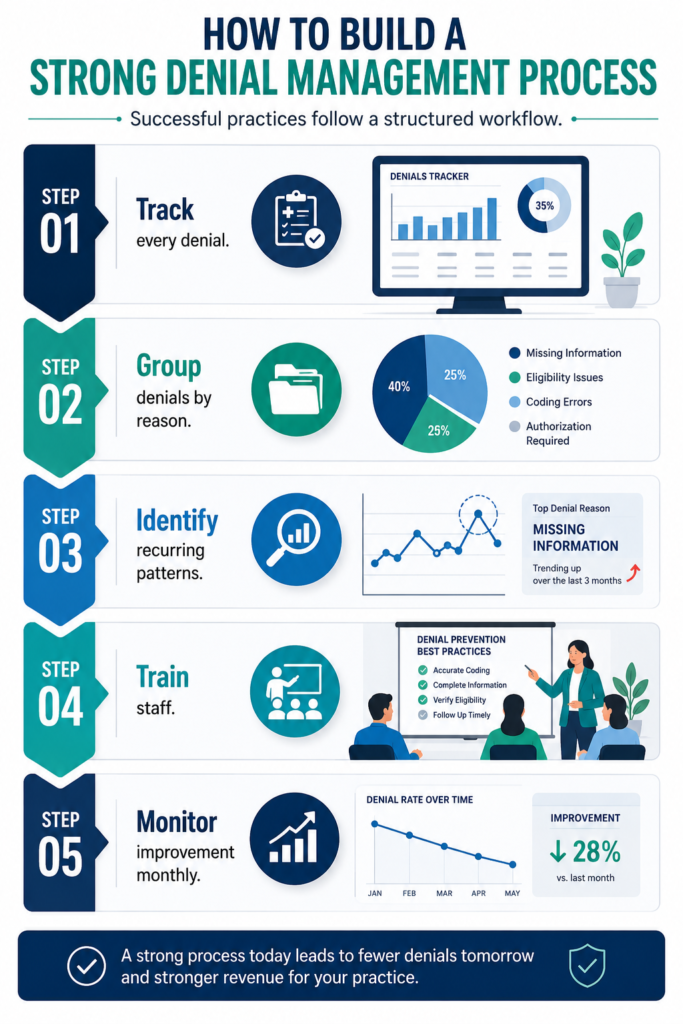
Denial Prevention Checklis
| Daily Task | Importance |
|---|---|
| Verify eligibility | High |
| Confirm authorization | High |
| Review documentation | High |
| Validate coding | High |
| Submit claims quickly | High |
| Monitor claim status | High |
| Appeal denied claims | High |
Should Every Denial Be Appealed?
No.
Some denials are worth appealing.
Others cost more in staff time than the expected reimbursement.
Consider:
- Claim value
- Appeal success rate
- Documentation quality
- Payer history
Smart practices prioritize appeals with the highest financial return.
Technology Can Reduce Denials
Modern billing software helps identify errors before claims are submitted.
Helpful features include:
- Eligibility verification
- Coding validation
- Authorization tracking
- Claim scrubbing
- Automated reminders
- Denial reporting
Automation never replaces knowledgeable billing staff, but it significantly reduces manual mistakes.
Staff Training Makes a Bigger Difference Than Most Practices Realize
One lesson many experienced billing managers learn is that denial prevention starts long before a claim reaches the billing department.
Front desk staff influence demographic accuracy.
Clinical staff influence documentation quality.
Coders influence coding accuracy.
Billers influence clean claim submission.
Everyone contributes to revenue cycle success.
Holding short monthly training sessions based on recent denial trends can produce measurable improvements over time.
Key Metrics Every Practice Should Track
Monitoring performance helps identify problems before they become expensive.
| Metric | Healthy Goal |
|---|---|
| Clean claim rate | Above 95 percent |
| First pass payment rate | Above 90 percent |
| Overall denial rate | Below 5 percent |
| Days in accounts receivable | Below 40 days |
| Appeal success rate | Above 60 percent |
Reviewing these numbers every month helps practices stay proactive instead of reacting after revenue has already been lost.
Final Thoughts
Managing a common denial in medical billing is not just about fixing rejected claims. It is about creating reliable processes that prevent problems before they happen. Practices that verify insurance, obtain authorizations, document thoroughly, code accurately, and monitor denial trends consistently recover more revenue with less administrative effort.
While every payer has unique rules, most denials stem from a relatively small group of recurring issues. By understanding the most common denials in medical billing, recognizing the top 10 denial in medical billing, learning the most common denial codes in medical billing, and responding quickly when issues arise, your practice can strengthen cash flow, reduce staff workload, and improve the overall patient financial experience.
Frequently Asked Questions
1. What is the most common denial in medical billing?
The most common denial in medical billing is eligibility related issues. Inactive insurance, incorrect policy information, and failure to verify benefits before the visit are frequent causes of denied claims.
2. What are the top 10 denial codes in medical billing?
Some of the most common denial codes include CO 16, CO 18, CO 22, CO 29, CO 50, CO 96, CO 97, CO 109, PR 1, and PR 2. Each code identifies a specific issue that must be corrected before payment can be received.
3. How can a medical practice reduce claim denials?
Practices can reduce denials by verifying insurance before appointments, obtaining prior authorizations, improving documentation, submitting clean claims promptly, reviewing coding accuracy, and regularly analyzing denial reports.
4. What is the difference between a rejected claim and a denied claim?
A rejected claim contains errors that prevent it from entering the payer’s processing system. A denied claim has already been processed but the payer has refused payment based on coverage, coding, documentation, or policy rules.
5. Why is denial management important in medical billing?
Effective denial management improves cash flow, lowers administrative costs, increases first pass claim acceptance, reduces accounts receivable, and helps healthcare practices collect the revenue they have rightfully earned.