
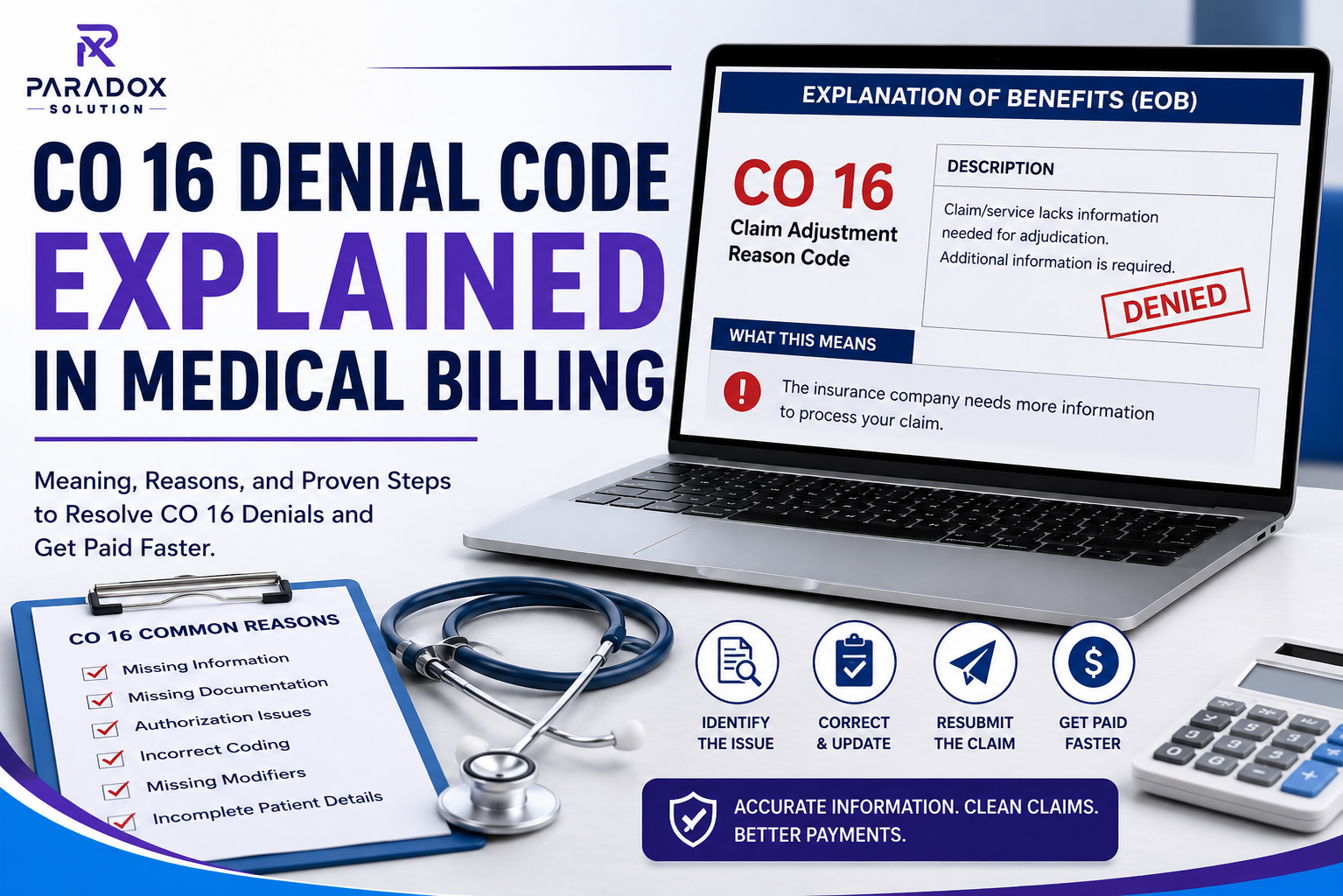
CO 16 Denial Code Explained: A Complete Guide to Faster Claim Payments
If you have worked in medical billing for even a short time, you have probably seen a CO 16 denial code appear on an Explanation of Benefits (EOB) or Electronic Remittance Advice (ERA). At first glance, it may seem like another frustrating insurance denial, but in many cases, it is one of the easiest problems to fix once you understand what the payer is asking for.
The good news is that a CO 16 denial usually does not mean the medical service was unnecessary or permanently rejected. Instead, it often means the insurance company needs more information before it can process the claim. That missing information could be a modifier, authorization number, medical record, diagnosis code, or even a simple patient detail.
In this guide, we will explain CO 16 Denial Code Explained in plain language, walk through the most common causes, show you how to fix each one, and share practical tips that help healthcare practices reduce future denials. Whether you are new to medical billing or have years of experience, these strategies can help improve claim acceptance and protect your revenue.
What Is CO 16 Denial Code?
The CO 16 denial code means the insurance company cannot process your claim because it is missing required information or contains incomplete details. The payer needs additional documentation or corrected claim information before making a payment decision.
Think of it as the insurance company saying:
“We cannot finish reviewing this claim until you provide the missing information.”
Unlike some denial codes that indicate a service is not covered, CO 16 usually points to an issue that can be corrected. Once the missing information is submitted, the claim may be reconsidered for payment.
Key Points
| Item | Explanation |
|---|---|
| Denial Code | CO 16 |
| Meaning | Missing or incomplete claim information |
| Can It Be Fixed? | Usually yes |
| Requires Appeal? | Not always |
| Common Solution | Correct the claim and submit required documentation |
Many billing professionals mistakenly assume every denial requires a formal appeal. With CO 16, the payer often only needs corrected claim information or supporting documents.
Understanding Claim Adjustment Reason Code 16
Claim Adjustment Reason Code 16, often called CARC 16, is a standardized denial code used by health insurance companies.
Its official meaning is straightforward:
Claim or service lacks information that is needed for adjudication. Additional information is required.
In simple words, the insurance company cannot determine whether the claim should be paid because something important is missing.
This missing information could include:
- Patient information
- Provider information
- Authorization number
- Medical records
- Diagnosis codes
- Procedure modifiers
- Accident details
- Referral information
- Supporting documentation
- Correct place of service
- National Drug Code information when required
Each insurance company may request different supporting documents depending on its policies and the type of healthcare service provided.
Why Insurance Companies Use CO 16
Insurance companies process millions of claims every year. To make accurate payment decisions, they rely on complete and accurate information.
When required information is missing, the claim cannot move through the adjudication process.
Some common reasons include:
- Missing prior authorization
- Incorrect patient identification
- Incomplete diagnosis coding
- Missing CPT modifier
- Missing physician documentation
- Missing operative report
- Incomplete medical necessity documentation
- Incorrect accident information
- Missing referral
Rather than automatically denying payment forever, many payers issue CO 16 to give providers an opportunity to correct the problem.
How the Claim Review Process Works
| Billing Stage | What Happens |
|---|---|
| Patient Registration | Patient demographics are collected. |
| Insurance Verification | Eligibility and benefits are confirmed. |
| Medical Coding | Diagnoses and procedures are assigned. |
| Claim Submission | Claim is sent to the insurance payer. |
| Claim Review | Insurance checks the claim for accuracy and completeness. |
| CO 16 Issued | Missing information is identified. |
| Claim Correction | Provider submits the requested information. |
| Final Decision | Claim is approved, partially paid, or denied. |
Common Causes of CO 16 Denials
Although every insurance payer has its own rules, most CO 16 denials happen for a handful of common reasons.
1. Missing Prior Authorization
Many healthcare services require approval before treatment. If the authorization number is missing or invalid, the insurance company may issue a CO 16 denial.
Examples include:
- MRI scans
- CT scans
- Specialty medications
- Surgical procedures
- Physical therapy visits
Tip: Always verify authorization requirements before the patient’s appointment.
2. Missing Medical Documentation
Insurance companies often request documentation to confirm that the service was medically necessary.
Examples include:
- Progress notes
- Physician notes
- Operative reports
- Laboratory reports
- Imaging results
- Hospital discharge summaries
Without these records, the payer may be unable to complete the review.
3. Incomplete Patient Information
Even small registration errors can trigger a denial.
Common issues include:
- Incorrect patient name
- Wrong date of birth
- Missing member ID
- Incorrect insurance policy number
- Missing gender
- Incorrect address
Accurate patient registration is one of the easiest ways to prevent avoidable denials.
4. Missing Procedure Modifier
Procedure modifiers provide additional details about the service performed.
If a required modifier is missing, the payer may not understand the circumstances of the procedure.
Examples include:
- Modifier 25
- Modifier 59
- Modifier 76
- Modifier 91
Always review payer specific billing guidelines before claim submission.
5. Incorrect Diagnosis Coding
Diagnosis codes explain why a service was medically necessary.
Common coding mistakes include:
- Invalid diagnosis codes
- Deleted ICD codes
- Incomplete diagnosis selection
- Diagnosis that does not support medical necessity
Regular coding audits can reduce these errors and improve first pass claim acceptance.
Real World Example
A family medicine clinic performed a minor skin lesion removal for a patient with commercial insurance.
The physician completed the procedure, but the claim was submitted without the required documentation explaining why the removal was medically necessary.
A week later, the practice received a CO 16 denial.
The billing specialist reviewed the remittance advice and found that the payer requested supporting clinical notes. After obtaining the physician documentation, the clinic submitted the records along with the corrected claim.
Within two weeks, the insurance company approved the claim and issued payment.
This example shows that CO 16 often reflects an information gap rather than a permanent denial. Careful review of the payer’s request and prompt submission of the missing documentation can lead to a successful outcome.
Information Commonly Missing From Claims
The following checklist highlights the information most often requested when a CO 16 denial is issued.
| Missing Information | Potential Impact |
|---|---|
| Prior authorization number | Claim cannot be reviewed |
| Medical records | Medical necessity cannot be verified |
| Physician signature | Documentation may be considered incomplete |
| Referral information | Specialist services may not qualify |
| CPT modifier | Procedure may process incorrectly |
| Diagnosis code | Medical necessity may not be established |
| Place of service | Incorrect reimbursement |
| Patient demographics | Claim matching errors |
| Provider credentials | Provider validation may fail |
| Insurance member ID | Eligibility cannot be confirmed |
Why Accurate Documentation Matters
Accurate documentation does much more than support claim payment. It protects your practice during audits, strengthens compliance efforts, and improves communication between clinical and billing teams.
Successful practices treat documentation as part of patient care rather than just a billing requirement. Physicians record clear clinical details, coders translate those details into accurate codes, and billing specialists review claims before submission. This team approach reduces delays and increases the likelihood of first pass claim acceptance.
Incomplete documentation, on the other hand, often leads to additional requests from insurance companies, payment delays, higher administrative costs, and unnecessary follow up work.
How to Fix a CO 16 Denial Code Step by Step
Receiving a CO 16 denial does not mean you should immediately appeal the claim. In most cases, the insurance company is simply asking for additional information. The key is to identify exactly what is missing, correct it, and respond as quickly as possible.
Here is a practical workflow many successful billing teams follow.
Step 1: Review the Remittance Advice (ERA or EOB)
The first step is reading the denial carefully. Never assume the reason based only on the CO 16 code.
Look for:
- Remark Codes (RARC)
- Additional payer messages
- Missing documentation requests
- Missing authorization details
- Missing modifier requests
The accompanying remark codes often tell you exactly what the insurance company needs.
Step 2: Compare the Claim With the Medical Record
Open both the submitted claim and the patient’s chart.
Verify:
- Patient demographics
- Insurance information
- Diagnosis codes
- Procedure codes
- Modifiers
- Authorization numbers
- Physician documentation
- Referral information
Many practices discover that one small omission caused the denial.
Step 3: Contact the Provider if Needed
Sometimes the billing department cannot fix the denial alone.
The provider may need to supply:
- Progress notes
- Operative reports
- Medical necessity documentation
- Missing signatures
- Clarification of services performed
Quick communication between the billing and clinical teams can save several days.
Step 4: Correct the Claim
Once the missing information has been identified:
- Update incorrect fields.
- Add required modifiers.
- Include authorization numbers.
- Attach supporting documentation.
- Verify all claim details before resubmission.
Never resend the exact same claim without making corrections.
Step 5: Submit the Corrected Claim
Each payer has its own process.
Some require:
- Corrected electronic claim
- Paper claim with attachments
- Medical records
- Claim reconsideration form
- Provider portal upload
Always follow the payer instructions to avoid another denial.
Step 6: Monitor the Claim Status
After resubmission:
- Track claim progress.
- Watch payer response times.
- Follow up before filing deadlines expire.
- Document every conversation with the insurance company.
Good follow up prevents claims from sitting unpaid for months.
CO 16 Denial Resolution Workflow
| Step | Action | Responsible Team |
|---|---|---|
| 1 | Review denial message | Billing Staff |
| 2 | Identify missing information | Billing Staff |
| 3 | Obtain documentation | Provider or Clinical Staff |
| 4 | Correct claim | Medical Biller |
| 5 | Submit corrected claim | Billing Team |
| 6 | Monitor payment | AR Follow Up Team |
Common CO 16 Denial Scenarios
Every healthcare specialty experiences CO 16 denials differently.
Family Practice
A patient receives treatment for diabetes.
The diagnosis code is correct, but the physician forgot to sign the encounter note.
The insurance company requests signed documentation before processing payment.
Solution
Obtain the provider signature and submit the updated documentation.
Orthopedic Clinic
A patient undergoes knee surgery.
The surgery required prior authorization, but the authorization number was omitted from the claim.
The insurance company issues CO 16.
Solution
Verify the approved authorization and resubmit the corrected claim.
Cardiology Practice
A patient completes an echocardiogram.
The payer requests clinical documentation showing medical necessity.
Solution
Send physician notes and diagnostic findings supporting the procedure.
Physical Therapy Clinic
A therapist bills multiple treatment sessions.
Required therapy documentation is incomplete.
The claim receives CO 16.
Solution
Submit complete treatment notes and the physician plan of care.
Urgent Care Center
A patient is treated after a minor accident.
The claim is missing accident information.
The payer cannot determine coverage.
Solution
Update accident details and resubmit the claim.
The Most Common Missing Information
| Missing Item | Why It Matters | Prevention Tip |
|---|---|---|
| Authorization Number | Confirms payer approval | Verify before treatment |
| Medical Records | Supports medical necessity | Complete documentation daily |
| Patient ID | Confirms eligibility | Double check registration |
| CPT Modifier | Explains procedure details | Review coding edits |
| Diagnosis Code | Supports reimbursement | Perform coding audits |
| Referral | Required for many plans | Confirm referral before visit |
| Physician Signature | Validates documentation | Complete chart before billing |
| Place of Service | Determines payment rules | Review claim before submission |
How Insurance Verification Prevents CO 16 Denials
Many CO 16 denials begin long before a claim is submitted.
The registration team plays an important role in preventing billing problems.
Before every appointment, verify:
- Active insurance coverage
- Member identification number
- Group number
- Referral requirements
- Prior authorization requirements
- Covered services
- Copayment responsibility
A five minute verification can prevent weeks of claim delays.
Clean Claims Reduce Denials
A clean claim is one that contains complete, accurate, and properly documented information when it reaches the insurance company.
Characteristics of a clean claim include:
- Correct patient information
- Accurate diagnosis coding
- Correct CPT codes
- Required modifiers
- Complete documentation
- Valid authorization
- Correct provider information
Practices with high clean claim rates generally spend less time correcting denials and receive payments faster.
Common Billing Mistakes That Trigger CO 16
| Mistake | Result |
|---|---|
| Missing authorization | Claim delayed |
| Missing modifier | Incorrect processing |
| Invalid diagnosis | Medical necessity questioned |
| Incomplete documentation | Additional information requested |
| Wrong member ID | Eligibility cannot be confirmed |
| Missing referral | Specialist claim delayed |
| Incorrect provider information | Claim review stopped |
| Unsigned medical record | Documentation considered incomplete |
Best Practices to Prevent CO 16 Denials
Experienced billing teams rarely rely on luck. They build processes that catch errors before a claim reaches the payer.
Some proven best practices include:
- Verify insurance before every visit.
- Confirm prior authorization requirements.
- Complete documentation on the same day of service.
- Review coding before claim submission.
- Use claim scrubbing software.
- Train staff on payer specific requirements.
- Monitor denial trends each month.
- Perform internal billing audits.
- Update coding resources regularly.
- Encourage communication between providers and billing staff.
Small improvements in these areas can significantly reduce denial rates and improve cash flow.
Compliance Tips for Billing Teams
Reducing CO 16 denials is not only about getting paid. It also supports compliance and audit readiness.
Keep these practices in place:
- Document services clearly and accurately.
- Protect patient information under HIPAA.
- Maintain complete medical records.
- Keep authorization records accessible.
- Follow payer documentation requirements.
- Retain billing records according to policy.
- Conduct routine internal audits.
Practices that emphasize compliance often experience fewer billing disputes and smoother payer reviews.
Billing Team Responsibilities
| Team Member | Primary Responsibility |
|---|---|
| Front Desk | Register patients and verify insurance |
| Medical Assistant | Collect required patient information |
| Provider | Document services completely |
| Medical Coder | Assign accurate diagnosis and procedure codes |
| Medical Biller | Submit clean claims |
| AR Specialist | Follow up on denied claims |
| Practice Manager | Monitor billing performance and compliance |
Payer Specific CO 16 Denial Scenarios
Although the CO 16 denial code has the same general meaning across the industry, each insurance company may request different supporting information. Understanding payer expectations can help your team respond faster.
| Payer Type | Common Reason for CO 16 | Recommended Action |
|---|---|---|
| Medicare | Missing documentation or required modifiers | Review Medicare billing guidelines and submit requested records |
| Medicaid | Eligibility or authorization issues | Verify coverage dates and authorization requirements |
| Commercial Insurance | Missing clinical notes or referral | Upload supporting documentation through the payer portal |
| Workers Compensation | Missing accident details | Include injury information and employer details |
| Auto Insurance | Incomplete claim documentation | Submit accident reports and medical records |
Always read the accompanying remark codes because they provide the exact reason the payer could not complete claim adjudication.
How Repeated CO 16 Denials Affect Revenue
A single CO 16 denial may seem like a small issue, but repeated denials can significantly impact a practice.
Some of the hidden costs include:
- Delayed reimbursement
- Increased staff workload
- Higher administrative expenses
- More time spent on follow up
- Reduced cash flow
- Greater risk of timely filing deadlines
- Lower staff productivity
- Poor patient financial experience
Practices with strong denial management processes often collect payments faster and spend less time correcting avoidable errors.
Denial Prevention Checklist
Use this checklist before submitting every claim.
| Checklist Item | Complete |
|---|---|
| Patient demographics verified | ☑ |
| Insurance eligibility confirmed | ☑ |
| Prior authorization obtained | ☑ |
| Referral verified if required | ☑ |
| ICD diagnosis codes reviewed | ☑ |
| CPT procedure codes verified | ☑ |
| Required modifiers added | ☑ |
| Medical documentation completed | ☑ |
| Provider signature present | ☑ |
| Claim reviewed before submission | ☑ |
Following the same checklist for every claim helps reduce preventable denials and improves first pass acceptance rates.
Audit Readiness Checklist
Healthcare organizations should always be prepared for payer audits.
A well organized practice keeps:
| Requirement | Why It Matters |
|---|---|
| Signed provider notes | Supports billed services |
| Complete medical records | Demonstrates medical necessity |
| Authorization documentation | Confirms payer approval |
| Referral records | Supports specialist billing |
| Coding documentation | Shows coding accuracy |
| Billing history | Tracks claim corrections |
| Payment records | Supports reimbursement history |
| Communication logs | Documents payer interactions |
Good documentation protects both reimbursement and compliance.
Key Performance Indicators (KPIs) to Monitor
Tracking billing performance helps identify trends before they become serious problems.
| KPI | Goal |
|---|---|
| First Pass Claim Acceptance Rate | Above 95% |
| Overall Denial Rate | Below 5% |
| CO 16 Denial Rate | Monitor monthly and reduce over time |
| Average Days in Accounts Receivable | Under 40 days |
| Corrected Claim Turnaround Time | Within 3 business days |
| Authorization Accuracy | Above 98% |
| Insurance Verification Accuracy | Above 98% |
Review these metrics every month to identify training opportunities and process improvements.
In House Billing vs Outsourced Billing
Some practices wonder whether outsourcing can reduce claim denials. While both approaches can be effective, the right choice depends on the size of the practice, available staff, and billing expertise.
| Feature | In House Billing | Outsourced Billing |
|---|---|---|
| Control | High | Moderate |
| Staff Training | Practice responsibility | Vendor responsibility |
| Upfront Cost | Higher | Lower startup cost |
| Scalability | Limited by staff | Easier to scale |
| Billing Expertise | Depends on team | Usually specialized |
| Claim Monitoring | Internal | Shared with vendor |
No matter which model you choose, complete documentation and accurate claim submission remain essential for preventing CO 16 denials.
Practical Tips From Real Billing Experience
Practices that consistently keep denial rates low often share the same habits.
- Verify insurance every visit, even for returning patients.
- Do not assume prior authorizations are still valid.
- Encourage providers to finish documentation on the day of service.
- Review claims before submission instead of after denial.
- Keep payer specific billing guides available for staff.
- Hold monthly meetings to review denial trends.
- Train new employees on documentation standards before they begin submitting claims.
- Use claim scrubbing tools to identify missing information before submission.
These small habits often make a much bigger difference than expensive software alone.
Key Takeaways
The CO 16 denial code is one of the most common claim adjustment reason codes in medical billing, but it is also one of the most manageable. In most cases, it does not mean the service is permanently denied. Instead, it tells you that the payer needs additional or corrected information before completing claim adjudication.
Practices that focus on accurate patient registration, insurance verification, complete documentation, proper coding, and timely follow up experience fewer CO 16 denials and faster reimbursements. Building a standardized billing workflow, training staff regularly, and monitoring denial trends can improve revenue cycle performance and reduce unnecessary administrative work.
Treat every CO 16 denial as an opportunity to strengthen your billing process. Over time, these improvements lead to cleaner claims, healthier cash flow, and better patient service.
Final Thoughts
Understanding CO 16 Denial Code Explained is about more than resolving a single claim. It is about creating a reliable billing process that reduces errors before they happen. Every step, from patient registration to final payment posting, contributes to claim accuracy.
By investing in staff training, maintaining complete documentation, verifying insurance coverage, and reviewing claims carefully before submission, healthcare organizations can reduce denial rates, improve revenue cycle performance, and spend more time focusing on patient care instead of correcting avoidable billing errors.
Frequently Asked Questions
CO 16 means the insurance company cannot process the claim because required information is missing or incomplete. The provider must submit the requested details before the claim can be fully reviewed.
No. A rejected claim usually fails before entering the payer adjudication process due to formatting or submission errors. A CO 16 denial generally means the payer received the claim but needs additional information to continue processing it.
Sometimes. However, many CO 16 denials are resolved by correcting the claim or providing the requested documentation rather than filing a formal appeal. Always follow the payer's instructions.
Verify insurance eligibility, obtain required authorizations, document services thoroughly, use accurate diagnosis and procedure codes, include required modifiers, and review claims before submission.
Depending on the payer, you may need to provide physician notes, operative reports, referral information, prior authorization records, laboratory results, imaging reports, or other documentation supporting medical necessity.
Yes. Payment is usually delayed until the requested information is received and the claim is reprocessed. Prompt follow up helps reduce reimbursement delays.
Preventing these denials requires teamwork. Front desk staff verify patient information, providers complete accurate documentation, coders assign correct codes, billers submit clean claims, and accounts receivable specialists follow up on outstanding claims.