
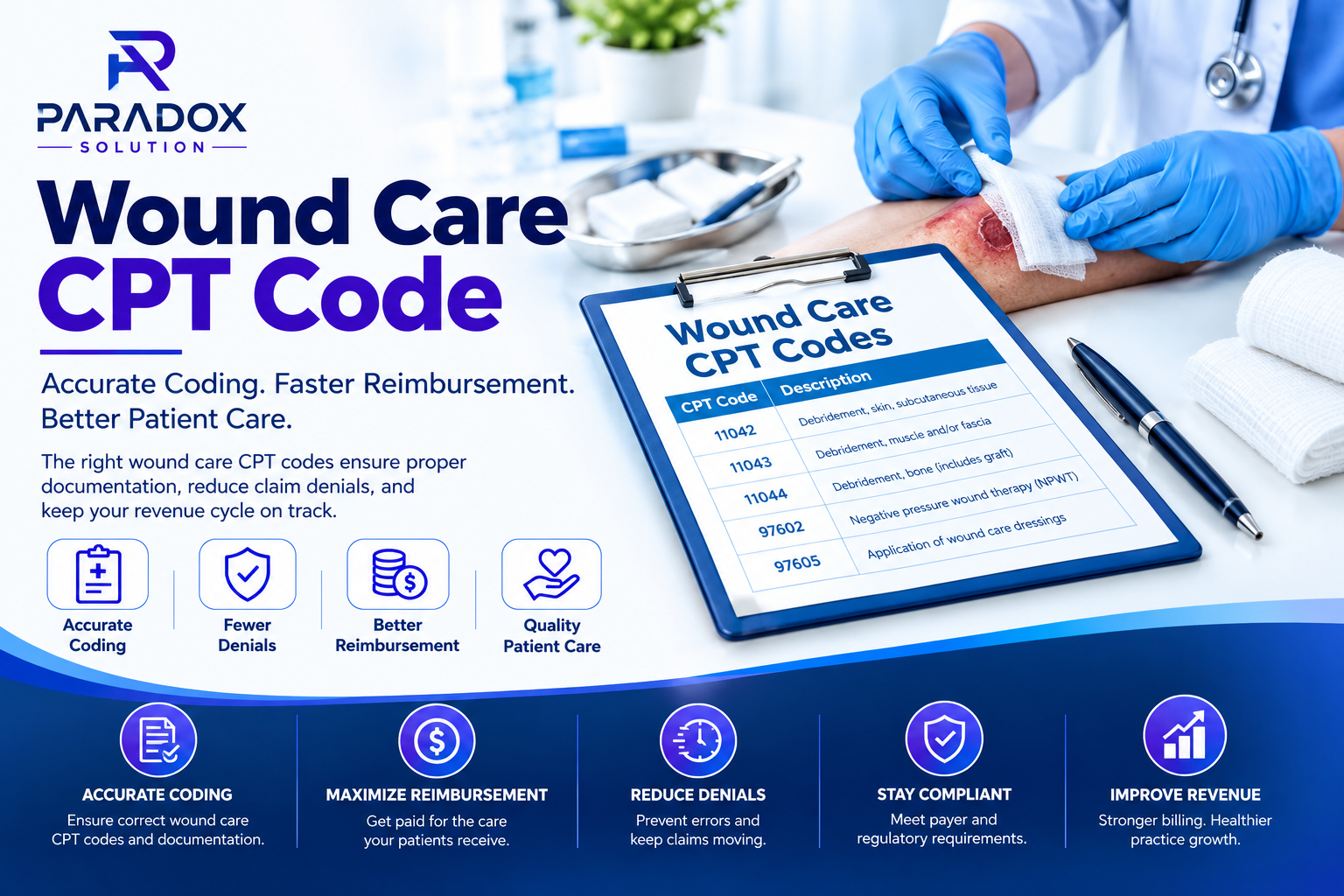
Wound care can look straightforward in the exam room, but billing it correctly requires careful attention to documentation, tissue depth, wound size, medical necessity, and payer rules. A provider may clean a wound, remove devitalized tissue, apply a dressing, or perform a deeper debridement. These services do not all use the same wound care CPT code.
For medical billers and providers, one of the biggest challenges is choosing a code that accurately represents what was actually performed. Using a deeper debridement code simply because a wound is deep, for example, can create a coding problem if the provider did not actually remove tissue at that depth.
This guide explains common wound care CPT codes, documentation requirements, billing mistakes, and practical ways to improve wound care medical billing. It is designed for physicians, practice owners, coders, billers, revenue cycle managers, and beginners who want a clear understanding of the process.
What Is a Wound Care CPT Code?
A wound care CPT code is a Current Procedural Terminology code used to report a specific wound treatment or debridement service. The correct code depends on the actual procedure performed, including the type and depth of tissue removed and the area treated.
For Medicare billing, CMS emphasizes that the selected debridement code should reflect the tissue actually removed, not simply the wound’s overall depth or grade.
Common Wound Care CPT Codes
There is no single cpt code for wound care. Several codes may apply depending on the service.
| CPT Code | General Use |
|---|---|
| 97597 | Selective debridement, first 20 sq cm or less |
| 97598 | Each additional 20 sq cm |
| 11042 | Surgical debridement involving subcutaneous tissue |
| 11043 | Surgical debridement involving muscle/fascia |
| 11044 | Surgical debridement involving bone |
| 11045–11047 | Add-on codes for additional wound area |
| 97605–97606 | Negative pressure wound therapy in applicable cases |
These codes should not be selected based only on the appearance or stage of a wound. The medical record must support the procedure actually performed.
Selective vs. Surgical Debridement
This distinction is especially important in wound care billing.
Selective debridement is generally reported with 97597 or 97598 when devitalized tissue is selectively removed.
Surgical debridement is reported using the appropriate 11042–11047 code when the documentation supports removal of tissue at the corresponding level.
CMS states that the deepest level of tissue actually removed determines the appropriate surgical debridement code.
For example, if a wound extends toward bone but the provider only removes necrotic subcutaneous tissue, a bone-level debridement code would not be appropriate.
How Wound Care Billing Works
A strong wound care billing workflow usually follows these steps:
1. Assess the Wound
The provider documents:
-
- Location
-
- Wound type
-
- Length and width
-
- Depth
-
- Tissue characteristics
-
- Drainage
-
- Infection or other clinical findings
2. Perform and Document the Procedure
The record should explain exactly what was done.
For debridement, documentation should support the tissue removed and the area treated.
3. Select the CPT Code
The coder compares the documented procedure with the appropriate CPT code.
4. Assign the Diagnosis
The ICD-10-CM diagnosis should accurately describe the patient’s condition and support medical necessity.
5. Submit the Claim
Before submission, the billing team should check:
-
- Payer requirements
-
- Modifiers
-
- NCCI edits
-
- Medical necessity
-
- Documentation
6. Manage Denials
If the claim is denied, review the explanation of benefits and compare the denial reason with the medical record before correcting or appealing the claim.
Wound Care Documentation Requirements
Good documentation is one of the strongest defenses against wound care claim denials.
| Documentation Element | Why It Matters |
|---|---|
| Wound location | Identifies the treated site |
| Length and width | Supports surface-area reporting |
| Depth | Helps establish treatment level |
| Tissue removed | Supports debridement code |
| Procedure performed | Establishes the service billed |
| Medical necessity | Supports payer coverage |
| Patient response | Shows treatment outcome |
| Follow-up plan | Supports ongoing care |
CMS guidance specifically addresses wound measurements and the amount of tissue actually debrided. When only part of a wound is treated, the area actually debrided should be reported rather than automatically using the entire wound measurement.
Is There a Wound Dressing CPT Code?
Providers often search for a wound dressing CPT code when they apply a dressing after treatment.
However, a dressing is not automatically separately billable.
CMS states that dressings applied as part of several wound debridement services are included in those services and should not be billed separately. Routine dressing changes also generally do not justify reporting a debridement code when no qualifying wound procedure was performed.
Therefore, the billing team should ask:
Was a separately reportable wound procedure actually performed?
Do not select a CPT code simply because a dressing was changed.
What Is the CPT Code for Wound Cleaning?
Another common search is cpt code for wound cleaning.
Simple cleansing does not automatically support a separately billable debridement code. CMS guidance indicates that removing material without removal of qualifying devitalized tissue does not necessarily meet the definition of a debridement service.
The medical record should therefore describe what was actually removed and what procedure was performed.
Common Wound Care Billing Errors
1. Coding the Wound’s Depth Instead of Tissue Removed
This is one of the most important errors.
A wound may extend to bone, but if the provider only removes subcutaneous tissue, the claim should not automatically use a bone-level debridement code.
2. Separately Billing Included Dressings
Dressings may already be included in the reported wound service.
3. Reporting Multiple Debridement Codes Incorrectly
CMS states that 97597–97598 should not be reported with 11042–11047 for the same wound on the same date of service.
4. Missing Measurements
Incomplete wound measurements can make it difficult to support the reported code.
5. Weak Medical Necessity Documentation
The record should explain why skilled wound treatment was medically necessary.
Wound Care Coding Example
Consider a patient with a chronic diabetic foot ulcer.
The provider documents:
-
- Ulcer on the foot
-
- Wound measurement
-
- Devitalized tissue
-
- Selective removal of the devitalized tissue
-
- Treatment area
-
- Follow-up plan
The coder reviews the documentation and determines that the service supports selective debridement rather than a deeper surgical debridement.
The claim is then submitted with:
-
- Appropriate CPT code
-
- Specific ICD-10-CM diagnosis
-
- Correct units
-
- Required modifiers, if applicable
-
- Supporting documentation
The important lesson is that the procedure performed—not simply the appearance of the wound—drives CPT selection.
Wound Care Compliance Best Practices
A reliable wound care medical billing process should include the following:
Verify Documentation Before Claim Submission
Do not assume the clinical note supports the code. Review it.
Check CMS and Payer Policies
Medicare and commercial insurers may have different coverage and documentation requirements.
Review NCCI Edits
National Correct Coding Initiative (NCCI) edits can affect whether procedures can be reported together.
Audit High-Risk Claims
Regularly review claims involving:
-
- Deep debridement
-
- Multiple wounds
-
- Multiple procedures
-
- Modifiers
-
- Repeated wound treatment
Keep Diagnosis Coding Specific
ICD-10-CM coding should be reported to the highest level of specificity supported by the medical record. CMS specifically requires the diagnosis to be appropriately linked to the procedure.
Wound Care CPT Code vs. Wound Dressing
| Service | Separately Billable? |
|---|---|
| Qualifying debridement | May be billable |
| Routine dressing change | Generally not separately billable |
| Dressing included with debridement | Included |
| Simple cleansing | Not automatically billable |
| Advanced wound procedure | Depends on service and payer |
Always verify the current payer policy before submitting a claim.
Key Takeaways
-
- There is no single wound care CPT code for every wound treatment.
-
- CPT selection must reflect the service actually performed.
-
- The deepest tissue removed, rather than simply exposed, is critical for surgical debridement coding.
-
- 97597 and 97598 are commonly associated with selective debridement.
-
- 11042–11047 are used for surgical debridement at specified tissue levels.
-
- Routine dressing changes are not automatically separately billable.
-
- Accurate wound measurements and procedure documentation are essential.
-
- Always verify current CMS, NCCI, and payer-specific requirements before submitting claims.
Conclusion
Accurate wound care CPT code selection starts with good clinical documentation. Providers should clearly record what was treated, what tissue was removed, how much area was treated, and why the service was medically necessary.
For billing teams, the goal is not simply to select the highest-paying code. The goal is to submit a code that accurately represents the documented service and meets payer requirements. This approach reduces denials, protects revenue, and supports compliant wound care medical billing.
For authoritative guidance, review CMS Medicare Coverage Database.
Frequently Asked Questions
There is no single code that applies to every wound. CPT 97597 and 97598 are commonly used for selective debridement, while 11042–11047 describe surgical debridement at different tissue levels. The correct code depends on the actual procedure and documentation.
Start with the provider's documentation. Identify the procedure performed, tissue actually removed, wound area treated, and applicable CPT requirements. Do not choose a code based only on the wound's overall depth or appearance.
Generally, routine dressing changes are not separately reimbursed when they are included in another wound service. CMS also states that dressings associated with several debridement procedures are included in those services.
Documentation should describe the wound location, measurements, clinical condition, procedure performed, tissue removed when applicable, medical necessity, and follow-up plan. The documentation should support the exact service reported on the claim.
For the same wound on the same date of service, CMS guidance states that 97597/97598 should not be reported with 11042–11047. The appropriate code depends on the type and depth of tissue actually debrided.
Medicare may cover medically necessary wound care when applicable coverage requirements are met and documentation supports the service. Providers should review the current Medicare Administrative Contractor (MAC) policy applicable to their location and service.