
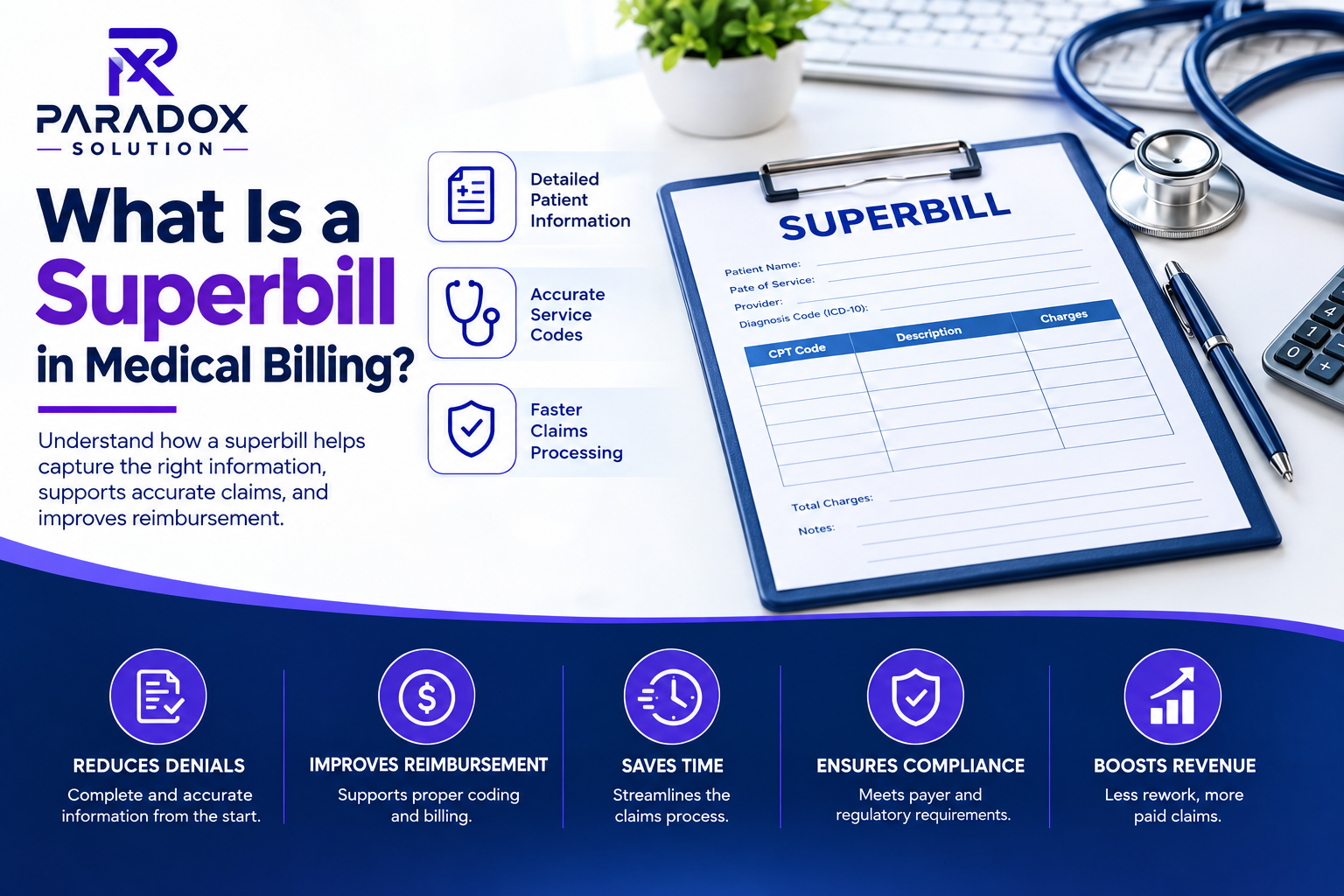
A superbill is an important document in medical billing, especially when a patient receives care from an out-of-network healthcare provider. It gives the patient and insurance company the detailed information needed to process an out-of-network reimbursement claim.
For healthcare providers, creating an accurate superbill is more than simply listing services and charges. It requires correct patient information, provider details, medical codes, dates of service, charges, and other claim-related information.
In this guide, we explain what a superbill is, what it includes, how it works, who uses it, common errors, submission methods, and how providers can improve superbill accuracy in 2026.
Quick Answer: What Is a Superbill?
A superbill is an itemized document prepared by a healthcare provider that summarizes the services provided to a patient and includes the coding and provider information needed for an insurance claim.
It commonly includes:
-
- Provider information
-
- Patient information
-
- Date of service
-
- CPT or HCPCS codes
-
- ICD-10-CM diagnosis codes
-
- Modifiers, when applicable
-
- Place of Service (POS) code
-
- Charges
-
- Payments
-
- NPI and other provider identification information
A patient may use the superbill to submit an out-of-network claim to their insurance company when the provider does not submit the claim directly.
However, receiving a superbill does not guarantee reimbursement. Payment depends on the patient’s insurance benefits, network status, deductible, allowed amount, exclusions, authorization requirements, and the payer’s claim-processing rules.
What Is a Superbill in Medical Billing?
A superbill is a detailed billing document that records the healthcare services provided during a patient encounter.
Unlike a simple receipt, which primarily proves that a payment was made, a superbill contains information that can help an insurance company understand:
-
- Who provided the service
-
- Who received the service
-
- When the service occurred
-
- What service was performed
-
- Why the service was performed
-
- How much the provider charged
-
- How much the patient paid
Superbills are particularly common in practices that see patients who pay privately or receive care from providers who are not participating providers with the patient’s insurance plan.
The exact format can vary between practices and software systems. There is not one universal superbill template that every payer requires.
Other Names for a Superbill
You may hear a superbill referred to as:
-
- Encounter form
-
- Charge ticket
-
- Fee ticket
-
- Itemized statement
-
- Insurance reimbursement statement
-
- Itemized medical invoice
The terminology can vary, but the purpose is generally similar: documenting healthcare services and the information needed to support billing or reimbursement.
Superbill vs. Invoice vs. Insurance Claim
These documents are related, but they are not interchangeable.
| Document | Main Purpose | Typical User | Medical Coding |
|---|---|---|---|
| Receipt | Shows payment was made | Patient | Usually no |
| Invoice | Shows charges or amount due | Patient | May or may not |
| Superbill | Provides detailed service and coding information for reimbursement | Patient/provider | Yes |
| CMS-1500 | Standard professional claim form | Providers/billing organizations | Yes |
| EOB | Explains how an insurer processed a claim | Patient/provider | Claim information |
The CMS-1500 is an official professional claim form used for certain professional claims, including applicable Medicare claims. It should not be confused with a superbill.
A superbill can provide information that is later used to prepare a formal insurance claim, but the insurer may require a specific claim form or electronic submission instead.
Who Creates a Superbill?
The healthcare provider or the provider’s billing team typically creates the superbill.
Depending on the practice’s workflow, the document may be generated through:
-
- An EHR
-
- Practice management software
-
- Medical billing software
-
- A billing service
-
- A manual template
The provider is responsible for making sure the information is accurate and supported by the medical record.
The patient may then submit the superbill to the insurance company when the plan permits patient-submitted out-of-network claims.
In some situations, the provider or billing company may submit the claim on the patient’s behalf.
Who Uses Superbills?
Superbills can be useful for both healthcare providers and patients.
Patients Who May Need a Superbill
A superbill may be relevant when a patient:
-
- Receives care from an out-of-network provider
-
- Has a PPO plan with out-of-network benefits
-
- Pays a provider directly
-
- Receives care from a private-pay practice
-
- Needs documentation for certain reimbursement processes
-
- Wants to submit an out-of-network claim
Mental and behavioral health practices are another area where superbills are commonly used because many private-practice clinicians operate outside traditional insurance networks.
Important Note About HSA and FSA Accounts
A superbill may help document a healthcare expense, but it does not automatically make an expense eligible for HSA or FSA reimbursement.
Eligibility depends on the applicable tax and plan rules. The IRS also requires HSA account holders to maintain records supporting qualified medical expenses.
Patients should therefore confirm requirements with their plan administrator or tax professional when necessary.
Which Providers Commonly Issue Superbills?
Superbills can be used across many healthcare specialties.
Examples include:
-
- Psychologists
-
- Psychotherapists
-
- Counselors
-
- Psychiatrists
-
- Chiropractors
-
- Physical therapists
-
- Occupational therapists
-
- Speech-language pathologists
-
- Nutrition professionals
-
- Certain private-pay physicians
-
- Concierge medicine practices
-
- Other out-of-network healthcare providers
The actual use of a superbill depends on the provider’s business model and the patient’s insurance plan.
Why Do Providers Use Superbills?
Some healthcare providers choose a private-pay or out-of-network model because they want greater control over their practice operations.
Potential reasons include:
-
- Avoiding certain payer contracting requirements
-
- Reducing administrative work associated with insurance participation
-
- Maintaining control over scheduling and fees
-
- Avoiding certain payer-specific restrictions
-
- Serving patients who have out-of-network benefits
However, a private-pay model does not eliminate administrative responsibilities.
Providers still need accurate documentation, coding, patient statements, superbills, payment records, and appropriate claim information when patients seek reimbursement.
What Information Should a Superbill Include?
There is no single universal layout for every payer. Requirements can vary.
However, a well-prepared superbill commonly contains the following information.
1. Provider Information
Typical provider information includes:
-
- Provider’s full name
-
- Credentials
-
- Practice name
-
- Practice address
-
- Phone number
-
- NPI
-
- Tax identification information when required
-
- License information when applicable
-
- Referring provider information when applicable
The National Provider Identifier (NPI) is a standard 10-digit identifier used to identify covered healthcare providers. You can learn more from the CMS National Provider Identifier (NPI) Standard.
2. Patient Information
A superbill may include:
-
- Patient’s full legal name
-
- Date of birth
-
- Address
-
- Insurance information
-
- Member ID
-
- Group number, when applicable
-
- Patient relationship to subscriber
The information should match the patient’s insurance records as closely as possible.
3. Service Information
The service section is one of the most important parts of a superbill.
It may include:
-
- Date of service
-
- CPT code
-
- HCPCS code when applicable
-
- ICD-10-CM diagnosis code
-
- Modifier
-
- Place of Service code
-
- Units
-
- Time, when relevant
-
- Charge per service
-
- Total charge
-
- Amount paid
Why Coding Accuracy Matters
CPT and HCPCS codes describe healthcare services and procedures, while ICD-10-CM codes describe diagnoses or conditions. CPT is maintained by the American Medical Association (AMA), which provides current CPT coding resources and guidance. AMA CPT Coding Resources.
The diagnosis and procedure information should accurately reflect the services documented in the patient’s medical record.
A superbill should never be used to select codes simply because they produce a better reimbursement result.
How Does a Superbill Work? Step by Step
The process can vary by provider and payer, but a typical workflow looks like this.
Step 1: Patient Receives Healthcare Services
The patient receives care from the provider.
The provider documents the encounter, services performed, diagnosis information, and other required clinical details.
Step 2: Provider Charges the Patient
If the practice operates on a private-pay or out-of-network basis, the patient may pay the provider directly.
Step 3: Superbill Is Prepared
The provider or billing team prepares the superbill using the information from the encounter.
An EHR or practice management system may automate much of this process.
Step 4: Superbill Is Reviewed
Before giving the document to the patient, the practice should check:
-
- Patient information
-
- Provider information
-
- NPI
-
- Date of service
-
- CPT/HCPCS codes
-
- ICD-10-CM codes
-
- Modifiers
-
- Charges
-
- Payment information
Step 5: Patient Reviews Insurance Benefits
The patient should confirm whether the insurance plan provides out-of-network benefits.
This is particularly important because having a superbill does not mean the insurance company will reimburse the claim.
Step 6: Patient Submits the Claim
Depending on the payer, the patient may submit the documentation through:
-
- An insurance portal
-
- Mobile application
-
- Fax, if accepted
-
- Another method specified by the insurer
Some plans may require a separate claim form.
Step 7: Insurance Company Processes the Claim
The payer reviews the claim according to the patient’s plan and applicable policies.
The payer may evaluate:
-
- Eligibility
-
- Benefits
-
- Network status
-
- Deductible
-
- Coinsurance
-
- Medical necessity
-
- Coding
-
- Authorization requirements
-
- Timely filing
Step 8: Claim Is Paid or Denied
If the claim is eligible for reimbursement, the insurer processes payment according to the patient’s plan.
If the claim is denied, the patient generally receives an explanation of the decision and information about available correction or appeal options.
What Does a Superbill Look Like?
A superbill is generally structured as an itemized billing document rather than a narrative report.
A typical layout may contain:
| Section | Common Information |
|---|---|
| Provider | Name, credentials, NPI, address |
| Patient | Name, DOB, insurance information |
| Visit | Date of service |
| Diagnosis | ICD-10-CM codes |
| Procedure | CPT/HCPCS codes |
| Modifiers | Applicable modifiers |
| Location | Place of Service |
| Charges | Fee for each service |
| Payment | Amount paid |
| Totals | Total charges and payments |
Many modern EHR and practice management systems can generate superbills automatically.
The important point is not the visual design. Accuracy and completeness are what matter most.
Common CPT Codes Found on Mental Health Superbills
Mental health providers frequently use superbills for out-of-network reimbursement.
Some commonly encountered CPT codes include:
| CPT Code | General Description |
|---|---|
| 90791 | Psychiatric diagnostic evaluation |
| 90832 | Psychotherapy, approximately 30 minutes |
| 90834 | Psychotherapy, approximately 45 minutes |
| 90837 | Psychotherapy, approximately 60 minutes |
| 90839 | Psychotherapy for crisis, first 60 minutes |
| 90847 | Family psychotherapy with patient present |
| 90853 | Group psychotherapy |
| 96130 | Psychological testing evaluation services |
Important: CPT code descriptions and coding requirements can change. Providers should use the current applicable coding resources and verify that documentation supports the selected code.
Does Medicare Reimburse a Superbill?
This is an area where providers and patients should be careful.
A superbill by itself does not create Medicare reimbursement eligibility.
For traditional Medicare fee-for-service, claims generally have a 12-month timely filing limit from the date of service.
Whether a patient can receive reimbursement depends on the provider’s Medicare participation status, the type of service, the patient’s coverage, and Medicare rules.
Medicare Advantage plans are different because they are administered through private Medicare Advantage organizations and may have their own network and claims processes.
Patients should check their specific Medicare or Medicare Advantage coverage before assuming that submitting a superbill will result in payment.
How Much Will Insurance Reimburse From a Superbill?
There is no universal reimbursement percentage.
The amount depends on the patient’s specific health plan.
Important factors include:
-
- Out-of-network benefits
-
- Deductible
-
- Coinsurance
-
- Copayment
-
- Allowed amount
-
- Provider’s billed charge
-
- Annual out-of-pocket maximum
-
- Service exclusions
-
- Prior authorization
-
- Medical necessity requirements
-
- Network status
For example, a provider may charge $200 for a service while the insurance company’s allowed amount is lower. The insurer’s calculation is based on the terms of the patient’s plan rather than simply paying a fixed percentage of the provider’s billed charge.
That is why patients should verify their benefits before receiving expensive out-of-network care.
8 Common Superbill Problems That Can Delay Reimbursement
A superbill may be rejected or require correction for several reasons.
1. Incorrect Provider Information
An incorrect NPI, provider name, address, or other identifying information can cause processing problems.
Prevention: Verify provider information before issuing the document.
2. Incorrect CPT or HCPCS Code
A coding error can cause the claim to be processed incorrectly or denied.
Prevention: Use current coding resources and make sure the code matches the documented service.
3. Missing Diagnosis Information
The diagnosis information should support the services reported.
Prevention: Ensure diagnosis codes are accurate and appropriately linked to the reported services.
4. Incorrect Patient Information
A spelling difference, incorrect date of birth, or incorrect member ID can create processing issues.
Prevention: Verify patient information against the insurance card.
5. Missing Modifier
Certain services require modifiers when specific circumstances apply.
Prevention: Review the coding requirements for the service before issuing the superbill.
6. Coverage Exclusion
The patient’s plan may not cover the service.
Prevention: Verify benefits and exclusions before treatment when possible.
7. Prior Authorization Requirement
Some services require authorization before they are performed.
Prevention: Check payer requirements before providing services that may require authorization.
8. Timely Filing
Each payer can have its own filing requirements. Medicare fee-for-service, for example, generally uses a 12-month filing period, while commercial payer deadlines can vary.
Prevention: Submit claims as early as practical and always confirm the deadline for the specific plan.
What Should You Do If a Superbill Claim Is Denied?
A denial does not necessarily mean the patient has lost the opportunity for reimbursement.
Start by reviewing the Explanation of Benefits (EOB) or denial notice.
Step 1: Identify the Denial Reason
Look for the denial or adjustment code and the payer’s explanation.
Step 2: Check the Superbill
Review:
-
- Patient information
-
- Provider information
-
- NPI
-
- CPT/HCPCS codes
-
- ICD-10-CM codes
-
- Dates of service
-
- Modifiers
-
- Charges
Step 3: Correct Any Errors
If the provider identifies an error, request a corrected document or claim when appropriate.
Step 4: Resubmit When Allowed
Follow the insurer’s instructions for corrected claims or resubmission.
Step 5: Appeal When Appropriate
If the denial appears incorrect and the plan provides an appeal process, follow the instructions in the denial notice.
Keep copies of:
-
- Superbill
-
- Claim submission
-
- EOB
-
- Correspondence
-
- Supporting documentation
4 Ways to Submit a Superbill
The available options depend on the insurance company.
1. Online Member Portal
Many insurers provide online claim submission through a member portal.
The patient may upload the superbill and other requested documents.
2. Mobile App
Some insurers allow members to submit documentation through their mobile application.
3. Mail
The patient can mail the required documentation to the claims address provided by the insurer.
Always use the current address and instructions supplied by the insurance company.
4. Fax
Some payers may still accept faxed documentation, although availability varies.
Best practice: Always confirm the submission method directly with the insurer before sending sensitive healthcare information.
Is There a Deadline to Submit a Superbill?
Yes, but there is no single deadline that applies to every insurance plan.
| Payer/Plan | Filing Consideration |
|---|---|
| Medicare fee-for-service | Generally 12 months from date of service |
| Commercial insurance | Varies by plan |
| Medicaid | Varies by state and program |
| Medicare Advantage | Follow the plan’s specific requirements |
For Medicare fee-for-service, CMS states that claims generally must be filed within 12 months of the date services were furnished.
For commercial insurance and other plans, patients should check their plan documents or contact the insurer.
Best practice: Do not wait until the deadline. Submit eligible claims as soon as possible.
Advantages and Disadvantages of Superbills
Advantages for Providers
Superbills can help providers:
-
- Support patients seeking out-of-network reimbursement
-
- Maintain a private-pay workflow
-
- Provide detailed billing documentation
-
- Reduce confusion about services and charges
-
- Create a consistent billing record
Advantages for Patients
Patients may benefit from:
-
- Access to out-of-network providers
-
- A documented record of services
-
- The ability to request reimbursement when their plan allows it
-
- Greater choice when selecting healthcare providers
Disadvantages for Patients
Patients may have to:
-
- Pay the provider before receiving reimbursement
-
- Submit their own claim
-
- Wait for insurance processing
-
- Pay some or all of the service cost if their plan provides no out-of-network benefit
Disadvantages for Providers
Providers must:
-
- Maintain accurate billing information
-
- Keep coding current
-
- Ensure documentation supports reported services
-
- Correct errors when patients encounter reimbursement problems
How Healthcare Providers Can Create Better Superbills
A reliable superbill process can reduce avoidable administrative problems.
1. Use an EHR or Practice Management System
Automated systems can reduce repetitive data entry and improve consistency.
However, automation does not replace professional review.
2. Keep Coding Resources Current
CPT, HCPCS, and ICD-10-CM coding information changes over time.
Review applicable updates and make sure your systems and templates are maintained.
3. Create Specialty-Specific Templates
A dermatology practice, behavioral health practice, primary care office, and physical therapy practice may have very different billing requirements.
Templates should reflect the services actually provided by the practice.
4. Use a Pre-Issuance Checklist
Before releasing a superbill, verify:
-
- Patient name
-
- Date of birth
-
- Insurance information
-
- Provider name
-
- NPI
-
- Date of service
-
- CPT/HCPCS codes
-
- ICD-10-CM codes
-
- Modifiers
-
- Place of Service
-
- Charges
-
- Payments
5. Audit Superbills Regularly
Periodic reviews can identify recurring problems before they affect more patients.
For example, an audit may reveal repeated:
-
- Missing modifiers
-
- Incorrect POS codes
-
- Incorrect diagnosis linkage
-
- Patient demographic errors
-
- Outdated templates
6. Train Staff
Front-desk staff, clinical staff, coders, and billing teams should understand their responsibilities.
Small errors at registration or charge entry can eventually affect claim processing.
7. Consider Professional Medical Billing Support
If your team is spending too much time correcting billing information, preparing claims, checking coding, or following up on reimbursement issues, outsourcing selected revenue cycle tasks can help.
Paradox Solution can support healthcare practices with medical billing and revenue cycle management services designed to improve billing accuracy, reduce administrative workload, and keep claims moving through the revenue cycle.
Superbill Best-Practice Checklist
Before providing a superbill to a patient, review this checklist:
| Item | Check |
|---|---|
| Patient name | ✓ |
| Date of birth | ✓ |
| Insurance/member information | ✓ |
| Provider name | ✓ |
| NPI | ✓ |
| Practice information | ✓ |
| Date of service | ✓ |
| CPT/HCPCS code | ✓ |
| ICD-10-CM diagnosis code | ✓ |
| Modifier, if applicable | ✓ |
| Place of Service | ✓ |
| Charge amount | ✓ |
| Payment amount | ✓ |
| Documentation supports services | ✓ |
| Patient received submission instructions | ✓ |
A simple checklist can prevent many avoidable administrative problems.
Superbill vs. CMS-1500: An Important Difference
One of the most common misunderstandings is assuming that a superbill and CMS-1500 are the same thing.
They are not.
A superbill is generally an itemized provider document containing information about the services provided.
A CMS-1500 is a standardized professional claim form used to submit certain healthcare claims. CMS identifies the CMS-1500 as the professional paper claim form used for applicable non-institutional provider and supplier claims.
Depending on the payer and claim situation, information from a superbill may be used to prepare a formal claim.
Frequently Asked Questions
The primary purpose of a superbill is to provide detailed information about healthcare services, charges, diagnoses, and provider information. Patients may use it to support out-of-network insurance claims when their plan allows patient-submitted claims.
No. A medical bill or invoice primarily communicates charges or an amount due. A superbill contains additional healthcare coding and provider information that can support insurance claim processing.
No. Superbills are most relevant when the provider or billing workflow requires one, particularly for private-pay or out-of-network situations.
No. Insurance reimbursement depends on the patient's specific plan and the insurer's rules. A correctly prepared superbill does not guarantee payment.
Yes, when the patient's plan permits patient-submitted claims. The patient should follow the insurer's instructions and confirm whether additional forms are required.
It may provide documentation of a healthcare expense, but eligibility depends on the applicable HSA/FSA rules and the nature of the expense. Patients should retain appropriate records and confirm requirements with their plan administrator.
A superbill itself is not a substitute for the applicable Medicare claim process. Medicare fee-for-service has specific claim submission and timely filing requirements, and coverage depends on the provider, service, and Medicare rules.
Record-retention requirements can vary based on federal law, state law, payer contracts, professional requirements, and the type of record. Practices should establish a documented retention policy appropriate to their jurisdiction and operations.