

What Is Medical Billing?
Medical billing is the process of turning healthcare services into claims, submitting those claims to the appropriate payer, tracking their progress, recording payments, and resolving problems that prevent proper reimbursement.
It sounds simple, but there is a lot happening behind the scenes.
When a patient visits a physician, hospital, clinic, or other healthcare provider, the provider needs a way to communicate the services performed and the amount being requested for reimbursement. Medical billing helps make that connection between patient care, insurance, claims, and payment.
The process can involve patient registration, insurance verification, medical coding, charge entry, claim creation, claim submission, payer processing, payment posting, denial management, and accounts receivable follow-up.
AAPC describes medical billing as translating healthcare services into a bill sent to an insurance company or patient for payment.
For someone new to healthcare, medical billing can feel complicated because it has its own terminology, rules, codes, software, and payer requirements. But once you understand how the pieces fit together, the process becomes much easier to follow.
This guide explains what medical billing is, how it works, what medical billers do, how claims are processed, why claims get rejected or denied, and how billing connects to the larger healthcare revenue cycle.
How Does Medical Billing Work?
At a high level, medical billing follows a journey:
Patient Registration → Insurance Verification → Healthcare Service → Documentation → Coding → Charge Entry → Claim Creation → Claim Submission → Payer Processing → Payment or Denial → Payment Posting → Follow-Up
Not every organization follows exactly the same workflow, and some steps may happen simultaneously. However, this gives you a useful picture of how money moves through a healthcare practice.
Let’s look at each stage.
1. Patient Registration
Medical billing starts before a claim is ever created.
When a patient schedules an appointment or arrives at a healthcare facility, the organization collects information needed for the patient’s account.
This may include:
-
- Patient name
-
- Date of birth
-
- Address
-
- Phone number
-
- Insurance information
-
- Member ID
-
- Group number
-
- Subscriber information
-
- Employer information when applicable
-
- Referring provider information when applicable
This information may look administrative, but it can have a direct effect on billing.
For example, entering an incorrect insurance member ID can create problems later when the claim is submitted.
A good billing process therefore begins with accurate information.
2. Insurance Eligibility Verification
After registration, the practice may verify whether the patient’s insurance is active and whether the planned service is covered under the patient’s benefits.
Eligibility verification can help identify information such as:
-
- Active or inactive coverage
-
- Insurance effective dates
-
- Copayment
-
- Deductible
-
- Coinsurance
-
- Network status
-
- Referral requirements
-
- Authorization requirements
-
- Benefit limitations
This is one reason eligibility verification is an important part of the revenue cycle.
If a problem is discovered before the appointment, the practice may have an opportunity to address it before services are provided.
If the same problem is discovered only after the claim is submitted, the practice may have to spend additional time correcting the issue.
Related Guide:
Eligibility Verification Checklist
3. The Patient Receives Healthcare Services
The patient then receives the healthcare service.
It could be something as simple as an office visit or something more complex, such as:
-
- Surgery
-
- Diagnostic testing
-
- Laboratory services
-
- Physical therapy
-
- Imaging
-
- Preventive care
-
- Telehealth
-
- Hospice services
-
- Emergency services
-
- Specialty care
The provider documents what happened during the encounter.
That documentation becomes extremely important because the billing process needs reliable information about the services that were actually provided.
4. Medical Coding
Medical coding and medical billing are closely connected, but they are not the same thing.
Coding involves translating information from healthcare documentation into standardized codes.
Common coding systems include:
-
- ICD-10-CM
-
- CPT
-
- HCPCS
-
- Modifiers
CMS explains that standardized coding systems provide a consistent language for processing healthcare claims. CMS also identifies CPT as HCPCS Level I and describes HCPCS Level II as covering items and services such as certain supplies, ambulance services, and durable medical equipment.
The coding information becomes part of the claim submitted for reimbursement.
A simple way to remember it
Coding answers:
“What healthcare service or diagnosis is being reported?”
Billing answers:
“How do we submit this information and obtain payment?”
That distinction is important for anyone learning medical billing.
5. Charge Entry
Once the necessary information is available, the charges associated with the encounter are entered into the billing system.
Depending on the healthcare setting, the billing record may include:
-
- Procedure codes
-
- Diagnosis codes
-
- Modifiers
-
- Units
-
- Charges
-
- Provider information
-
- Place of service
-
- Date of service
The objective is to make sure the claim reflects the services documented for the patient.
A mismatch between documentation, coding, and billing information can create problems later.
6. Claim Creation
The next step is creating the healthcare claim.
A medical claim is a request for payment for healthcare services provided to a patient.
For example, imagine a patient visits a physician for an examination.
The claim may contain information about:
-
- The patient
-
- The provider
-
- The insurance plan
-
- The date of service
-
- The diagnosis
-
- The procedure
-
- The amount charged
The claim is then prepared for submission to the appropriate payer.
AAPC describes claims as requests for payment sent to insurance companies after healthcare services have been provided.
7. Claim Scrubbing and Quality Checks
Before submission, billing systems and clearinghouses may perform various checks to identify potential errors.
This stage is often called claim scrubbing.
Depending on the system and payer requirements, checks may identify issues such as:
-
- Missing information
-
- Invalid claim data
-
- Incorrect patient information
-
- Invalid payer information
-
- Coding inconsistencies
-
- Formatting problems
Claim scrubbing can reduce avoidable errors, but it does not guarantee that a claim will be paid.
A claim can pass basic checks and still be denied later during payer adjudication.
8. Claim Submission
Once the claim is ready, it is submitted to the payer.
Today, many claims are submitted electronically.
CMS explains that electronic Medicare claims can be transmitted from providers to Medicare Administrative Contractors using software that meets applicable electronic filing requirements. CMS also describes initial edits that check whether submitted claims meet basic requirements.
A clearinghouse may be involved in the electronic claims workflow.
This is one reason medical billing professionals need to understand not only billing software but also the broader claims process.
9. What Happens After a Claim Is Submitted?
Submitting the claim is not the end of medical billing.
It is actually where another important part of the work begins.
The payer processes the claim according to the patient’s coverage, the information submitted, applicable requirements, and other factors.
The claim may eventually be:
-
- Paid
-
- Partially paid
-
- Denied
-
- Rejected
-
- Returned for correction
-
- Placed in a pending status
The billing team needs to monitor what happens.
AAPC emphasizes that billers don’t simply submit claims; they also follow up on unpaid claims and work to correct problems when claims are denied.
Claim Rejection vs Claim Denial
This is one of the most important distinctions for beginners.
A rejection generally means a claim has a problem that prevents it from moving through the normal processing workflow.
A denial generally means the payer has processed the claim but will not make payment as submitted.
The exact handling depends on the payer and circumstances.
For example:
Rejected claim → Identify error → Correct → Resubmit
Whereas:
Denied claim → Identify denial reason → Review documentation/payer requirements → Correct or appeal when appropriate
Related Guide:
Claim Rejection vs Claim Denial: What’s the Difference?
Why Do Medical Claims Get Denied?
There is no single reason for a claim denial.
Common causes can include:
-
- Eligibility problems
-
- Missing information
-
- Authorization issues
-
- Coding problems
-
- Medical necessity concerns
-
- Duplicate claims
-
- Timely filing issues
-
- Incorrect payer information
-
- Coordination of benefits issues
-
- Documentation problems
-
- Coverage limitations
The important thing is not simply knowing that a claim was denied.
The billing team needs to understand why it was denied and what action is appropriate.
This is where denial management becomes an important part of medical billing.
Common Medical Billing Denial Codes
Denial codes can look confusing when you’re first learning medical billing. A denial code gives the billing team information about why a payer did not process or pay a claim as expected. Understanding the reason behind the code is the first step toward correcting the problem and preventing similar denials in the future.
Some common denial codes you may encounter include:
-
- CO 16 Denial Code — Missing or incorrect information is preventing the claim from being processed correctly.
-
- CO 18 Denial Code — The claim may have been identified as a duplicate.
-
- CO 22 Denial Code — The service may be related to another claim or payer responsibility issue.
-
- CO 29 Denial Code — The claim was submitted after the payer’s filing deadline.
-
- CO 50 Denial Code — The payer determined that the service was not considered medically necessary under its coverage requirements
What Is Payment Posting in Medical Billing?
Once a payer processes a claim and sends payment information back to the provider, the billing team needs to record the result.
This is known as payment posting.
Payment posting can involve recording:
-
- Insurance payments
-
- Patient payments
-
- Contractual adjustments
-
- Deductibles
-
- Coinsurance
-
- Copayments
-
- Remaining balances
-
- Denials
Accurate payment posting helps the practice understand what has been paid and what remains outstanding.
What Is Accounts Receivable in Medical Billing?
Accounts receivable, or A/R, represents money that is still owed to the healthcare provider.
If a claim has not been paid, or a patient still has an outstanding balance, that amount may become part of the organization’s accounts receivable.
A billing team may monitor A/R by:
-
- Age
-
- Payer
-
- Patient
-
- Claim status
-
- Denial reason
-
- Outstanding balance
The older an account becomes, the more attention it may require.
This makes A/R follow-up an important part of the billing cycle.
Related article:
Healthcare Accounts Receivable
Medical Billing vs Medical Coding
A common question is:
Is medical billing the same as medical coding?
No.
They are different but closely connected functions.
| Medical Billing | Medical Coding |
|---|---|
| Focuses on claims and reimbursement | Focuses on assigning standardized codes |
| Submits and tracks claims | Interprets documentation for coding |
| Works with payer responses | Works with coding guidelines |
| Posts payments | Supports accurate reporting |
| Handles billing follow-up | Supports the coding side of the claim |
In some workplaces, one professional may perform both billing and coding responsibilities.
AAPC notes that people can specialize in billing or develop skills in both billing and coding.
Medical Billing vs Revenue Cycle Management
Another common misunderstanding is assuming medical billing and revenue cycle management mean exactly the same thing.
They don’t.
Medical billing is one important component of the broader revenue cycle.
Revenue cycle management can include activities before, during, and after the patient encounter.
Front-end
-
- Scheduling
-
- Registration
-
- Insurance verification
-
- Eligibility
-
- Authorization
Mid-cycle
-
- Documentation
-
- Coding
-
- Charge capture
-
- Claim preparation
Back-end
-
- Claim submission
-
- Payment posting
-
- Denial management
-
- A/R follow-up
-
- Patient balances
The Medical Billing Cycle Explained Simply
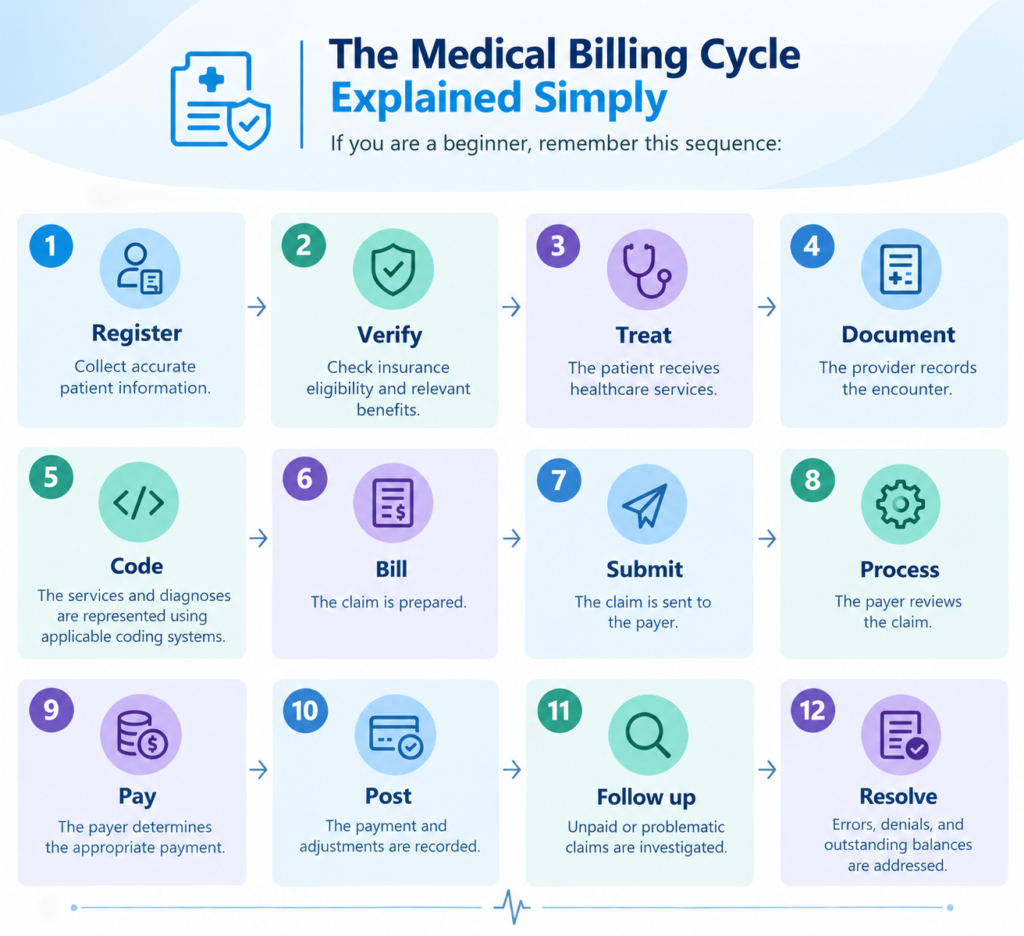
That’s the basic medical billing cycle.
Who Uses Medical Billing?
Medical billing exists across many areas of healthcare.
Physician Practices
Primary care physicians and specialists use billing workflows to submit claims for professional services.
Hospitals
Hospital billing can involve complex services, facility charges, and multiple departments.
Clinics
Specialty clinics may have billing workflows specific to the services they provide.
Physical Therapy Practices
Therapy organizations may deal with repeated visits, authorization requirements, units, and payer rules.
Hospice Organizations
Hospice billing has specialized requirements and Medicare-related considerations.
Telehealth Providers
Telehealth billing can involve payer-specific requirements, coding, and place-of-service considerations.
Professional Claims vs Institutional Claims
Not every healthcare claim is structured in exactly the same way.
A useful distinction is between professional claims and institutional claims.
Professional claims are generally associated with services provided by individual healthcare professionals.
Institutional claims are generally associated with facilities such as hospitals.
The details and billing requirements can differ significantly.
Why Insurance Verification Matters
A large part of effective billing happens before the claim is created.
Insurance verification can help a practice understand the patient’s coverage before or around the time services are provided.
For example, a practice may discover that:
-
- Coverage is inactive
-
- The provider is out of network
-
- A referral is required
-
- Prior authorization is required
-
- A deductible applies
-
- The patient’s information does not match payer records
Finding these issues early can give the practice a chance to address them.
That’s why eligibility is not simply a front-desk task.
It can influence the entire revenue cycle.
Prior Authorization and Referrals
These terms are often confused.
Prior authorization
Prior authorization generally refers to approval that a health plan requires before certain services, procedures, medications, or treatments are provided.
Referral
A referral generally involves direction from one healthcare provider to another provider or specialist, depending on the patient’s insurance plan and care arrangement.
The exact requirements depend on the payer, plan, service, and circumstances.
What Is Credentialing in Medical Billing?
Credentialing is related to the provider side of the healthcare revenue cycle.
It involves processes used to verify a provider’s qualifications and establish participation with healthcare organizations or payers.
It can involve information such as:
-
- Education
-
- Licensure
-
- Training
-
- Certifications
-
- Work history
-
- Provider identifiers
-
- Professional qualifications
A provider’s participation status can affect how claims are handled.
What Are Place of Service Codes?
A Place of Service (POS) code identifies the location where a healthcare service was provided.
For example, different POS codes can represent services provided in:
-
- Physician offices
-
- Hospitals
-
- Outpatient facilities
-
- Patient homes
-
- Other healthcare settings
Why Medical Billing Accuracy Matters
A medical billing error can seem small.
But small errors can create larger consequences.
For example:
Incorrect patient information
↓
Claim problem
↓
Delayed processing
↓
Additional follow-up
↓
Delayed reimbursement
That is why accuracy matters at every stage.
AAPC identifies attention to detail, organization, communication, problem-solving, and technical proficiency as important skills for medical billing professionals.
The Role of a Medical Biller
A medical biller’s responsibilities can vary by employer, but commonly include:
-
- Reviewing patient and insurance information
-
- Preparing claims
-
- Checking claim data
-
- Submitting claims
-
- Monitoring claim status
-
- Investigating rejected claims
-
- Working denied claims
-
- Posting payments
-
- Following up on unpaid claims
-
- Communicating with insurance companies
-
- Communicating with patients
-
- Maintaining billing records
The job requires more than typing information into software.
A good biller needs to understand how different parts of the healthcare payment process connect.
What Skills Does a Medical Biller Need?
Medical billing is detail-oriented work.
Important skills include:
Attention to detail
A single incorrect number or piece of information can create a billing problem.
Organization
Billers may manage many claims and patient accounts simultaneously.
Communication
They may communicate with patients, providers, insurance representatives, and coworkers.
Problem solving
Claims don’t always process smoothly.
Technology skills
Modern billing involves software, electronic health records, claim systems, and electronic transactions.
Insurance knowledge
Understanding payer requirements is an important part of the job.
AAPC similarly highlights attention to detail, organization, communication, problem-solving, and technical proficiency among important medical billing skills.
Is Medical Billing the Same as Patient Billing?
No.
Medical billing generally refers to the broader process of billing and reimbursement associated with healthcare services.
Patient billing is more specifically concerned with amounts the patient may owe after insurance processing or when the patient is responsible for payment.
For example:
A provider charges $300.
The insurance plan processes the claim.
The payer allows and pays an applicable amount.
The patient’s deductible or coinsurance may leave a remaining balance.
That remaining amount may become the patient’s responsibility.
The exact calculation depends on the patient’s plan and the claim.
Common Medical Billing Terms
If you’re new to medical billing, start with these terms.
| Term | Meaning |
|---|---|
| Claim | Request for payment for healthcare services |
| Payer | Organization responsible for processing the claim |
| Provider | Healthcare professional or organization providing care |
| Deductible | Amount a patient may have to pay before certain coverage applies |
| Copayment | A fixed patient payment for a covered service |
| Coinsurance | Patient’s percentage of an applicable covered cost |
| Denial | A claim or claim line that the payer does not reimburse as submitted |
| Rejection | A claim that encounters an issue preventing normal processing |
| A/R | Accounts receivable |
| EOB | Explanation of Benefits |
| ERA | Electronic Remittance Advice |
| CPT | A standardized system for reporting many medical procedures and services |
| ICD-10-CM | Diagnosis coding system used in the United States |
| HCPCS | Healthcare Common Procedure Coding System |
| Modifier | Additional coding information attached to a procedure code when applicable |
| Clearinghouse | Organization/system that can facilitate electronic claims transactions |
| Eligibility | Information about whether coverage is active/applicable |
| Authorization | Payer approval that may be required for certain services |
| Credentialing | Process associated with verifying provider qualifications and participation |
Common Medical Billing Mistakes to Avoid
1. Incorrect patient information
Always compare patient information carefully.
2. Incorrect insurance information
A wrong member ID or payer can cause avoidable problems.
3. Ignoring eligibility
Don’t assume coverage is active simply because a patient has an insurance card.
4. Missing authorization requirements
Some services require payer authorization.
5. Incorrect coding
Claims should accurately represent the documented services and applicable coding requirements.
6. Poor denial follow-up
A denial sitting untouched in an aging report doesn’t resolve itself.
7. Incorrect payment posting
Payment and adjustment information needs to be recorded accurately.
8. Ignoring older A/R
Older outstanding balances deserve attention.
9. Relying on outdated information
Payer policies and healthcare billing requirements can change.
How to Improve the Medical Billing Process
A strong billing operation doesn’t wait for every problem to become a denial.
Instead, it tries to prevent avoidable problems earlier.
Improve registration
Make sure patient and insurance information is accurate.
Verify coverage
Check eligibility before services whenever appropriate.
Review documentation
Make sure the billing information is supported by the underlying record.
Check claims
Use appropriate claim-editing and quality-control processes.
Monitor submissions
Don’t assume every submitted claim will be paid.
Work denials promptly
Identify the root cause instead of simply resubmitting the same claim.
Monitor A/R
Track unpaid balances and prioritize appropriate follow-up.
Review patterns
If the same denial repeatedly appears, investigate the underlying workflow.
This last step is especially important.
If one denial keeps happening, the goal should not simply be to work more denials.
The goal should be to reduce the reason those denials are happening in the first place.
What Is Medical Billing Software?
Medical billing software helps healthcare organizations manage billing and reimbursement activities.
Depending on the system, it may support:
-
- Patient registration
-
- Insurance verification
-
- Charge entry
-
- Claim creation
-
- Electronic claim submission
-
- Payment posting
-
- A/R management
-
- Denial tracking
-
- Reporting
-
- Patient statements
Software can make billing more efficient, but technology does not remove the need for knowledgeable people.
A system can identify a problem.
Someone still needs to understand why the problem occurred and what should happen next.
For more information:
Different Types of Billing Systems
Should Medical Billing Be Outsourced?
Some healthcare organizations manage billing internally.
Others outsource some or all billing responsibilities to a medical billing company.
In-house billing
The practice manages billing with its own employees.
Outsourced billing
An external company handles some or all billing activities.
Hybrid billing
The practice keeps some responsibilities internally while outsourcing others.
There isn’t one answer that works for every organization.
The right approach depends on factors such as:
-
- Practice size
-
- Specialty
-
- Claim volume
-
- Staffing
-
- Expertise
-
- Technology
-
- Cost
-
- Management priorities
Medical Billing for Beginners: Where Should You Start?
If you’re completely new to medical billing, don’t start by memorizing hundreds of codes.
Start with the workflow.
Learn:
-
- How patients enter the healthcare system
-
- How insurance eligibility works
-
- What a medical claim is
-
- The difference between billing and coding
-
- How claims are submitted
-
- What a rejection means
-
- What a denial means
-
- How payments are posted
-
- What accounts receivable means
-
- How denial follow-up works
Once you understand the overall process, individual codes and billing rules become easier to understand.
AAPC’s educational material similarly introduces medical billing through claims, reimbursement, billing responsibilities, terminology, and the skills required for the profession.
A Simple Example of Medical Billing
Let’s make the entire process practical.
Imagine Sarah visits a primary care physician for an office visit.
Step 1: Registration
Sarah provides her demographic and insurance information.
Step 2: Eligibility
The practice checks her coverage.
Step 3: Visit
The physician evaluates Sarah.
Step 4: Documentation
The provider documents the encounter.
Step 5: Coding
Applicable diagnosis and procedure codes are assigned based on the documentation.
Step 6: Charge entry
The service and associated charges are entered into the billing system.
Step 7: Claim
A claim is created.
Step 8: Submission
The claim is electronically submitted to the payer.
Step 9: Processing
The payer evaluates the claim.
Step 10: Payment
The payer processes the applicable payment according to the patient’s coverage and the claim.
Step 11: Posting
The payment and adjustments are recorded.
Step 12: Patient responsibility
If an applicable balance remains, it may become the patient’s responsibility.
Step 13: Follow-up
If something goes wrong, the billing team investigates and takes the appropriate action.
That’s medical billing in real life.
What Makes Medical Billing Difficult?
The basic idea is straightforward.
The difficult part is the detail.
Healthcare billing involves:
-
- Different payers
-
- Different insurance plans
-
- Different healthcare settings
-
- Coding systems
-
- Documentation requirements
-
- Authorization rules
-
- Claim requirements
-
- Denial codes
-
- Timely filing requirements
-
- Patient responsibility
-
- Changing payer policies
-
- Electronic transactions
This is why experienced medical billers can be valuable to healthcare organizations.
The work requires consistency, attention to detail, and the ability to investigate problems rather than simply process transactions.
The Connection Between Medical Billing and Revenue
Medical billing has a direct relationship with the financial side of healthcare.
A provider may deliver excellent patient care, but if claims are consistently submitted incorrectly or unpaid claims are not followed up, reimbursement can be delayed.
A simplified relationship looks like this:
Patient Care
↓
Documentation
↓
Coding
↓
Claim
↓
Payer Processing
↓
Reimbursement
↓
Payment Posting
↓
A/R Follow-Up
The quality of each stage can influence what happens in the next stage.
10 Practical Medical Billing Tips
1. Verify information early
Don’t wait until a claim fails to discover incorrect patient or insurance information.
2. Understand the complete workflow
Knowing how the pieces connect makes individual billing tasks easier.
3. Don’t treat every denial the same
Find the actual reason.
4. Watch aging A/R
Older balances should not disappear from your attention.
5. Keep documentation in mind
Billing should be connected to what is supported by the healthcare record.
6. Learn payer differences
Not every payer handles every situation identically.
7. Use technology intelligently
Billing software can improve efficiency, but it doesn’t replace judgment.
8. Track recurring problems
Repeated denials can point to workflow weaknesses.
9. Keep learning
Medical billing is not a field where you learn everything once and stop.
10. Focus on accuracy before speed
Fast billing with avoidable errors can create more work later.
Final Takeaway
Medical billing is much more than sending a bill.
It is a connected process that begins with accurate patient and insurance information and continues through documentation, coding, claim submission, payer processing, payment posting, denial management, and accounts receivable follow-up.
The easiest way to understand medical billing is to stop looking at each task separately.
Look at the entire journey:
Patient → Provider → Documentation → Coding → Claim → Payer → Payment → Follow-Up
Once that journey makes sense, terms such as eligibility, CPT, ICD-10-CM, HCPCS, modifiers, claims, denials, payment posting, A/R, and revenue cycle management start to fit into a much clearer picture.
For healthcare practices, accurate billing can support a healthier revenue cycle and reduce avoidable administrative problems. For people learning the profession, understanding the complete workflow provides the foundation needed to move into more specialized areas.
And that is where the individual topics on Paradox Solution become useful. Instead of trying to learn everything from one page, readers can move from this broad guide into specialized resources covering claims, coding, insurance verification, denials, payment posting, credentialing, accounts receivable, RCM, hospice billing, telehealth billing, and more.