
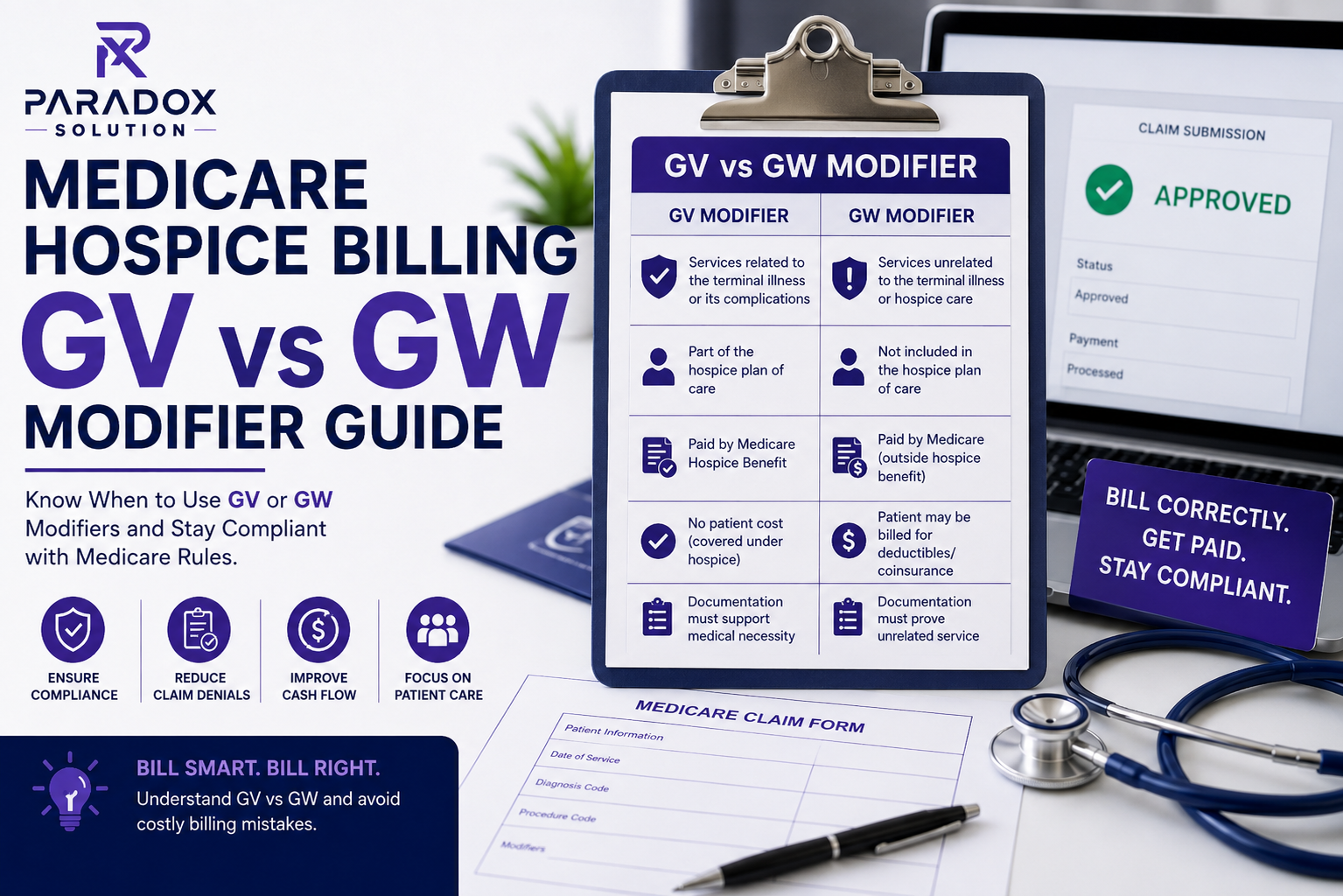
Medicare Hospice Billing: GV vs. GW Modifiers A Clear Clinical and Compliance Guide
Introduction
Medicare Hospice Billing: GV vs. GW Modifiers is one of those topics that causes confusion even for experienced medical billers. A simple modifier mistake can delay payment, trigger claim denials, or create unnecessary compliance concerns during an audit.
The good news is that once you understand why these modifiers exist and how Medicare views hospice services, choosing the correct one becomes much easier. This guide explains the difference in plain language, walks through real billing situations, highlights common mistakes, and shares practical documentation tips that help keep claims clean. Whether you are a physician, nurse practitioner, billing specialist, compliance officer, or practice manager, this guide will help you confidently decide when to use the GV modifier and when the GW modifier is the right choice while staying aligned with current Medicare hospice billing requirements.
Understanding Medicare Hospice Billing
When a Medicare beneficiary elects hospice care, Medicare shifts its payment rules. Hospice becomes responsible for services related to the patient’s terminal illness under the hospice benefit.
However, not every medical service a hospice patient receives is related to that terminal diagnosis.
That is where GV and GW modifiers become important.
These modifiers tell Medicare why a physician or practitioner should receive payment outside of the hospice payment system.
Using the correct modifier helps:
-
- Prevent claim denials
-
- Reduce payment delays
-
- Improve compliance
-
- Lower audit risk
-
- Support accurate documentation
Why Medicare Uses GV and GW Modifiers
Hospice patients often continue seeing physicians besides the hospice medical director.
Medicare needs to know two important facts:
-
- Is the physician the patient’s attending physician?
-
- Is the service related to the terminal illness?
The answers determine which modifier belongs on the claim.
Quick Comparison Table
| Feature | GV Modifier | GW Modifier |
|---|---|---|
| Physician is hospice attending physician | Yes | No requirement |
| Service related to terminal illness | Yes | No |
| Service paid outside hospice benefit | Yes | Yes |
| Used by physicians or qualified practitioners | Yes | Yes |
| Most common purpose | Attending physician services | Unrelated medical services |
What Is the GV Modifier?
The GV modifier tells Medicare that:
The attending physician is not employed or paid by the hospice but is the patient’s designated attending physician.
This allows Medicare Part B to pay that physician directly for covered services.
The hospice does not bill these professional services.
When to Use GV
Use the GV modifier when all of these are true:
✔ Patient elected Medicare hospice
✔ Physician is the designated attending physician
✔ Physician is not employed by the hospice
✔ Service relates to the terminal illness
Real World Example
Mrs. Johnson has advanced heart failure and elects hospice.
She chooses her longtime family physician as her attending physician.
The physician evaluates worsening heart failure symptoms during an office visit.
Since:
-
- physician is attending
-
- physician is independent from hospice
-
- visit relates to terminal illness
The physician bills Medicare Part B using the GV modifier.
Documentation Checklist for GV
| Documentation Item | Why It Matters |
|---|---|
| Hospice election date | Confirms hospice enrollment |
| Attending physician designation | Supports modifier use |
| Clinical notes | Describe treatment provided |
| Relation to terminal illness | Shows medical necessity |
| Signed documentation | Required for compliance |
What Is the GW Modifier?
The GW modifier tells Medicare:
The service provided is not related to the patient’s terminal hospice diagnosis.
This is probably the modifier practices use incorrectly most often.
The key question is simple:
Would this service have been needed even if the patient did not have the terminal illness?
If the answer is yes, GW may apply.
When to Use GW
Use GW when:
-
- Patient elected hospice
-
- Service is unrelated to terminal illness
-
- Documentation clearly supports that relationship
Real World Example
A hospice patient has terminal lung cancer.
During hospice care the patient develops:
-
- fractured wrist after falling
The orthopedic surgeon treats the fracture.
The wrist injury has nothing to do with terminal lung cancer.
The orthopedic provider bills Medicare using the GW modifier.
More Clinical Examples
| Terminal Diagnosis | Separate Condition | Modifier |
|---|---|---|
| Lung cancer | Broken ankle | GW |
| End stage heart failure | Skin laceration | GW |
| ALS | Cataract evaluation | GW |
| Advanced dementia | Eye infection | GW |
| Metastatic cancer | Hand fracture | GW |
Services Usually Related to Hospice
The following commonly relate to hospice care.
| Service | Usually Related |
|---|---|
| Pain management | Yes |
| Symptom control | Yes |
| Terminal diagnosis follow up | Yes |
| Comfort medications | Yes |
| Disease progression evaluation | Yes |
These generally would not receive the GW modifier.
Services Often Unrelated
Examples include:
| Service | Often GW Eligible |
|---|---|
| Broken bone treatment | Yes |
| Eye examination | Yes |
| Dermatology visit | Yes |
| Ear infection | Sometimes |
| Minor injury care | Yes |
Documentation always determines the final decision.
How Medicare Reviews These Claims
Medicare contractors review several factors.
Clinical Documentation
The medical record should clearly explain:
-
- why patient received treatment
-
- diagnosis addressed
-
- relationship to hospice condition
-
- physician assessment
Coding Accuracy
Incorrect diagnosis coding often causes unnecessary denials.
The diagnosis should match the documented reason for treatment.
Medical Necessity
Every service billed must remain medically necessary regardless of modifier selection.
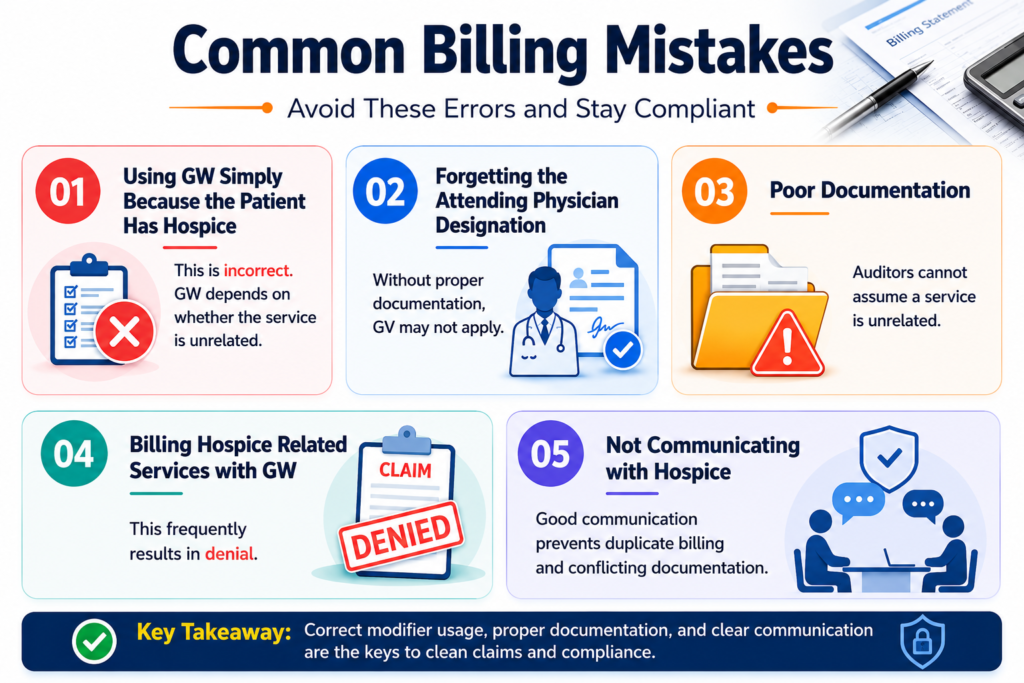
Common Billing Mistakes
Documentation Best Practices
| Best Practice | Benefit |
|---|---|
| Verify hospice enrollment | Prevents billing errors |
| Confirm attending physician | Supports GV |
| Document relationship of service | Supports GW decisions |
| Review diagnosis carefully | Reduces denials |
| Keep physician notes detailed | Helps during audits |
Compliance Tips for Medical Practices
Successful practices usually build simple workflows.
Before Claim Submission
Ask these questions.
-
- Is the patient enrolled in Medicare hospice?
-
- Who is the attending physician?
-
- Is today’s service related to the terminal illness?
-
- Does documentation support the decision?
-
- Is the correct modifier attached?
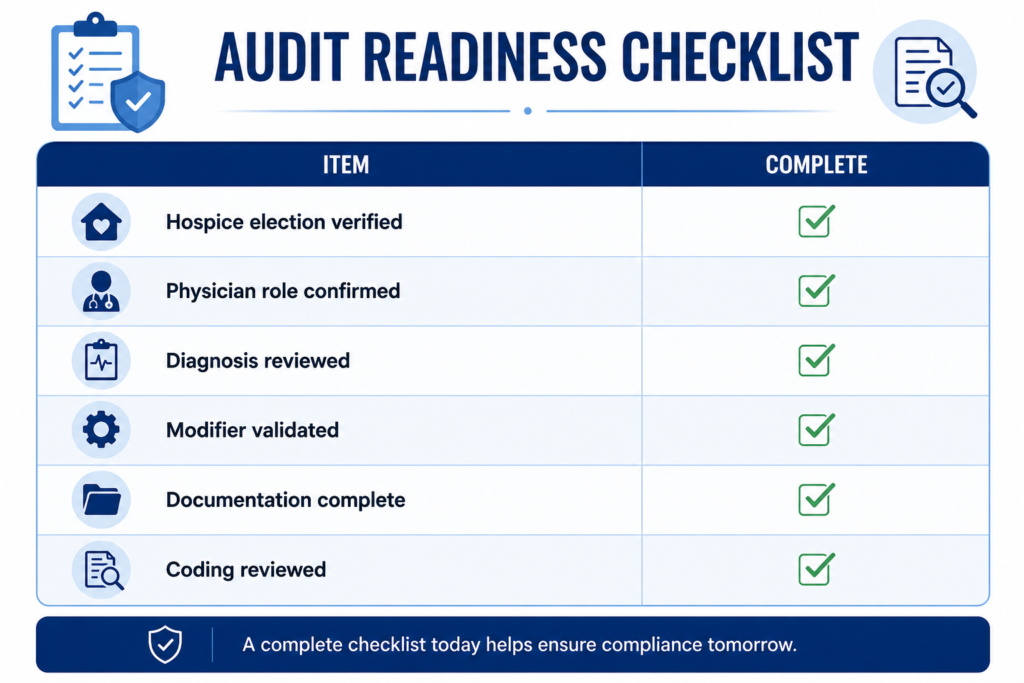
A short internal checklist often prevents expensive rework.
GV vs GW Decision Table
| Question | GV | GW |
|---|---|---|
| Physician is attending physician | Yes | Not required |
| Physician works for hospice | No | No requirement |
| Service related to terminal illness | Yes | No |
| Medicare Part B payment possible | Yes | Yes |
| Documentation required | Yes | Yes |
Sample Office Workflow
| Step | Action |
|---|---|
| 1 | Verify hospice status |
| 2 | Confirm attending physician |
| 3 | Review diagnosis |
| 4 | Determine relationship to terminal illness |
| 5 | Apply modifier |
| 6 | Review documentation |
| 7 | Submit clean claim |
Audit Readiness Checklist
Practical Advice From Billing Experience
Many billing problems happen because teams focus only on coding instead of the clinical story. A modifier should never be chosen based on habit or software prompts. Start by asking the provider what condition was treated and whether it relates to the patient’s terminal illness. Encourage physicians to clearly document that relationship in their notes instead of assuming the billing team will interpret it. Regular communication with the hospice organization can also prevent duplicate billing and conflicting records. Practices that combine good clinical documentation with a simple pre submission review process typically see fewer denials, faster payments, and stronger audit readiness.
Final Thoughts
GV and GW modifiers may look similar, but they serve very different purposes. The GV modifier identifies services provided by the patient’s designated attending physician for care related to the terminal illness, while the GW modifier is used for medically necessary services that are unrelated to the terminal hospice diagnosis. Correct use depends on understanding the patient’s hospice status, the physician’s role, and the clinical reason for the visit. With accurate documentation, careful claim review, and clear communication between providers and hospice teams, practices can reduce denials, improve compliance, and ensure Medicare claims are processed correctly.