
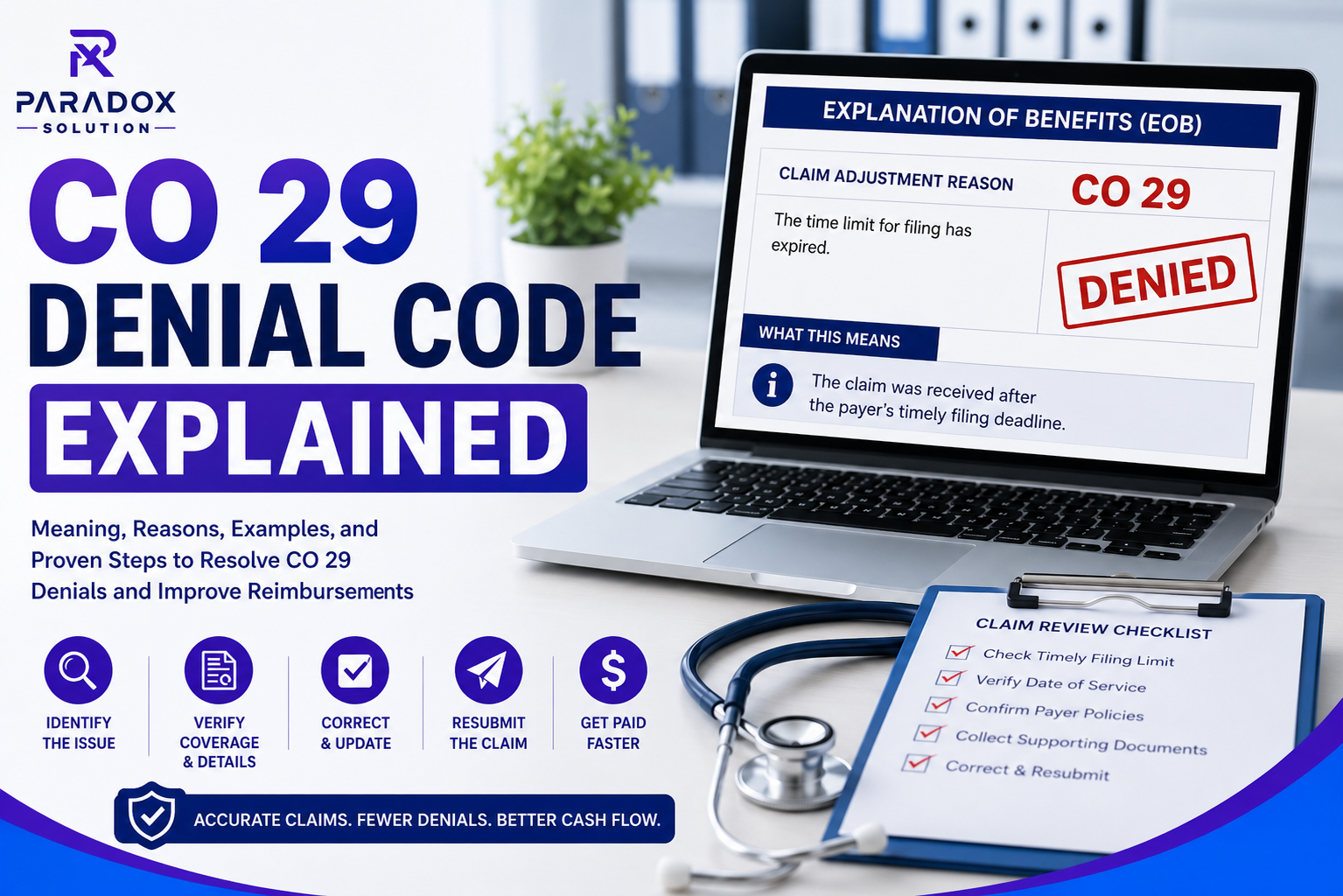
CO 29 Denial Code Explained
If you work in medical billing long enough, you will eventually come across a CO 29 denial. It is one of those denials that often surprises providers because the medical service may have been medically necessary, properly documented, and correctly coded, yet the insurance company still refuses payment.
The reason is simple. The claim arrived after the payer filing deadline.
That makes CO 29 Denial Code Explained an important topic for every healthcare organization. Whether you manage a solo physician office, a specialty clinic, an urgent care center, or a large multi provider practice, understanding filing deadlines can protect thousands of dollars in revenue each year.
The good news is that most CO 29 denials are preventable. Strong eligibility verification, accurate patient registration, timely claim submission, regular claim monitoring, and consistent staff training all reduce the chances of missing filing limits.
In this guide, you will learn what CO 29 means, why it happens, how different insurance companies handle timely filing, when an appeal may be successful, and practical workflows that experienced revenue cycle teams use to prevent this denial from happening again.
What Is CO 29 Denial Code?
A CO 29 denial code means the insurance company denied payment because the claim was submitted after the payer required filing deadline.
The letters CO stand for Contractual Obligation. This means the payer considers the denial the provider responsibility according to the provider agreement or insurance policy.
Unlike many other denials that can be corrected by updating coding or documentation, a CO 29 denial often becomes permanent once the filing deadline has passed.
In simple terms:
The insurance company is saying, “We received your claim too late.”
Why This Matters
Many providers focus heavily on coding accuracy while overlooking claim submission timelines.
A perfectly coded claim can still receive a CO 29 denial if it misses the payer filing limit.
That is why timely filing is one of the most important performance indicators in revenue cycle management.
Quick Reference Table
| Item | Description |
|---|---|
| Denial Code | CO 29 |
| Meaning | Claim submitted after filing deadline |
| Category | Contractual Obligation |
| Primary Cause | Late claim submission |
| Can It Be Corrected? | Sometimes, depending on payer rules |
| Common Solution | Appeal with proof of timely filing when applicable |
Why Insurance Companies Use Filing Deadlines
Insurance companies receive millions of claims every year.
Without filing deadlines, claims could arrive years after services were provided, making it difficult to verify eligibility, documentation, coordination of benefits, and policy coverage.
Filing limits help insurers:
-
- Process claims consistently
-
- Reduce fraud
-
- Maintain accurate financial records
-
- Meet regulatory requirements
-
- Close accounting periods
-
- Encourage efficient billing practices
Healthcare providers benefit as well because timely billing generally leads to faster reimbursement and fewer accounts receivable problems.
Understanding Timely Filing Limits
A timely filing limit is the maximum amount of time a provider has to submit a claim after the date of service.
Each payer sets its own deadline.
Some allow 90 days.
Others allow 180 days.
Many commercial insurers allow one year.
Government programs may have different requirements depending on regulations and claim circumstances.
Always verify the current filing limit directly with the payer because policies can change.
Common Filing Limit Examples
| Payer Type | Typical Filing Limit* |
|---|---|
| Commercial Insurance | 90 to 365 days |
| Medicare | Generally follows CMS timely filing requirements |
| Medicaid | Varies by state |
| Workers Compensation | Varies by state laws |
| Managed Care Plans | Defined by payer contract |
*Always verify current payer requirements before submitting claims.
Common Reasons for CO 29 Denials

Late claims rarely happen because of one mistake.
In real practice, several small workflow problems usually combine to create a missed filing deadline.
Delayed Patient Registration
Incorrect demographic information can delay claim creation.
Examples include:
-
- Wrong insurance ID
-
- Missing date of birth
-
- Incorrect patient name
-
- Invalid subscriber information
These errors often prevent claims from leaving the billing system on time.
Insurance Verification Problems
If insurance eligibility is not verified before the visit, staff may spend weeks identifying the correct payer.
Every delay moves the claim closer to the filing deadline.
This is why many experienced billing managers treat eligibility verification as the first step in denial prevention.
Coding Delays
Providers sometimes complete documentation several weeks after the patient visit.
Until documentation is complete, coders cannot assign diagnosis codes, procedure codes, or modifiers.
No coding means no claim submission.
Documentation Issues
Missing physician signatures, incomplete operative reports, or unfinished progress notes often stop claims from moving through the billing process.
Billing teams cannot submit incomplete documentation without risking additional denials.
Clearinghouse Rejections
A clearinghouse checks claims before sending them to insurance companies.
If a claim fails validation, it is rejected rather than transmitted.
Examples include:
-
- Missing provider identifier
-
- Invalid diagnosis code
-
- Incorrect procedure code
-
- Missing modifier
-
- Patient information mismatch
If staff do not monitor clearinghouse reports daily, rejected claims may sit for weeks unnoticed.
Staff Shortages
Small physician practices often have only one biller.
When that employee takes leave or resigns, claims can remain unprocessed long enough to exceed filing limits.
Cross training staff helps reduce this risk.
Revenue Impact of CO 29 Denials
Many providers underestimate how expensive timely filing denials become over time.
Consider this simple example.
A family medicine clinic submits approximately 1,200 claims each month.
If just 2 percent miss filing deadlines and the average reimbursement is $180, the financial impact is significant.
| Monthly Claims | CO 29 Rate | Average Payment | Monthly Revenue Lost |
|---|---|---|---|
| 1,200 | 2% | $180 | $4,320 |
Over one year, that equals more than $51,000 in lost reimbursement.
Most practices cannot afford to lose that amount simply because claims were submitted late.
How a CO 29 Denial Happens: Step by Step
Understanding the workflow helps identify where problems occur.
| Step | What Happens |
|---|---|
| Patient receives treatment | Clinical services are provided |
| Documentation created | Provider completes visit notes |
| Coding completed | Diagnosis and procedure codes assigned |
| Claim generated | Billing software creates claim |
| Claim submitted | Sent through clearinghouse |
| Delay occurs | Claim rejected or held |
| Filing deadline passes | Payer time limit expires |
| Claim resubmitted | Insurance denies payment |
| CO 29 issued | Payment refused due to late filing |
Early Warning Signs That a CO 29 Denial Is Coming
Experienced revenue cycle teams rarely wait until the denial arrives.
Instead, they monitor warning signs such as:
-
- Claims sitting unbilled for more than seven days
-
- Incomplete provider documentation
-
- Large numbers of clearinghouse rejections
-
- Eligibility issues awaiting correction
-
- Claims pending provider signatures
-
- Missing referrals or authorizations
-
- Accounts receivable reports showing aging before initial submission
These warning signs allow staff to resolve issues before filing deadlines expire.
Staff Responsibilities for Preventing CO 29
Preventing timely filing denials requires teamwork across the entire practice.
| Team Member | Responsibility |
|---|---|
| Front Desk | Collect accurate demographics and insurance information |
| Medical Assistant | Confirm patient information before provider visit |
| Provider | Complete documentation promptly |
| Medical Coder | Assign accurate diagnosis and procedure codes |
| Billing Specialist | Submit clean claims quickly |
| AR Specialist | Monitor rejected claims and payer responses |
| Practice Manager | Track denial trends and workflow performance |
Even one delay in this process can increase the risk of a CO 29 denial.
Practical Tip
Create a daily “Unsubmitted Claims” report. Reviewing claims that have not yet been transmitted is one of the simplest ways to catch delays before they turn into costly CO 29 denials. Many practices recover significant revenue simply by monitoring this report every morning.
How to Fix a CO 29 Denial
A CO 29 denial can feel discouraging because it often means the payer believes the claim was filed after the allowed deadline. However, that does not always mean the denial is correct. Before writing the balance off, investigate why the claim was denied.
In my experience, a surprising number of CO 29 denials are caused by payer processing errors, incorrect filing dates, or claims that were rejected by the clearinghouse without the practice realizing it.
The key is to work through the denial methodically.
Step 1: Confirm the Filing Deadline
Start by checking the payer’s timely filing policy.
Review:
- The payer provider manual
- Your provider contract
- The payer website
- Any recent policy updates
- State Medicaid guidance if applicable
Remember that filing deadlines differ among insurance companies. Never assume one payer follows another’s rules.
Step 2: Verify the Original Date of Submission
Many practices confuse the date a claim was corrected with the date it was first submitted.
Look for evidence such as:
- Electronic claim acceptance reports
- Clearinghouse confirmation reports
- Electronic Data Interchange (EDI) reports
- Claim acknowledgement files
- Transmission logs
- Certified mail receipts for paper claims
If you can prove the original claim reached the payer before the deadline, the denial may be overturned.
Step 3: Determine Why the Claim Was Late
Finding the root cause prevents the problem from happening again.
Question Why It Matters Was the claim ever submitted? Determines whether staff missed billing entirely. Did the clearinghouse reject it? Rejected claims are not considered received by most payers. Was insurance information incorrect? Incorrect payer information delays submission. Was documentation incomplete? Coding cannot begin until documentation is finalized. Was eligibility verified? Incorrect insurance often causes billing delays. Did the payer receive the claim? Electronic proof can support an appeal. Step 4: Decide Whether an Appeal Is Appropriate
Not every CO 29 denial should be appealed.
Appeal when:
- The claim was submitted within the filing limit.
- The payer made a processing error.
- The payer lost the original claim.
- A system outage prevented processing.
- Another insurance carrier delayed payment, affecting secondary billing.
- The payer specifically allows exceptions.
An appeal is much less likely to succeed if the provider simply missed the filing deadline without an approved exception.
When Can a CO 29 Denial Be Reversed?
Some billing professionals assume timely filing denials are final. That is not always true.
Here are situations where a reversal may be possible.
Scenario 1: Clearinghouse Transmission Proof
A pediatric clinic submitted a claim two days after the patient visit.
The clearinghouse accepted the file immediately.
The payer later denied the claim as untimely.
The billing department attached the electronic transmission report showing the original submission date.
The payer reprocessed the claim and issued payment.
Lesson: Always retain clearinghouse reports.
Scenario 2: Coordination of Benefits Delay
A patient had two insurance plans.
The primary insurance took several months to process the claim.
The secondary payer denied it with CO 29.
The billing specialist appealed with:
- Primary payer Explanation of Benefits (EOB)
- Original submission dates
- Coordination of Benefits documentation
The secondary payer accepted the appeal because its policy allowed additional time after the primary payer completed processing.
Scenario 3: Payer System Error
A specialty practice received dozens of CO 29 denials on claims submitted electronically.
Investigation showed the payer experienced a system issue during claim intake.
After submitting transmission logs, the payer reopened every affected claim.
Documentation Needed for an Appeal
Strong documentation often determines whether an appeal succeeds.
Document Purpose Original claim submission report Shows claim was transmitted Clearinghouse acceptance report Confirms electronic acceptance Electronic acknowledgement Demonstrates payer receipt Explanation of Benefits Supports coordination of benefits Medical records if requested Confirms service occurred Appeal letter Explains why denial should be reconsidered Provider contract References filing policy if needed Sample CO 29 Appeal Workflow
Step Action 1 Review denial reason 2 Confirm filing deadline 3 Locate submission proof 4 Gather supporting documents 5 Write appeal letter 6 Submit appeal before appeal deadline 7 Track appeal status 8 Follow up until determination Real World Example: Family Medicine Practice
A family medicine clinic noticed several claims older than 120 days remained in “draft” status inside its billing software.
The physician had not completed documentation for several complex visits.
Without completed notes, coding staff could not assign diagnosis codes.
By the time documentation was finished, several claims exceeded the payer filing limit.
The practice lost nearly $8,500 in reimbursements.
How They Fixed It
The clinic introduced a simple workflow:
- Providers complete notes within 48 hours.
- Coders review charts daily.
- Billing staff submit claims every business day.
- Practice managers review aging reports each Friday.
Within three months, timely filing denials dropped by more than 80%.
Common CO 29 Mistakes
Many practices unknowingly create conditions that lead to timely filing denials.
Waiting Too Long to Bill
Some offices batch claims once each month.
Daily claim submission shortens the revenue cycle and reduces filing risks.
Ignoring Clearinghouse Reports
Rejected claims do not automatically reach the payer.
Someone should review rejection reports every day.
Missing Provider Documentation
Incomplete documentation delays coding.
Delayed coding delays billing.
Delayed billing increases denial risk.
Incorrect Insurance Information
Wrong policy numbers, inactive coverage, or incorrect subscriber information often require extensive correction before claims can be submitted.
Collecting accurate information during patient registration prevents many of these delays.
No Claim Aging Reports
Practices should know exactly how many claims remain unbilled.
Without reporting, delayed claims may remain unnoticed until it is too late.
CO 29 Prevention Checklist
Task Frequency Responsible Staff Verify eligibility Every visit Front desk Complete provider documentation Within 24–48 hours Provider Code completed charts Daily Medical coder Submit claims Daily Billing specialist Review clearinghouse rejections Daily Billing staff Monitor unbilled claims Weekly Practice manager Review denial trends Monthly Revenue cycle manager Update payer filing limits Quarterly Billing supervisor Compliance Considerations
Timely filing is not just about getting paid. It is also part of maintaining an organized and compliant revenue cycle.
Practices should maintain policies that support:
- Accurate documentation
- Complete patient records
- Correct coding
- Timely claim submission
- Secure handling of protected health information under HIPAA
- Regular staff education
- Internal billing audits
For Medicare claims, follow applicable CMS timely filing requirements. Commercial insurers and Medicaid programs may have different deadlines and exception policies, so always verify payer-specific rules before filing or appealing a claim.
Best Practice Reminder
A clean claim submitted today is far more valuable than a perfect claim submitted too late. Focus on accurate documentation, prompt coding, daily claim submission, and continuous monitoring of unbilled accounts. These habits consistently reduce CO 29 denials and improve cash flow.
Building a Long Term Strategy to Prevent CO 29 Denials
Every successful medical practice eventually realizes that denial management is not just about fixing claims after they are denied. The real goal is to prevent denials from happening in the first place.
Practices with the lowest CO 29 denial rates usually follow a standardized workflow. Everyone knows their responsibilities, claims move quickly through the revenue cycle, and managers regularly monitor key performance indicators.
The following checklist has worked well across family medicine practices, specialty clinics, urgent care centers, and hospital outpatient departments.
Clean Claim Checklist
| Task | Completed |
|---|---|
| Verify patient demographics | ✔ |
| Verify insurance eligibility | ✔ |
| Confirm authorization if required | ✔ |
| Complete provider documentation | ✔ |
| Assign correct ICD 10 diagnosis codes | ✔ |
| Assign correct CPT and HCPCS codes | ✔ |
| Apply modifiers when appropriate | ✔ |
| Validate Place of Service code | ✔ |
| Run claim scrubbing edits | ✔ |
| Submit claim within payer filing limit | ✔ |
When each step is completed before claim submission, the likelihood of receiving a CO 29 denial decreases significantly.
Key Performance Indicators to Track
Revenue cycle managers should monitor timely filing performance every month.
| KPI | Goal |
|---|---|
| Initial claim submission within 7 days | Greater than 95% |
| Clearinghouse rejection rate | Less than 2% |
| CO 29 denial rate | As close to 0% as possible |
| Average days before first submission | Less than 5 days |
| Unbilled claims older than 14 days | Zero whenever possible |
| Documentation completion time | Within 24 to 48 hours |
Tracking these metrics helps identify workflow issues before they become revenue problems.
Should You Outsource Medical Billing?
Some smaller practices struggle with timely filing because they have limited billing staff. In these situations, outsourcing may be worth considering.
| In House Billing | Outsourced Billing |
|---|---|
| Full internal control | Experienced billing specialists |
| Requires hiring and training | Lower staffing burden |
| May slow during vacations | Consistent claim submission |
| Practice manages software | Vendor often provides technology |
| Higher staffing responsibility | Service fees apply |
There is no single right answer. The best choice depends on practice size, claim volume, staffing, and available resources.
Internal Linking Opportunities
As you continue improving your revenue cycle, these related topics naturally complement CO 29 Denial Code Explained:
-
- Medical Coding
-
- ICD 10 Coding
-
- HCPCS Codes
-
- CPT Modifiers
-
- Revenue Cycle Management
-
- Prior Authorization
-
- Insurance Verification
-
- Eligibility Verification
-
- Claim Denials
-
- AR Follow Up
-
- Payment Posting
-
- Credentialing
-
- Clearinghouses
-
- Medical Billing Software
-
- Place of Service Codes
These topics work together to create a stronger billing process and reduce preventable denials.
Final Takeaways
Understanding CO 29 Denial Code Explained is about more than learning a denial definition. It is about protecting practice revenue and improving the overall health of your revenue cycle.
Most CO 29 denials happen because claims are submitted after the payer filing deadline. While some denials can be successfully appealed with proof of timely submission, many cannot. That is why prevention is far more effective than correction.
The most successful practices consistently:
-
- Verify insurance before every visit.
-
- Complete documentation promptly.
-
- Code charts without unnecessary delays.
-
- Submit clean claims every day.
-
- Review clearinghouse reports daily.
-
- Monitor unbilled claims.
-
- Follow payer specific filing limits.
-
- Educate staff regularly.
-
- Audit denial trends and improve workflows.
Remember that payer rules, appeal rights, and filing deadlines may vary. Always review the latest payer policies, provider contracts, and applicable CMS guidance before submitting or appealing claims.
A disciplined billing workflow, supported by accurate documentation, timely claim submission, and regular follow up, will reduce CO 29 denials, improve cash flow, and strengthen your practice over the long term.