

Provider Re Credentialing is one of those tasks that can easily get pushed to the side when a medical practice is busy. Patient care comes first, claims need attention, staff have questions, and the billing team is already dealing with payer issues. Then suddenly, a provider credential is close to expiring.
That can become a serious problem for medical billing.
If re credentialing is not completed on time, a provider may face problems with payer participation and claim submission. The result can be delayed payments, rejected claims, and unnecessary pressure on the practice.
The good news is that provider re credentialing does not have to be complicated. With a clear process, updated documents, CAQH information, payer follow up, and a simple tracking system, practices can stay ahead of expiration dates and keep their revenue cycle moving.
What Is Provider Re Credentialing?
Provider Re Credentialing is the process of reviewing and renewing the credentials of a healthcare provider who is already participating with an insurance payer.
Think of it as keeping an existing provider record current.
A payer may need updated information about licenses, certifications, malpractice coverage, work history, practice information, and other credentials before continuing network participation.
| Credentialing Activity | What It Means |
|---|---|
| Initial credentialing | Getting a provider approved by a payer for the first time |
| Provider re credentialing | Renewing an existing payer credential |
| Provider enrollment | Registering a provider with a payer for participation and billing |
| Primary source verification | Checking credentials directly with the original source |
| CAQH credentialing | Maintaining provider information through the CAQH system |
| Payer credentialing | Meeting the requirements of a specific insurance payer |
For a medical billing team, this process matters because credentialing and billing are closely connected. When a provider loses active participation with a payer, claims can become difficult to process.
Why Provider Re Credentialing Matters in Medical Billing
Credentialing may seem like an administrative task, but it can have a direct connection with revenue.
A provider can deliver services to patients every day, but the practice still needs an active payer relationship to receive reimbursement under the applicable network arrangement.
Here is where the connection becomes clear:
| Credentialing Problem | Possible Billing Impact |
|---|---|
| Expired provider license | Claims may face processing problems |
| Missed payer deadline | Provider participation may be affected |
| Outdated CAQH information | Payer may request additional information |
| Missing documentation | Application can be delayed |
| Incorrect provider information | Claims may require correction |
| No expiration tracking | Important deadlines can be missed |
| Delayed payer follow up | Application can remain unresolved |
This is why medical billing teams should not treat provider credentialing as something separate from the revenue cycle.
At Paradox Solution, credentialing and re credentialing are included alongside other revenue cycle services such as claims submission, coding, denial management, eligibility verification, and reporting.
Understanding the Provider Re Credentialing Process
The provider re credentialing process can vary depending on the payer, provider type, state, and participation requirements. Still, most practices follow a similar pattern.
1. Check the Current Credential File
Start by reviewing what is already available.
Look at the provider license, board certification, malpractice insurance, DEA information when applicable, NPI information, work history, hospital privileges, and other payer documents.
Do not wait until the expiration date is close.
| Document | What to Check |
|---|---|
| State license | Expiration and current status |
| Board certification | Current certification |
| Malpractice insurance | Coverage dates |
| DEA registration | Current registration when applicable |
| NPI | Accurate provider information |
| CAQH profile | Current information and attestation |
| Work history | Complete and updated information |
| Hospital privileges | Current status when applicable |
This basic review can uncover problems before the payer receives the application.
2. Review CAQH Information
CAQH plays an important role in provider credentialing for many commercial payers.
For CAQH ProView re credentialing, the practice should review the information carefully and make sure the profile reflects current provider information.
A simple mistake in an address, license, employment history, or certification can create additional work later.
3. Complete Payer Applications
Not every payer handles re credentialing in exactly the same way.
Some payers may use their own applications or portals. Others may pull information from CAQH.
This is where payer re credentialing can become time consuming for a practice with many providers.
A good tracking system should record:
| Information | Why It Matters |
|---|---|
| Payer name | Identifies the application |
| Provider name | Connects application to provider |
| Submission date | Shows when the process started |
| Expiration date | Helps track urgency |
| Documents submitted | Confirms application completeness |
| Follow up date | Prevents applications from being forgotten |
| Payer response | Keeps status current |
| Effective date | Important before billing |
What Are the Common Re Credentialing Requirements?
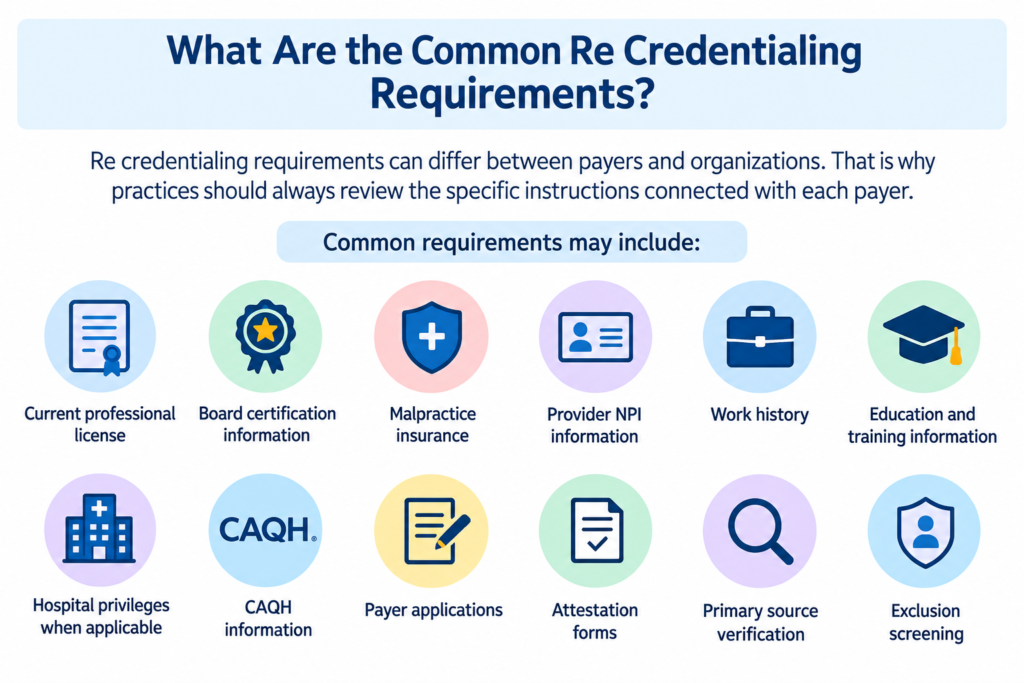
The important part is not simply collecting documents. The information needs to be accurate and current.
Re Credentialing Timeline: When Should You Start?
One of the easiest mistakes is waiting too long.
The exact re credentialing timeline depends on the payer and provider situation, but starting several months before expiration gives the practice more room to handle missing documents and payer questions.
A practical internal schedule can look like this:
| Time Before Expiration | Suggested Action |
|---|---|
| 180 days | Review provider file |
| 120 days | Update documents and CAQH |
| 90 days | Submit required payer information |
| 60 days | Check application status |
| 30 days | Follow up on outstanding issues |
| Before expiration | Confirm payer status and effective date |
The point is simple. Do not make the expiration date the starting date.
Medicare and Medicaid Provider Re Credentialing
Medicare provider re credentialing and Medicaid provider re credentialing can involve requirements that differ from commercial insurance.
Practices working with Medicare, Medicaid, and commercial payers may need to track each payer separately.
| Payer Type | What Practices Should Track |
|---|---|
| Medicare | Enrollment information and required updates |
| Medicaid | State specific requirements |
| Commercial payers | Payer specific credentialing requirements |
| Telehealth payers | Provider and state participation requirements |
This becomes even more important for organizations working across multiple states.
Provider Enrollment and Re Credentialing Are Connected
Provider enrollment and re credentialing are related but they are not exactly the same activity.
Provider enrollment generally involves establishing participation with a payer. Re credentialing focuses on continuing that relationship by confirming that provider information and credentials remain current.
For a busy medical billing operation, both need to be monitored.
A practice can have a provider properly enrolled but still run into problems later if re credentialing deadlines are missed.
That is why credentialing teams often benefit from keeping enrollment information, credential information, payer information, and expiration dates together.
A Simple Credentialing Checklist for Providers
A credentialing checklist for providers makes the process easier because staff do not have to remember everything from memory.
| Checklist Item | Action |
|---|---|
| State license | Check status and expiration |
| Board certification | Verify current information |
| Malpractice insurance | Confirm coverage |
| NPI | Verify provider information |
| CAQH | Review and update |
| Work history | Check for missing information |
| Hospital privileges | Verify when applicable |
| Payer application | Complete according to payer instructions |
| Primary source verification | Confirm required credentials |
| OIG exclusion screening | Complete according to compliance procedures |
| SAM exclusion check | Review according to organizational requirements |
| Payer follow up | Track outstanding requests |
| Effective date | Confirm before billing |
How Delays Can Affect Medical Billing
Imagine a physician continues seeing patients while a payer credential is approaching expiration.
The practice may continue providing services, but the billing team still needs to know whether the provider remains active with that payer.
If the situation is not handled properly, claims can face avoidable problems.
That is why credentialing teams and medical billing teams should communicate.
The billing team should know:
- Which providers are approaching expiration
- Which payer applications are pending
- Which providers have completed re credentialing
- Whether additional documents are requested
- When the new effective date begins
This simple communication can prevent surprises.
Healthcare Re Credentialing Services Can Help
Some practices manage everything internally. Others use healthcare re credentialing services because credentialing becomes difficult when there are many providers, payers, and locations.
A healthcare re credentialing service may help with:
| Service | Purpose |
|---|---|
| File review | Find missing or outdated information |
| Document collection | Organize provider credentials |
| CAQH support | Help maintain current information |
| Payer applications | Manage payer specific requirements |
| Follow up | Track application progress |
| Verification | Confirm credential information |
| Expiration tracking | Monitor upcoming deadlines |
| Reporting | Give the practice visibility into status |
For practices already outsourcing parts of medical billing, adding medical billing credentialing support can make the overall workflow more connected.
Paradox Solution currently lists provider credentialing and re credentialing as part of its services, along with billing audits, payment posting, claims, coding, eligibility, prior authorization, and denial management.
Technology and Credentialing Software
Credentialing software can make tracking easier, especially when a practice has many providers.
Instead of keeping everything in separate spreadsheets and email conversations, a centralized system can help staff see upcoming expirations, missing documents, payer status, and follow up dates.
| Manual Approach | Technology Supported Approach |
|---|---|
| Spreadsheet tracking | Centralized dashboard |
| Email reminders | Automated reminders |
| Separate provider files | Central provider records |
| Manual status checks | Status tracking |
| Scattered documents | Central document storage |
| Calendar based follow up | Workflow based follow up |
Technology does not replace human review. It simply makes it easier for the team to see what needs attention.
Telehealth Credentialing Adds Another Layer
Telehealth credentialing can become more complicated when providers work with patients across multiple states.
Each state and payer can have different participation requirements. A practice expanding telehealth services should therefore keep provider licenses, payer participation, and expiration dates organized.
For growing practices, this can become a full time administrative task without a good system.
How Paradox Solution Can Fit Into the Process
Provider credentialing fits naturally into a broader revenue cycle strategy.
Paradox Solution presents its services around the complete billing workflow, including insurance verification, prior authorization, coding, claims submission, denial management, A/R follow up, payment posting, credentialing, and reporting.
That matters because credentialing does not exist in isolation.
A provider needs the right credentials, the billing team needs accurate provider information, claims need correct submission, and the practice needs visibility into payments and denials.
Keeping these areas connected can make the revenue cycle easier to manage.
Final Thoughts
Provider Re Credentialing may not get as much attention as claims or denial management, but it can have a real effect on the billing workflow.
The easiest approach is to start early, keep provider records current, monitor CAQH information, understand payer requirements, track applications, and confirm the effective date before billing.
A simple credentialing checklist can prevent many avoidable problems.
For practices with multiple providers or payers, healthcare re credentialing services and credentialing software can also make the process easier to manage.
The goal is not to make credentialing complicated. The goal is to make it routine.