
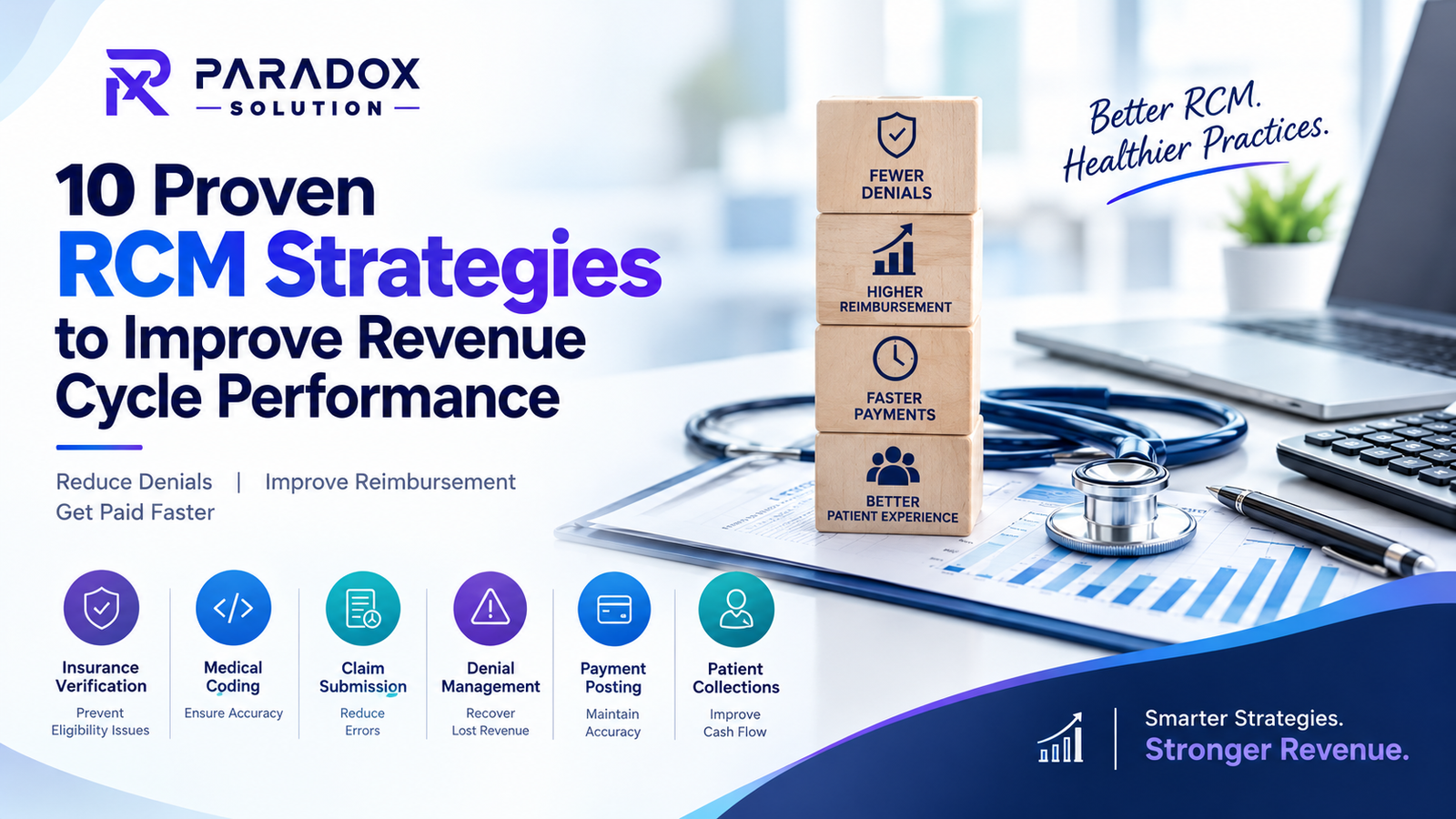
Strong revenue cycle management can make the difference between a financially healthy practice and one that constantly struggles with cash flow. The most effective RCM strategies help healthcare organizations reduce claim denials, improve reimbursement, and get paid faster for the services they provide.
In simple terms, Revenue Cycle Management (RCM) is the process of managing patient revenue from appointment scheduling through final payment collection. Every step matters. A small mistake during insurance verification, medical coding, or claim submission can delay reimbursement and increase administrative costs.
After working with healthcare providers and medical billing teams, one common lesson stands out: successful practices focus on prevention rather than fixing problems after claims are denied.
This guide covers 10 proven RCM strategies that help improve financial performance, strengthen compliance, reduce billing errors, and create a smoother experience for both patients and staff.
Why Revenue Cycle Performance Matters
| Revenue Cycle Area | Impact on Practice |
|---|---|
| Insurance Verification | Prevents eligibility-related denials |
| Medical Coding | Improves claim accuracy |
| Claim Submission | Accelerates reimbursement |
| Denial Management | Recovers lost revenue |
| Payment Posting | Maintains financial accuracy |
| Patient Collections | Improves cash flow |
Common Signs of Poor Revenue Cycle Performance
- Increasing claim denials
- Aging accounts receivable (AR)
- Slow reimbursement
- High write-offs
- Frequent billing errors
- Patient payment delays
1. Verify Insurance Eligibility Before Every Visit
Insurance eligibility verification confirms that a patient’s coverage is active before services are provided.
Why This Matters
Many denied claims result from inactive coverage, incorrect policy information, or unmet benefits.
Best Practices
- Verify benefits 24–72 hours before appointments
- Confirm copays and deductibles
- Check referral requirements
- Document verification results
Real World Example
A family medicine clinic reduced eligibility-related denials by nearly 20% after implementing automated insurance verification before appointments.
2. Improve Front-End Patient Registration
Accurate patient registration creates a strong foundation for the entire revenue cycle.
Registration Checklist
| Required Information | Verify |
|---|---|
| Patient Name | ✔ |
| Date of Birth | ✔ |
| Insurance ID | ✔ |
| Policy Holder Details | ✔ |
| Contact Information | ✔ |
| Referral Authorization | ✔ |
Common Mistakes
- Incorrect member IDs
- Misspelled patient names
- Outdated insurance information
3. Focus on Accurate Medical Coding
Medical coding converts healthcare services into standardized codes used for billing.
Why Coding Accuracy Matters
Incorrect coding can lead to:
- Claim denials
- Payment delays
- Compliance risks
- Audit exposure
Coding Best Practices
- Use current CPT, ICD-10, and HCPCS codes
- Review provider documentation carefully
- Conduct regular coding audits
- Educate providers on documentation requirements
Quick Tip
Never code based on assumptions. Always code according to documented services.
4. Submit Clean Claims the First Time
A clean claim is a claim submitted without errors and ready for processing.
Clean Claim Checklist
| Requirement | Status |
|---|---|
| Accurate Demographics | ✔ |
| Verified Insurance | ✔ |
| Correct CPT Codes | ✔ |
| Correct ICD-10 Codes | ✔ |
| Required Modifiers | ✔ |
| Provider Credentials | ✔ |
Revenue Impact
Practices with higher clean claim rates generally receive faster reimbursement and experience fewer denials.
5. Strengthen Documentation Practices
Clinical documentation supports medical necessity and billing accuracy.
Documentation Should Include
- Patient history
- Assessment
- Diagnosis
- Treatment plan
- Provider signature
Why This Matters
Payers often deny claims when documentation does not support billed services.
6. Track and Reduce Claim Denials
Denial management should focus on identifying root causes instead of repeatedly correcting the same issues.
Common Denial Reasons
| Denial Reason | Prevention Method |
|---|---|
| Eligibility Issues | Verify coverage |
| Coding Errors | Coding audits |
| Missing Authorization | Obtain prior approval |
| Duplicate Claims | Claim tracking |
| Documentation Issues | Provider education |
Best Practice
Review denial trends monthly and implement corrective actions.
7. Monitor Key Revenue Cycle KPIs
Key Performance Indicators (KPIs) help measure revenue cycle health.
Important RCM Metrics
| KPI | Goal |
|---|---|
| Clean Claim Rate | Above 95% |
| First Pass Resolution Rate | Above 90% |
| Denial Rate | Below 5% |
| Days in AR | Under 40 Days |
| Collection Rate | Above 95% |
Why This Matters
What gets measured gets improved.
8. Improve Accounts Receivable Follow Up
Accounts Receivable (AR) represents money owed to the practice.
AR Follow Up Workflow
- Review unpaid claims daily
- Identify payer delays
- Correct claim issues quickly
- Submit appeals when necessary
- Document all follow-up actions
Common Mistake
Many practices focus only on new claims while ignoring aging balances.
9. Invest in Continuous Staff Training
Payer rules, coding guidelines, and compliance requirements change regularly.
Training Topics
- ICD-10 updates
- CPT changes
- CMS guidelines
- Prior authorization requirements
- Denial prevention
Revenue Benefits
Well-trained staff make fewer mistakes and resolve billing issues faster.
10. Use Technology and Automation
Modern RCM software can automate repetitive tasks and improve efficiency.
Areas Suitable for Automation
| Process | Automation Benefit |
|---|---|
| Eligibility Checks | Faster verification |
| Claim Scrubbing | Error detection |
| Payment Posting | Reduced manual work |
| Denial Tracking | Better visibility |
| Reporting | Improved decision making |
Best Practice
Use automation to support staff, not replace quality review.
Revenue Cycle Workflow Overview
| Stage | Goal |
|---|---|
| Scheduling | Collect accurate information |
| Eligibility Verification | Confirm coverage |
| Registration | Capture demographics |
| Coding | Assign correct codes |
| Claim Submission | Bill payer accurately |
| Payment Posting | Record payments |
| Denial Management | Recover revenue |
| Patient Collections | Collect balances |
How Paradox Solution Can Help
At Paradox Solution, we support healthcare providers with revenue cycle optimization, medical billing services, denial management, insurance verification, payment posting, AR follow-up, and coding support.
By implementing proven RCM strategies and monitoring performance metrics, practices can reduce revenue leakage, improve reimbursement timelines, and strengthen overall financial performance.
Conclusion
Successful RCM strategies focus on preventing problems before they affect reimbursement. Accurate insurance verification, proper documentation, correct coding, timely claim submission, consistent follow-up, and ongoing staff education all play important roles in improving revenue cycle performance.
Healthcare organizations that regularly monitor KPIs, analyze denial trends, and invest in process improvements are better positioned to maintain healthy cash flow and operational stability. Even small improvements in claim accuracy and workflow efficiency can create meaningful financial results over time.
Frequently Asked Questions
1. What is the most important RCM strategy?
Insurance eligibility verification is often one of the most effective strategies because it prevents avoidable denials before services are provided.
2. How can a practice reduce claim denials?
Verify insurance coverage, improve coding accuracy, strengthen documentation, and review denial trends regularly.
3. What is a clean claim?
A clean claim is submitted without errors and contains all required information for payer processing.
4. How often should revenue cycle KPIs be reviewed?
Most practices benefit from reviewing KPIs monthly, while larger organizations may monitor them weekly.
5. Should medical billing be outsourced?
It depends on practice size, staffing, and expertise. Some organizations achieve better efficiency through experienced medical billing partners, while others prefer an in-house team.