
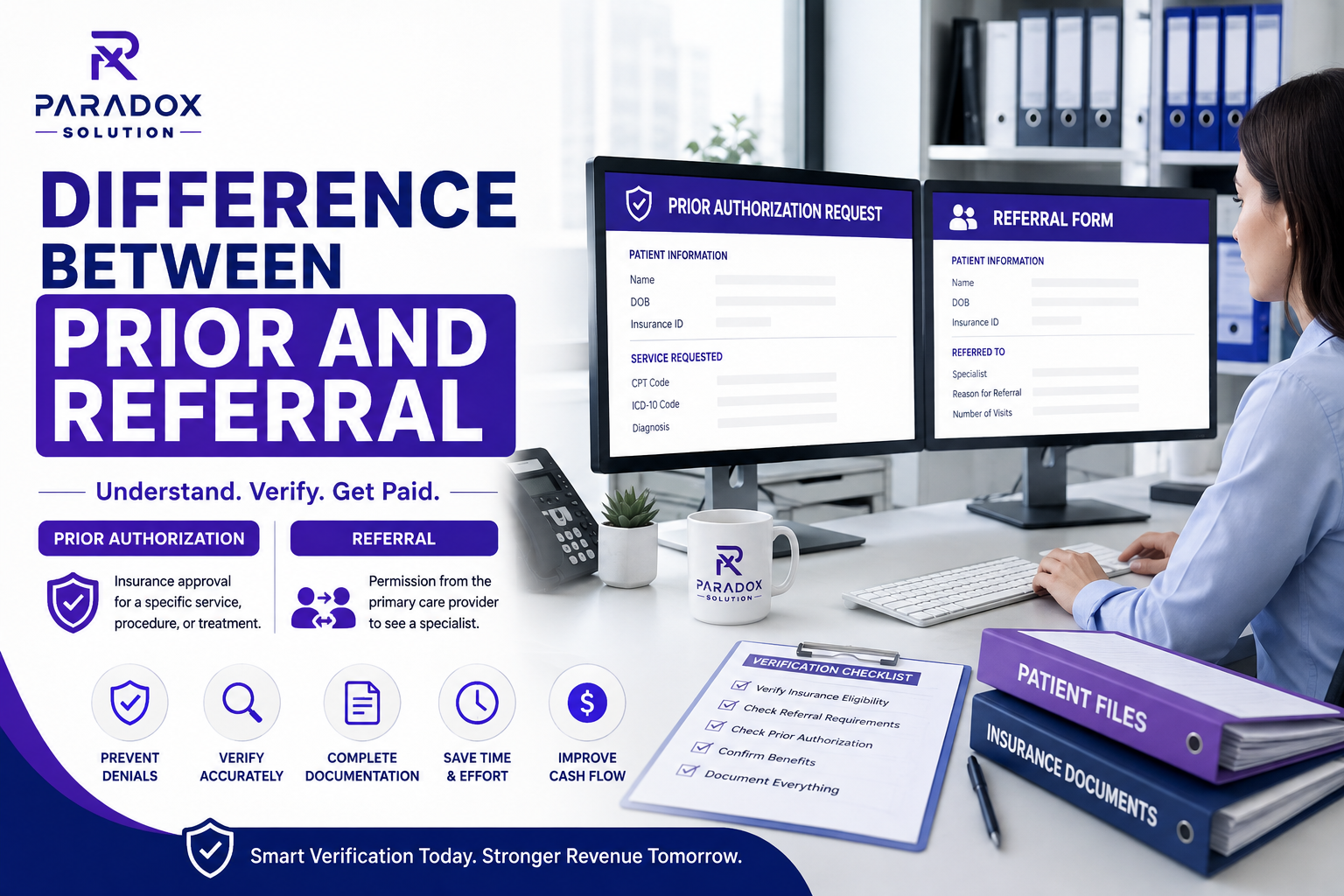
Difference Between Prior and Referral
Understanding the difference between prior and referral is essential for healthcare providers, medical billers, front desk staff, and anyone involved in the revenue cycle. These two terms are often confused because both happen before a patient receives certain healthcare services. However, they serve different purposes and follow different insurance rules.
A referral gives a patient permission to see another healthcare provider, while prior authorization is the insurance company’s approval for a specific treatment, procedure, medication, or diagnostic test. Confusing these requirements can result in delayed patient care, denied insurance claims, and lost revenue for a practice.
Whether you are new to medical billing or have years of experience, understanding when a referral or prior authorization is required can make your workflow much smoother. In this guide, you’ll learn how each process works, their key differences, real-world billing examples, common mistakes, and best practices that help improve reimbursement while keeping your practice compliant with payer requirements.
What Is a Referral?
A referral is a written or electronic request from a Primary Care Provider (PCP) asking another healthcare provider, usually a specialist, to evaluate or treat a patient.
Referrals are commonly required by Health Maintenance Organization (HMO) insurance plans. The goal is to coordinate patient care and ensure the primary physician manages the patient’s overall treatment.
For example, a family physician may refer a patient with chronic back pain to an orthopedic specialist for further evaluation.
When Is a Referral Required?
A referral may be required when:
-
- A patient needs to see a specialist.
-
- The insurance plan is an HMO.
-
- Specialized testing or treatment is needed.
-
- The primary care physician cannot provide the required care.
Not every insurance plan requires referrals. Many Preferred Provider Organization (PPO) plans allow patients to see specialists without one. Always verify the patient’s benefits before scheduling an appointment.
Information Included in a Referral
A referral usually contains:
| Information | Purpose |
|---|---|
| Patient information | Identifies the patient |
| Referring physician | Identifies the PCP |
| Specialist information | Indicates where the patient is being sent |
| Diagnosis | Explains why the referral is needed |
| Number of visits | Shows how many visits are approved |
| Effective dates | Indicates when the referral is valid |
What Is Prior Authorization?
Prior authorization, also called preauthorization, is approval from the insurance company before certain medical services are performed. The insurer reviews the request to determine whether the service is medically necessary and covered under the patient’s health plan.
Unlike a referral, prior authorization focuses on the service, not the provider.
Services That Commonly Require Prior Authorization
Many insurance companies require prior authorization for:
-
- MRI and CT scans
-
- PET scans
-
- Elective surgeries
-
- Specialty medications
-
- Physical therapy beyond benefit limits
-
- Sleep studies
-
- Durable Medical Equipment (DME)
-
- High-cost injections
Requirements vary between insurance companies, so staff should always verify payer policies before scheduling services.
Documents Needed for Prior Authorization
The insurance company may request:
| Document | Why It Is Needed |
|---|---|
| Physician order | Requests the service |
| Clinical notes | Supports medical necessity |
| ICD-10 diagnosis code | Explains the patient’s condition |
| CPT code | Identifies the procedure |
| Previous treatment records | Shows why the service is needed |
Providing complete documentation the first time often speeds up the approval process.
Difference Between Prior and Referral
Although they are both completed before treatment, referrals and prior authorizations have different purposes.
| Referral | Prior Authorization |
|---|---|
| Issued by a primary care provider | Approved by the insurance company |
| Allows the patient to visit a specialist | Approves a specific service or procedure |
| Common with HMO plans | Required by many insurance plans |
| Focuses on provider coordination | Focuses on medical necessity |
| Usually created by the PCP’s office | Usually requested by the treating provider |
| May cover multiple specialist visits | Usually covers one approved service |
| Missing referral may deny the specialist visit | Missing authorization may deny payment for the procedure |
Simple way to remember:
-
- Referral = Permission to see another provider.
-
- Prior Authorization = Permission to perform a medical service.
Why This Difference Matters in Medical Billing
Understanding the difference helps practices reduce claim denials and improve cash flow.
Imagine a patient with severe shoulder pain visits their family physician. The physician sends a referral to an orthopedic specialist because the patient’s HMO plan requires one. During the specialist visit, the orthopedic surgeon orders an MRI.
The referral covers only the specialist visit. Before the MRI can be performed, the office must obtain prior authorization from the insurance company. If the MRI is completed without approval, the insurance company may deny the claim even though the referral was valid.
This is one of the most common billing mistakes seen in medical practices.

Missing referrals and prior authorizations are among the leading causes of avoidable insurance claim denials. The following are some of the most common reasons practices receive these denials.
Common Denial Reasons
-
- No referral on file
-
- Prior authorization not obtained
-
- Authorization expired
-
- Incorrect CPT code submitted
-
- Diagnosis does not support medical necessity
-
- Wrong provider listed on the referral
Most of these denials can be prevented by verifying insurance benefits before the patient receives care.
Best Practices for Providers and Billing Staff
A standardized workflow helps reduce billing errors and improves reimbursement.
| Best Practice | Benefit |
|---|---|
| Verify insurance before every visit | Identifies referral and authorization requirements |
| Check payer policies | Rules vary by insurance plan |
| Obtain approvals before treatment | Prevents claim denials |
| Document authorization numbers | Supports claim submission |
| Keep clinical documentation complete | Demonstrates medical necessity |
| Train staff regularly | Reduces administrative errors |
Quick Tips
-
- Never assume every patient has the same insurance requirements.
-
- Recheck authorizations if appointments are rescheduled.
-
- Keep copies of referral and authorization approvals in the patient’s record.
-
- Communicate with patients if additional approvals are needed to avoid delays.
Common Mistakes to Avoid
Even experienced practices make avoidable errors.
Some of the most common include:
-
- Assuming a referral replaces prior authorization.
-
- Scheduling expensive procedures before approval.
-
- Forgetting authorization expiration dates.
-
- Failing to verify insurance eligibility.
-
- Submitting claims with incorrect diagnosis or procedure codes.
-
- Not documenting approval numbers in the patient’s chart.
Creating a simple insurance verification checklist can significantly reduce these issues.
Conclusion
Understanding the difference between prior and referral is essential for accurate medical billing and smooth patient care. A referral helps patients access specialist care, while prior authorization confirms insurance approval for specific medical services. Although they may seem similar, each has a unique purpose and different payer requirements.
Healthcare practices that verify insurance eligibility, obtain approvals before treatment, maintain complete documentation, and educate staff regularly experience fewer claim denials and faster reimbursement. Since every insurance company has its own policies, always verify requirements before services are provided. Following these best practices will improve workflow, protect revenue, and create a better experience for both patients and providers.