
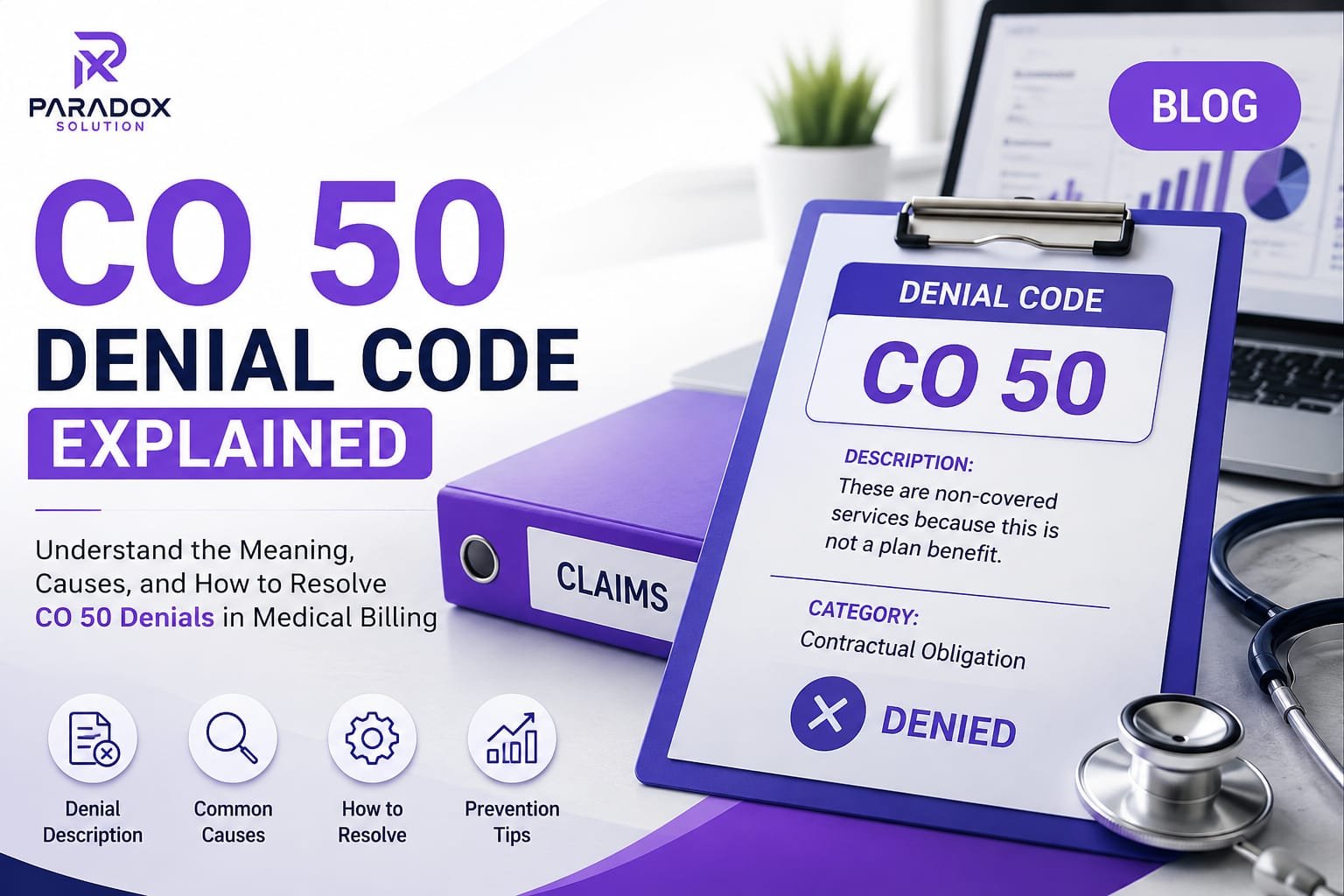
CO 50 Denial Code Explained
Receiving a CO 50 denial can be frustrating, especially when you believe the claim was coded correctly. In medical billing, every denial affects cash flow, staff productivity, and patient satisfaction. Understanding CO 50 Denial Code Explained is the first step toward reducing unnecessary write offs and getting paid faster.
CO 50 generally means the insurance company considers the billed service not medically necessary or not covered because it does not meet the payer’s medical necessity requirements. In simple terms, the payer believes the documentation or clinical information does not justify why the service was performed under its coverage rules.
The good news is that many CO 50 denials can be prevented. Proper documentation, correct diagnosis coding, insurance verification, and understanding payer policies significantly reduce these denials. In this guide, you’ll learn what CO 50 means, why it happens, how to correct it, practical billing examples, compliance considerations, and proven strategies to prevent it in everyday practice.
What Is CO 50 Denial Code?
Understanding the Denial
CO stands for Contractual Obligation, meaning the denial is based on the payer’s contract or coverage policy rather than a billing system error.
Denial Code 50 means:
These services are not considered medically necessary according to the payer’s coverage guidelines.
Medical necessity simply means the healthcare service must be reasonable and necessary to diagnose or treat a patient’s condition according to accepted medical standards.
If the documentation does not support that need, the payer may deny payment.
Why This Matters
A CO 50 denial can result in:
-
- Delayed reimbursement
-
- Increased accounts receivable (AR)
-
- Additional staff work
-
- Possible loss of revenue
-
- Patient billing confusion
-
- Higher denial rates during payer audits
For many practices, preventing just a few CO 50 denials each month can improve overall revenue cycle performance.
CO 50 Denial at a Glance
| Item | Details |
|---|---|
| Denial Code | CO 50 |
| Category | Contractual Obligation |
| Meaning | Service not medically necessary |
| Can it be appealed? | Often yes |
| Can it be corrected? | Depends on documentation |
| Common Departments | Primary Care, Imaging, Therapy, Specialist Offices |
| Revenue Impact | Moderate to High |
Why Does CO 50 Denial Occur?
The Most Common Causes
Insurance companies review whether the medical record supports the service billed.
If the documentation is weak or coverage rules are not met, payment may be denied.
Common Reasons
| Reason | Explanation |
|---|---|
| Insufficient documentation | Medical records do not justify the service. |
| Diagnosis does not support treatment | ICD 10 diagnosis does not establish medical necessity. |
| Non covered service | The patient’s plan excludes the service. |
| Frequency limitation | Service performed more often than allowed. |
| Experimental treatment | Payer considers treatment investigational. |
| Missing prior authorization | Required approval was not obtained. |
| Incorrect coding | CPT or HCPCS code does not match documentation. |
| Payer policy changes | Coverage rules were updated. |
How Medical Necessity Is Determined
Every Payer Has Rules
Healthcare providers should review payer coverage requirements and CMS medical necessity guidelines before submitting claims. The CMS Medicare Coverage Database allows providers to check coverage policies, National Coverage Determinations (NCDs), and documentation requirements.
Medical necessity is not determined solely by the physician.
Insurance companies compare:
-
- Diagnosis codes
-
- Procedure codes
-
- Clinical documentation
-
- CMS coverage policies
-
- National Coverage Determinations (NCDs)
-
- Local Coverage Determinations (LCDs) when applicable
-
- Individual payer medical policies
Because payer policies vary, a service approved by one insurer may be denied by another.
Example
A physician orders advanced imaging for mild lower back pain.
The documentation contains only:
“Back pain.”
The payer may determine the documentation does not justify an MRI because conservative treatment was not documented.
If the physician documents:
-
- Persistent pain
-
- Failed physical therapy
-
- Neurological symptoms
-
- Functional limitations
the same service may satisfy medical necessity requirements.
Workflow After Receiving a CO 50 Denial
Step by Step Process
| Step | Action |
|---|---|
| 1 | Review the Explanation of Benefits (EOB) or Electronic Remittance Advice (ERA). |
| 2 | Confirm the denial reason. |
| 3 | Review physician documentation. |
| 4 | Verify diagnosis and procedure coding. |
| 5 | Compare documentation with payer policy. |
| 6 | Determine whether additional documentation exists. |
| 7 | Correct the claim if appropriate. |
| 8 | Submit an appeal when supported. |
| 9 | Track appeal status. |
| 10 | Educate staff to prevent repeat denials. |
Documentation Requirements
Strong Documentation Reduces Denials
Medical necessity starts with clear documentation.
Providers should document:
| Documentation Element | Why It Matters |
|---|---|
| Chief complaint | Explains why patient sought care |
| History of present illness | Describes symptoms and progression |
| Physical examination | Supports diagnosis |
| Assessment | Clinical reasoning |
| Treatment plan | Justifies ordered services |
| Diagnostic findings | Supports necessity |
| Physician signature | Required for compliance |
Incomplete records often make an otherwise appropriate claim appear unsupported.
Real World Example: Family Medicine Clinic
What Happened
A family medicine physician ordered a vitamin D laboratory test during an annual wellness visit for every patient.
Several claims returned with CO 50 denials.
Why It Happened
The insurance company covered vitamin D testing only when supported by qualifying diagnoses such as osteoporosis, chronic kidney disease, or documented vitamin D deficiency risk.
Routine screening alone was not covered under the patient’s plan.
How It Was Fixed
The billing team:
-
- Reviewed payer policy.
-
- Confirmed diagnosis coding.
-
- Checked physician documentation.
-
- Appealed only those claims with sufficient clinical support.
-
- Updated the office’s laboratory ordering guidelines.
Lesson Learned
Ordering a medically appropriate test is not always enough. The documentation and diagnosis must also meet the payer’s coverage requirements.
Staff Responsibilities in Preventing CO 50 Denials
| Team Member | Responsibility |
|---|---|
| Front Desk | Verify insurance eligibility and benefits before the visit. |
| Medical Assistant | Ensure complete clinical information is available for the provider. |
| Provider | Document medical necessity clearly and accurately. |
| Medical Coder | Assign accurate ICD 10, CPT, and HCPCS codes based on documentation. |
| Billing Specialist | Review claims for payer-specific requirements before submission. |
| AR Follow Up Team | Investigate denials, file appeals, and monitor outcomes. |
Common Mistakes That Lead to CO 50 Denials
Documentation Mistakes
-
- Copying the same note for every patient.
-
- Missing clinical findings.
-
- Incomplete assessment.
-
- Weak treatment rationale.
-
- Missing supporting test results.
Coding Mistakes
-
- Using unspecified diagnosis codes when a more specific code is available.
-
- Reporting procedures unsupported by documentation.
-
- Billing services exceeding payer frequency limits.
-
- Failing to use appropriate CPT modifiers when required.
-
- Ignoring payer-specific billing edits.
Quick Tip: Before submitting a claim, compare the diagnosis code, procedure code, and physician documentation. They should clearly support one another. A clean claim is much less likely to receive a CO 50 denial.
How to Fix a CO 50 Denial

Review the Denial Carefully
Not every CO 50 denial should be appealed. Start by reviewing the Explanation of Benefits (EOB) or Electronic Remittance Advice (ERA) to confirm the exact denial reason. Some payers include additional remark codes that provide more detail.
Follow These Steps
-
- Verify the patient’s insurance benefits.
-
- Review the provider’s documentation.
-
- Confirm the ICD 10 diagnosis supports the CPT or HCPCS code.
-
- Check the payer’s medical necessity policy.
-
- Determine whether additional documentation is available.
-
- Correct any coding errors.
-
- Submit a corrected claim or appeal if appropriate.
-
- Track the claim until a final determination is received.
Best Practice: Never change documentation after the date of service simply to obtain payment. If clarification is needed, the provider should complete a compliant addendum according to your organization’s documentation policy.
Appeal Checklist for CO 50 Denials
What to Include
A strong appeal is based on facts rather than opinions.
| Required Item | Purpose |
|---|---|
| Appeal letter | Explains why payment should be reconsidered |
| Medical records | Demonstrate medical necessity |
| Physician notes | Support clinical decision making |
| Laboratory or imaging reports | Provide objective evidence |
| Relevant payer policy | Shows the service meets coverage requirements |
| Corrected claim, if needed | Fixes coding or billing errors |
| Prior authorization, if applicable | Confirms required approval was obtained |
Revenue Cycle Impact
Why CO 50 Matters Financially
Even a small number of CO 50 denials can reduce practice revenue.
| Impact Area | Effect |
|---|---|
| Cash flow | Slower reimbursement |
| Accounts receivable | Higher outstanding balances |
| Staff productivity | More time spent on appeals |
| Administrative costs | Increased labor expenses |
| Patient satisfaction | Confusion regarding financial responsibility |
| Audit risk | Greater scrutiny if documentation problems continue |
Practices that routinely monitor denial trends often identify workflow issues before they become significant revenue problems.
Compliance Considerations
Documentation Must Support the Claim
Medical billing compliance is about accurately representing the care that was provided.
Keep these principles in mind:
-
- Documentation must support every billed service.
-
- Diagnosis codes should reflect the patient’s condition.
-
- CPT and HCPCS codes must match the documented service.
-
- Medical necessity should be evident throughout the medical record.
-
- Maintain complete records for future audits.
-
- Follow CMS guidance when billing Medicare.
-
- Follow each commercial payer’s published coverage policies.
Remember that payer requirements vary, so a service covered by one insurer may require additional documentation or may not be covered by another.
Clean Claim Checklist
Use this checklist before submitting claims.
| Checklist Item | Complete |
|---|---|
| Insurance eligibility verified | ✔ |
| Benefits reviewed | ✔ |
| Prior authorization obtained if required | ✔ |
| Documentation complete | ✔ |
| Medical necessity documented | ✔ |
| ICD 10 codes accurate | ✔ |
| CPT and HCPCS codes verified | ✔ |
| Required modifiers added | ✔ |
| Provider signature present | ✔ |
| Claim reviewed before submission | ✔ |
Denial Prevention Checklist
Practical Tips That Work
-
- Review payer medical policies regularly.
-
- Train providers on documentation expectations.
-
- Perform internal coding audits.
-
- Verify insurance before every visit.
-
- Obtain prior authorization when required.
-
- Use claim-scrubbing software to identify errors.
-
- Monitor denial trends every month.
-
- Provide ongoing education for coding and billing staff.
-
- Keep coding resources updated.
-
- Communicate frequently between clinical and billing teams.
Quick Tip: Track CO 50 denials by provider, specialty, and payer. Patterns often reveal education opportunities or workflow improvements.
Real World Example: Pediatric Practice
What Happened
A pediatric office billed developmental screening for several well-child visits.
Multiple claims received CO 50 denials.
Why It Happened
The documentation stated the screening was performed but did not explain why it was medically necessary according to the payer’s policy or include all required documentation elements.
How It Was Fixed
The practice:
-
- Reviewed payer coverage criteria.
-
- Updated provider documentation templates.
-
- Educated physicians on documentation requirements.
-
- Corrected eligible claims and submitted appeals with supporting records.
Lesson Learned
Even when the service is appropriate, incomplete documentation can lead to payment delays.
Real World Example: Orthopedic Specialist
What Happened
An orthopedic clinic ordered advanced imaging shortly after the patient’s initial visit.
The insurer denied payment with CO 50.
Why It Happened
The medical record did not document conservative treatment, symptom duration, or clinical findings that met the payer’s imaging guidelines.
How It Was Fixed
The physician completed a compliant documentation addendum using existing clinical information, and the billing team submitted an appeal with supporting records.
Lesson Learned
Understanding payer-specific medical necessity policies before ordering high-cost services helps reduce avoidable denials.
Related Medical Billing Topics
Practices managing CO 50 denials should also strengthen processes in these areas:
-
- Medical Coding
-
- ICD 10 Coding
-
- HCPCS Codes
-
- CPT Modifiers
-
- Prior Authorization
-
- Insurance Verification
-
- Eligibility Verification
-
- Revenue Cycle Management
-
- Claim Denials
-
- AR Follow Up
-
- Payment Posting
-
- Place of Service Codes
-
- Clearinghouses
-
- Medical Billing Software
-
- Credentialing
Improving these workflows reduces not only CO 50 denials but many other common claim rejections as well.
Conclusion
Understanding CO 50 Denial Code Explained is essential for every healthcare practice that wants to improve collections and reduce preventable claim denials. Although this denial indicates the payer believes a service was not medically necessary, it does not always mean payment is impossible. Careful documentation review, accurate diagnosis coding, knowledge of payer policies, and timely appeals can often resolve legitimate denials.
From years of working with physician practices, one lesson stands out: most CO 50 denials are easier to prevent than to fix. Strong provider documentation, thorough insurance verification, correct coding, timely claim submission, regular claim follow-up, and continuous staff education create a healthier revenue cycle and reduce unnecessary administrative work.