
Medicare Hospice Billing
Medicare Hospice Billing is one of the most specialized areas of medical billing because it combines strict Medicare regulations, detailed clinical documentation, and timely claim submission requirements. Even a small billing mistake can delay reimbursement or trigger claim denials. For hospice providers, maintaining accurate billing practices is essential to ensure patients continue receiving compassionate end of life care while the organization receives appropriate payment.
Whether you are new to hospice billing or have years of billing experience, understanding Medicare’s hospice payment system helps improve clean claim rates and reduce unnecessary rework. In this guide, you will learn how Medicare Hospice Billing works, the required documentation, the claim submission process, common denial reasons, compliance requirements, and practical tips that can improve billing accuracy.
Understanding Medicare Hospice Billing
Medicare Hospice Billing is the process of submitting claims to Medicare for hospice services provided to eligible beneficiaries who have elected the Medicare Hospice Benefit.
Unlike traditional fee for service billing, Medicare pays hospice providers using a daily payment rate, known as a per diem payment. This means the hospice agency receives a fixed amount for each day the patient is enrolled in hospice care, regardless of how many services are provided that day, provided Medicare coverage requirements are met.
For official information about hospice payment policies, eligibility requirements, and billing guidance, providers can refer to the CMS Hospice program page:
This payment method encourages comprehensive patient care instead of billing every individual service separately.
Why It Matters
Accurate billing helps providers:
-
- Receive timely reimbursement
-
- Avoid claim denials
-
- Maintain Medicare compliance
-
- Reduce audit risk
-
- Improve cash flow
Medicare Hospice Billing Workflow
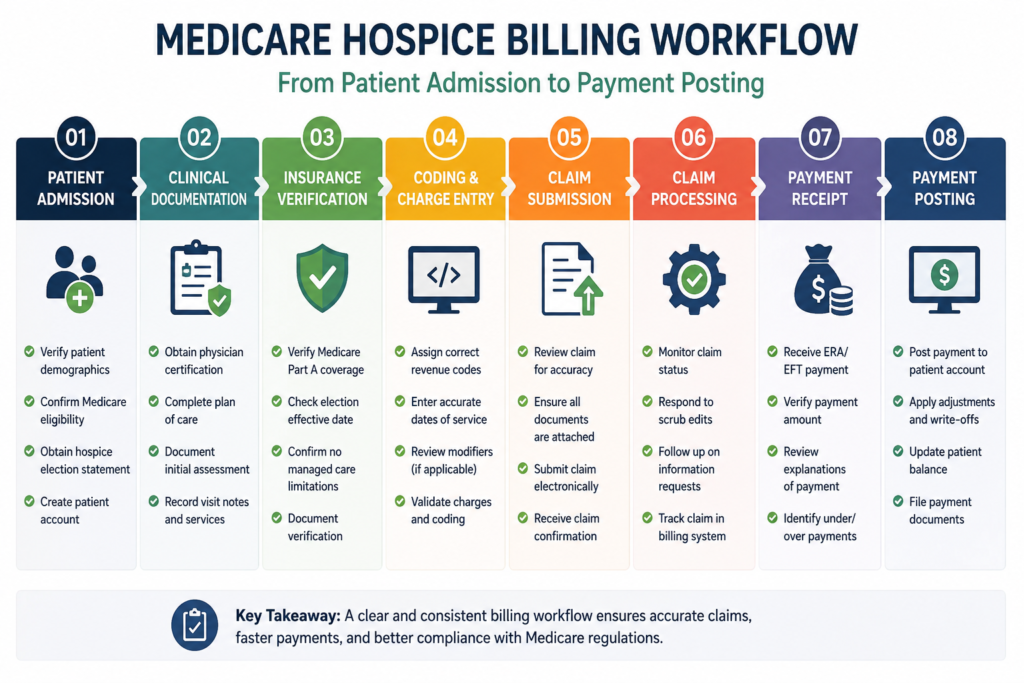
| Step | Activity | Why It Matters |
|---|---|---|
| 1 | Verify Medicare eligibility | Confirms coverage |
| 2 | Confirm hospice election | Required before billing |
| 3 | Obtain physician certification | Supports medical necessity |
| 4 | Complete admission documentation | Required for compliance |
| 5 | Assign correct revenue codes | Prevents billing errors |
| 6 | Submit electronic claim | Faster processing |
| 7 | Post payment | Updates patient account |
| 8 | Follow up denied claims | Protects revenue |
Documentation Requirements
Proper documentation supports every hospice claim.
Required Documentation
| Document | Purpose |
|---|---|
| Hospice Election Statement | Confirms patient chooses hospice care |
| Physician Certification | Verifies terminal illness |
| Plan of Care | Outlines treatment goals |
| Clinical Notes | Supports ongoing care |
| Visit Documentation | Shows services provided |
| Medication Records | Supports symptom management |
Missing documentation is one of the leading causes of delayed reimbursement.
Common Medicare Hospice Billing Mistakes

Even experienced billing teams occasionally encounter errors.
Frequent Problems
| Mistake | Result |
|---|---|
| Incorrect patient eligibility | Claim denial |
| Missing physician certification | Payment delay |
| Incorrect dates of service | Rejected claim |
| Documentation mismatch | Audit risk |
| Late claim submission | Lost reimbursement |
| Incorrect revenue codes | Billing edits |
Quick Tip
Create a pre-submission checklist so every claim is reviewed before it reaches Medicare.
Real World Example
Small Hospice Agency
A small hospice provider noticed increasing claim denials. After reviewing the workflow, the billing manager discovered that physician certifications were often signed after claims had already been submitted.
The agency updated its admission checklist to require completed certifications before billing.
Within two months:
-
- First-pass claim acceptance improved.
-
- Staff spent less time correcting claims.
-
- Cash flow became more predictable.
The lesson was simple: a strong front-end process prevents costly back-end corrections.
Medicare Compliance Considerations
Hospice providers should follow Medicare regulations throughout the billing process.
Important compliance areas include:
-
- Accurate documentation
-
- Timely claim submission
-
- Proper patient eligibility verification
-
- Medical necessity documentation
-
- Complete physician certifications
-
- HIPAA compliance for patient privacy
-
- Regular internal billing audits
Keep in mind that Medicare policies and payer requirements may change over time. Staff education should be an ongoing priority.
Best Practices for Medicare Hospice Billing
Experienced billing professionals often rely on consistent workflows rather than last-minute corrections.
Billing Checklist
| Task | Completed |
|---|---|
| Verify Medicare eligibility | ✔ |
| Confirm hospice election | ✔ |
| Review physician certification | ✔ |
| Validate documentation | ✔ |
| Check claim accuracy | ✔ |
| Submit electronically | ✔ |
| Monitor claim status | ✔ |
| Post payments promptly | ✔ |
Practical Tips
-
- Verify eligibility before every admission.
-
- Review documentation daily instead of weekly.
-
- Submit claims as soon as documentation is complete.
-
- Monitor aging reports for unpaid claims.
-
- Train billing staff on Medicare updates.
-
- Perform routine internal audits.
-
- Communicate regularly with clinical staff.
Related Revenue Cycle Areas
Hospice billing works best when integrated with the rest of the revenue cycle.
Related topics include:
-
- Medical Coding
-
- Revenue Cycle Management
-
- Insurance Verification
-
- Eligibility Verification
-
- Claim Denials
-
- Payment Posting
-
- AR Follow Up
-
- Medical Billing Software
-
- Clearinghouses
-
- ICD 10 Coding
-
- HCPCS Codes
Understanding these areas helps improve overall reimbursement and operational efficiency.
Conclusion
Medicare Hospice Billing requires attention to detail, accurate documentation, timely claim submission, and a strong understanding of Medicare requirements. While the payment system differs from many other healthcare specialties, following standardized workflows can significantly reduce denials and improve reimbursement.
Providers should focus on complete documentation, physician certification, insurance verification, coding accuracy, regular claim follow up, and continuous staff education. These best practices not only improve financial performance but also support uninterrupted care for hospice patients.