
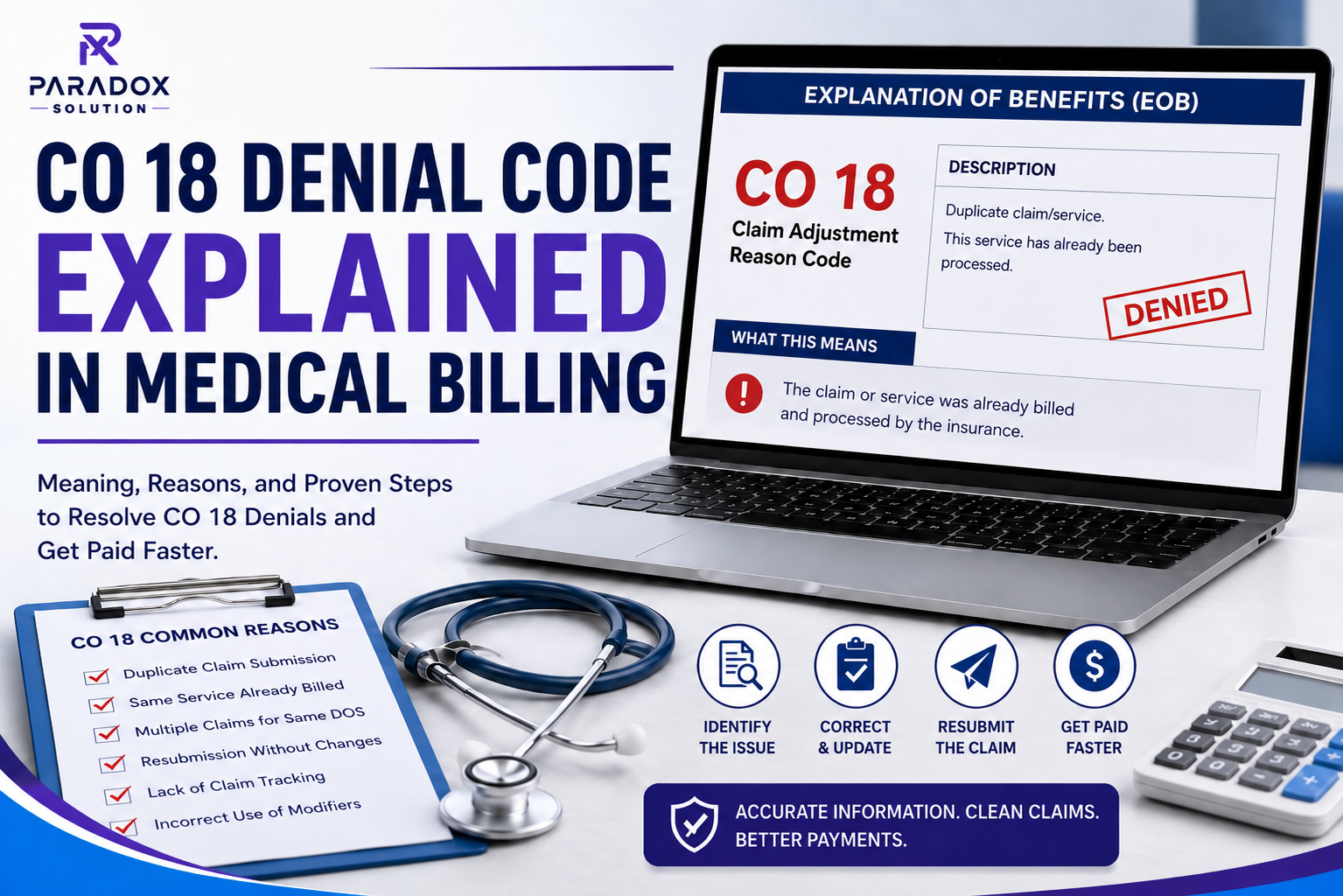
CO 18 Denial Code Explained: Complete Guide for Medical Billing
Medical claim denials are one of the biggest challenges in healthcare revenue cycle management. One denial that often confuses billing staff, providers, and even experienced billers is the CO 18 denial code explained. At first glance, it may seem like a simple rejection, but if it is not investigated correctly, it can delay payments, increase accounts receivable, and create unnecessary work for your billing team.
In day to day medical billing, every denied claim represents lost time until the issue is corrected. Some denials are caused by missing information, while others happen because the same service has already been processed. CO 18 falls into the second category. Understanding exactly why it happens can help your practice avoid duplicate billing errors and speed up reimbursement.
In this guide, you will learn what CO 18 means, why insurance companies issue it, how to investigate the denial, when it can be appealed, and what practical steps healthcare organizations can take to prevent it. Whether you work in a solo practice, a large multispecialty clinic, an urgent care center, or a billing company, these best practices can help improve claim accuracy and reduce unnecessary denials.
What Is CO 18 Denial Code?
The CO 18 denial code means:
Duplicate claim or service. The payer believes the same service has already been processed or paid.
The letters CO stand for Contractual Obligation. This means the insurance company considers the denial to be the provider responsibility rather than the patient responsibility.
Simply put, the payer has identified another claim in its system that appears to match the one you submitted. As a result, it will not process the claim again unless you can prove it is different.
Sometimes the denial is correct. Other times, it happens because the insurance company mistakenly identifies two different claims as duplicates.
Plain English Explanation
Imagine you mail the same electricity bill payment twice. Once the utility company receives and processes the first payment, it does not need the second one. The second payment would be considered a duplicate.
Insurance companies use a similar process when reviewing medical claims.
Why Understanding CO 18 Matters
Many billing professionals assume every CO 18 denial is an error by the insurance company. In reality, both providers and payers can contribute to duplicate claim situations.
Ignoring these denials may result in:
-
- Delayed reimbursement
-
- Higher accounts receivable balances
-
- Increased administrative costs
-
- Unnecessary appeals
-
- Reduced staff productivity
-
- Cash flow interruptions
-
- Lower clean claim rates
For practices with hundreds of claims submitted each week, even a small percentage of duplicate denials can have a noticeable impact on revenue.
How Insurance Companies Detect Duplicate Claims
Insurance companies compare many data elements before deciding whether a claim is a duplicate.
| Claim Element | Why It Matters |
|---|---|
| Patient name | Identifies the beneficiary |
| Member ID | Matches insurance coverage |
| Date of service | Compares treatment dates |
| Provider NPI | Identifies billing provider |
| CPT code | Compares procedures performed |
| HCPCS code | Checks supplies and services |
| ICD 10 diagnosis | Reviews medical necessity information |
| Charge amount | Compares billed charges |
| Place of service | Confirms treatment location |
| Units billed | Detects repeated services |
Even one or two matching fields may trigger duplicate claim edits depending on the payer.
Remember that every insurance company uses different claim editing software. A claim accepted by one payer could receive a CO 18 denial from another.
Understanding the Claim Review Workflow
The following simplified workflow shows where CO 18 usually occurs.
| Step | Activity | Possible Outcome |
|---|---|---|
| 1 | Patient receives treatment | Services documented |
| 2 | Medical coder assigns diagnosis and procedure codes | Coding completed |
| 3 | Claim created | Ready for submission |
| 4 | Claim sent through clearinghouse | Electronic validation |
| 5 | Insurance company receives claim | Claim editing begins |
| 6 | Duplicate claim edits performed | Possible CO 18 denial |
| 7 | Claim processed or denied | Payment or denial issued |
Duplicate claim detection usually happens before the payer completes payment processing.
Common Reasons for CO 18 Denials
Although every payer has unique claim editing rules, the same problems appear repeatedly across healthcare organizations.
1. The Same Claim Was Submitted Twice
This is the most common cause.
Sometimes staff members believe a claim was never received, so they submit it again before checking the claim status.
Real World Example
A family medicine clinic submits a claim electronically.
Two days later, a staff member notices no acknowledgment report has been reviewed. Assuming the claim failed, they submit it again.
Both claims reach the payer.
The first claim processes normally.
The second receives a CO 18 denial.
Lesson Learned
Always verify claim status before resubmitting.
2. Clearinghouse Delays
Many practices panic when they do not immediately receive confirmation from their clearinghouse.
Instead of waiting for the transmission report, staff submit another claim.
Hours later, both claims successfully reach the payer.
This creates an unnecessary duplicate.
Best Practice
Always check:
-
- Clearinghouse reports
-
- Accepted claim reports
-
- Rejected claim reports
-
- Claim acknowledgment files
before transmitting another claim.
3. Paper and Electronic Claims Submitted Together
Some practices still use paper claims under certain circumstances.
Problems occur when:
-
- Electronic claim is submitted.
-
- Staff believe it failed.
-
- Paper claim is mailed.
-
- Both claims arrive.
The insurance company identifies them as duplicates.
4. Multiple Staff Members Working the Same Account
Large billing departments often divide work among several employees.
Without clear communication, two people may unknowingly submit the same corrected claim.
Example
A pediatric office has three billers.
One employee works aging claims.
Another works denied claims.
Both independently resubmit the same encounter.
Result:
CO 18 duplicate denial.
5. Incorrect Claim Follow Up Process
Many practices resubmit claims before checking:
-
- Claim status
-
- Electronic remittance advice
-
- Explanation of benefits
-
- Payer portal
-
- Call reference numbers
Proper follow up often reveals the claim is already processing.
6. Software or System Errors
Although uncommon, practice management software can occasionally create duplicate transmissions.
Possible causes include:
-
- Interrupted internet connection
-
- Failed transmission retry
-
- Duplicate batch uploads
-
- System synchronization problems
-
- Interface issues between billing software and clearinghouse
Regular software monitoring helps reduce these problems.
7. Payer Processing Error
Sometimes the provider did everything correctly.
The payer may accidentally classify two different services as duplicates because:
-
- Similar CPT codes
-
- Same service date
-
- Multiple providers
-
- Split billing situations
-
- Claim editing software limitations
When this occurs, documentation becomes extremely important.
Common CO 18 Denial Causes at a Glance
| Cause | Provider Responsibility | Can It Be Corrected? |
|---|---|---|
| Duplicate submission | Yes | Yes |
| Paper and electronic billing | Yes | Yes |
| Clearinghouse resubmission | Yes | Yes |
| Software duplication | Usually | Yes |
| Multiple staff submissions | Yes | Yes |
| Payer processing error | No | Often |
| Incorrect claim tracking | Yes | Yes |
Real World Scenario: Solo Physician Practice
A solo internal medicine physician submits claims every evening.
One claim remains in “Pending” status for several days.
The office manager assumes the payer never received it and submits another claim.
Three days later:
-
- The first claim is paid.
-
- The second receives a CO 18 denial.
What Happened?
The insurance company had already accepted the original claim.
The office submitted a duplicate before verifying its status.
How It Was Fixed
The office implemented a standard operating procedure requiring staff to:
-
- Check the payer portal.
-
- Review clearinghouse reports.
-
- Confirm claim status.
-
- Document all follow up activities.
-
- Obtain payer confirmation before resubmitting.
Within two months, duplicate denials dropped significantly.
Quick Tip
Never resubmit a claim simply because payment has not arrived. Always verify whether the original claim is still being processed. Many duplicate denials happen because staff confuse payment delays with claim transmission failures.
Why This Matters for Revenue Cycle Management
Every duplicate claim creates unnecessary work for:
-
- Front desk staff
-
- Medical coders
-
- Billers
-
- Payment posting teams
-
- Accounts receivable specialists
-
- Revenue cycle managers
Instead of focusing on unpaid claims that truly need attention, staff spend valuable time correcting avoidable mistakes.
Reducing CO 18 denials helps improve:
| Performance Measure | Expected Benefit |
|---|---|
| Clean claim rate | Higher |
| First pass payment rate | Higher |
| Accounts receivable days | Lower |
| Administrative workload | Lower |
| Cash flow | Improved |
| Staff productivity | Improved |
| Denial rate | Reduced |
Key Takeaways So Far
By this point, you should understand that CO 18 is not simply another denial code. It usually indicates that the insurance company believes the same claim or service has already been submitted or processed. While duplicate submissions are the most common cause, clearinghouse delays, workflow gaps, software issues, and even payer processing errors can also trigger this denial.
The good news is that most CO 18 denials are preventable with better claim tracking, clear staff responsibilities, and consistent follow up procedures.
How to Investigate a CO 18 Denial Step by Step

When you receive a CO 18 denial, avoid the temptation to immediately resubmit the claim. In my experience, this is one of the most common mistakes that leads to even more duplicate claims and additional denials.
Instead, follow a structured investigation process. It takes a few extra minutes but can save hours of rework later.
Step 1: Review the Explanation of Benefits (EOB) or Electronic Remittance Advice (ERA)
Start by reviewing the denial details on the EOB or ERA.
Look for:
-
- Claim number
-
- Patient information
-
- Date of service
-
- CPT or HCPCS codes
-
- Denial reason
-
- Remark codes
-
- Payment history
Sometimes the payer includes additional remarks that explain exactly why the claim was considered a duplicate.
Step 2: Search Your Billing Software
Before contacting the payer, search your practice management or billing software.
Verify whether another claim exists with the same:
-
- Patient
-
- Date of service
-
- Provider
-
- CPT code
-
- Diagnosis code
-
- Amount billed
Many duplicate submissions are discovered at this stage.
Step 3: Check the Clearinghouse Reports
Your clearinghouse tracks every electronic claim sent to insurance companies.
Review:
-
- Accepted claims
-
- Rejected claims
-
- Transmission history
-
- Batch reports
-
- Acknowledgment reports
Sometimes staff mistakenly believe a claim failed when it was actually accepted.
Step 4: Review the Payer Portal
Most insurance companies provide online claim status tools.
Confirm whether:
-
- The original claim was received
-
- It is still processing
-
- It has already been paid
-
- It was denied for another reason
-
- A corrected claim has already been submitted
Never rely on assumptions when the payer portal can provide real time information.
Step 5: Contact the Insurance Company
If the reason is still unclear, call the payer.
Have the following information ready:
| Information Needed | Why It Matters |
|---|---|
| Patient name | Confirms member identity |
| Member ID | Locates the claim |
| Date of service | Finds the encounter |
| Provider NPI | Identifies the billing provider |
| Claim number | Speeds the search |
| CPT codes | Confirms billed services |
Ask questions such as:
-
- Which claim was identified as the duplicate?
-
- Has the original claim already been paid?
-
- Is this a payer processing error?
-
- Should a corrected claim be submitted?
-
- Is an appeal required?
Document the representative’s name, reference number, and the date of the call.
When Should You Correct the Claim?
Not every CO 18 denial requires an appeal.
Sometimes the problem can be corrected without a formal dispute.
Correct the Claim When
| Situation | Recommended Action |
|---|---|
| Duplicate submitted by mistake | Do not resubmit again |
| Wrong claim frequency code | Submit corrected claim if payer instructs |
| Missing modifier caused confusion | Correct and resubmit if allowed |
| Wrong billing provider | Correct claim information |
| Software created duplicate | Remove duplicate and monitor transmissions |
When Should You File an Appeal?
Appeals are appropriate when you believe the payer made the mistake.
Examples include:
-
- Two different services were treated as duplicates.
-
- Different providers billed legitimate services.
-
- Separate procedures occurred on the same day.
-
- The payer processed the original claim incorrectly.
-
- Medical records clearly support separate reimbursement.
Always follow the payer appeal guidelines and filing deadlines.
Documentation Needed to Resolve CO 18
Strong documentation makes the review process easier.
Depending on the payer, you may need:
| Document | Purpose |
|---|---|
| Medical records | Supports the service performed |
| Office notes | Verifies treatment |
| Operative report | Supports surgical services |
| Corrected claim | Fixes billing errors |
| Original EOB | Shows denial details |
| Appeal letter | Explains why payment is appropriate |
| Claim history | Demonstrates previous submissions |
Remember that documentation requirements vary by payer.
Real World Example: Family Medicine Clinic
A family medicine clinic billed an annual wellness visit.
A week later, the claim was denied with CO 18.
The billing specialist investigated the account.
The original claim had already been paid.
A second employee had unknowingly submitted the same visit while working aging accounts.
What Was Fixed?
The clinic introduced a simple claim tracking log.
Every follow up action was recorded before anyone could resubmit a claim.
Result
Within three months:
-
- Duplicate claim submissions dropped.
-
- Staff spent less time correcting avoidable denials.
-
- Cash flow became more predictable.
Real World Example: Pediatric Practice
A child received vaccines and an office visit on the same day.
The insurance company denied one claim as a duplicate.
The billing team reviewed the documentation.
Both services were medically necessary and separately reportable.
The denial occurred because the payer’s editing software incorrectly matched the services.
The practice submitted:
-
- Medical records
-
- Vaccine administration documentation
-
- Correct coding explanation
-
- Appeal letter
The payer overturned the denial and issued payment.
Lesson Learned
Not every CO 18 denial is the provider’s fault.
A careful review can prevent unnecessary write offs.
Compliance Considerations
Accurate billing is not only about getting paid. It is also part of maintaining compliance.
Healthcare organizations should follow:
CMS Guidance
The Centers for Medicare and Medicaid Services encourages providers to submit accurate, complete claims supported by proper documentation.
Duplicate billing can delay payment and increase administrative costs.
Although Medicare and commercial payers may use different editing systems, the basic expectation remains the same.
HIPAA Compliance
The Health Insurance Portability and Accountability Act requires providers to protect patient information during billing and claim follow up.
When investigating denials:
-
- Limit access to authorized staff.
-
- Protect patient records.
-
- Use secure communication methods.
-
- Maintain audit trails.
Documentation Standards
Documentation should always support:
-
- Medical necessity
-
- Correct diagnosis coding
-
- Accurate procedure coding
-
- Date of service
-
- Provider documentation
-
- Patient encounter details
Incomplete documentation increases the likelihood of denials and unsuccessful appeals.
Common Mistakes That Trigger Repeat CO 18 Denials
Many organizations continue receiving duplicate denials because the underlying workflow never changes.
Avoid these common mistakes.
| Mistake | Better Approach |
|---|---|
| Resubmitting before checking claim status | Verify status first |
| Ignoring clearinghouse reports | Review every transmission |
| Poor staff communication | Assign clear ownership |
| No claim tracking process | Document every follow up |
| Waiting until month end to investigate | Review denials daily |
| Assuming every denial is a payer mistake | Investigate objectively |
Staff Responsibilities
Every team member plays a role in preventing duplicate claims.
| Team Member | Responsibility |
|---|---|
| Front desk | Verify insurance eligibility and demographics |
| Medical coder | Assign accurate diagnosis and procedure codes |
| Billing specialist | Review claims before submission |
| Accounts receivable staff | Follow up without unnecessary resubmission |
| Revenue cycle manager | Monitor denial trends and educate staff |
| Compliance officer | Ensure billing follows payer and regulatory requirements |
Denial Prevention Checklist
Use this checklist before submitting or resubmitting any claim.
| Checklist Item | Complete |
|---|---|
| Patient demographics verified | ✓ |
| Insurance eligibility confirmed | ✓ |
| CPT and ICD 10 codes reviewed | ✓ |
| Documentation complete | ✓ |
| Clearinghouse reports checked | ✓ |
| Claim status verified | ✓ |
| No previous submission found | ✓ |
| Payer instructions reviewed | ✓ |
Practical Tips From Years of Billing Experience
Over the years, several habits have consistently reduced duplicate claim denials across different types of practices.
-
- Never resubmit a claim without checking its current status.
-
- Review denial reports every day instead of once a week.
-
- Train all billing staff on the same follow up workflow.
-
- Keep written procedures for corrected claims.
-
- Monitor duplicate claim trends by payer.
-
- Audit your billing software for transmission issues.
-
- Encourage staff to ask questions before resubmitting uncertain claims.
These simple habits often prevent problems before they affect your revenue.
Internal Linking Opportunities
As you strengthen your billing workflow, these related topics can provide additional value for your team:
-
- Medical Coding
-
- ICD 10 Coding
-
- HCPCS Codes
-
- CPT Modifiers
-
- Prior Authorization
-
- Insurance Eligibility Verification
-
- Credentialing
-
- Revenue Cycle Management
-
- Claim Denials
-
- AR Follow Up
-
- Payment Posting
-
- Clearinghouses
-
- Medical Billing Software
-
- Place of Service Codes
These subjects work together to improve clean claim rates and reduce avoidable denials.
Payer Specific Considerations for CO 18 Denial Code
Not every insurance company handles duplicate claims the same way. Medicare, Medicaid, and commercial insurance companies all use different claim editing systems. That means the same claim could be paid by one payer but denied by another.
Before taking action, always review the payer’s billing guidelines and claim submission requirements.
Here are a few important reminders:
| Payer Type | What to Review |
|---|---|
| Medicare | Claims processing guidelines, timely filing rules, corrected claim process |
| Medicaid | State specific billing policies and resubmission requirements |
| Commercial Insurance | Provider manual, claim frequency codes, appeal policy |
| Workers Compensation | State regulations and documentation requirements |
| Managed Care Plans | Contract terms and payer specific edits |
Best Practice: Never assume all payers follow the same workflow. Verify the policy before submitting a corrected claim or appeal.
Audit Readiness
Every healthcare organization should be prepared for internal or external billing audits. A well documented workflow not only helps resolve CO 18 denials but also demonstrates compliance.
Audit Readiness Checklist
| Item | Status |
|---|---|
| Original claim retained | ✓ |
| Claim submission history available | ✓ |
| Medical records complete | ✓ |
| EOB or ERA saved | ✓ |
| Appeal documentation filed | ✓ |
| Staff follow up documented | ✓ |
| Payer reference numbers recorded | ✓ |
| Corrected claims tracked | ✓ |
Maintaining these records can save significant time if a payer requests additional information or if an audit occurs months later.
Key Performance Indicators to Monitor
Tracking denial trends helps identify workflow problems before they become expensive.
| KPI | Why It Matters |
|---|---|
| Clean claim rate | Measures claims accepted on the first submission |
| First pass resolution rate | Indicates billing accuracy |
| Overall denial rate | Shows claim quality |
| Duplicate claim rate | Identifies unnecessary resubmissions |
| Days in Accounts Receivable | Measures payment speed |
| Appeal success rate | Evaluates documentation quality |
| Average denial turnaround time | Measures staff efficiency |
Review these metrics monthly and share the results with your billing team.
In House Billing vs Outsourced Billing
Some practices manage denials internally, while others work with a medical billing company.
| In House Billing | Outsourced Billing |
|---|---|
| Greater control over workflow | Experienced denial specialists |
| Direct communication with providers | Often uses advanced billing technology |
| Requires ongoing staff training | Lower internal administrative workload |
| Higher staffing responsibility | Service fees apply |
| Internal quality monitoring | Contract performance monitoring |
There is no single best solution. The right choice depends on your practice size, claim volume, staff experience, and budget.
Advanced Strategies to Prevent CO 18 Denials
Experienced billing departments focus on prevention rather than correction.
Consider implementing these strategies:
Standardize Claim Follow Up
Use one written workflow for every employee.
This reduces confusion and prevents duplicate submissions.
Monitor Clearinghouse Reports Daily
Do not wait until the end of the week.
Daily monitoring allows staff to catch transmission issues before duplicate claims are created.
Assign Claim Ownership
Each claim should have one assigned staff member responsible for follow up.
This prevents multiple employees from working the same account.
Use Claim Notes
Record every action taken.
Include:
-
- Date
-
- Staff member
-
- Payer contacted
-
- Reference number
-
- Next action
-
- Expected follow up date
Conduct Monthly Denial Reviews
Review trends by:
-
- Provider
-
- Insurance company
-
- CPT code
-
- Office location
-
- Billing staff member
Trend analysis often reveals recurring workflow issues that can be corrected through training.
Common Questions Staff Should Ask Before Resubmitting
Before sending another claim, every biller should answer these questions.
-
- Has the original claim been accepted?
-
- Has the payer already processed payment?
-
- Was the claim rejected or simply delayed?
-
- Did the clearinghouse transmit the claim successfully?
-
- Has another employee already worked this account?
-
- Does the payer require a corrected claim instead of a new submission?
-
- Do I have documentation supporting resubmission?
If any answer is uncertain, investigate before resubmitting.
Quick Reference Workflow
| Step | Action |
|---|---|
| 1 | Review ERA or EOB |
| 2 | Search billing software |
| 3 | Review clearinghouse reports |
| 4 | Check payer portal |
| 5 | Contact payer if needed |
| 6 | Determine whether correction or appeal is appropriate |
| 7 | Submit required documentation |
| 8 | Track the outcome |
Keeping this workflow consistent helps reduce errors and improves reimbursement.
Lessons Learned From Real Practice Experience
Across many healthcare practices, the same pattern appears repeatedly.
The majority of CO 18 denials are preventable.
Practices that consistently achieve lower denial rates usually have:
-
- Clear written procedures
-
- Well trained staff
-
- Daily claim monitoring
-
- Strong communication
-
- Regular quality audits
-
- Ongoing education about payer policy updates
One of the biggest improvements often comes from slowing down before resubmitting a claim. Spending a few minutes verifying claim status can prevent hours of unnecessary work later.
Conclusion
Understanding the CO 18 denial code explained is an important part of running an efficient medical billing operation. This denial generally means the insurance company believes the same claim or service has already been submitted or processed. While duplicate submissions are the most common cause, payer processing errors, workflow gaps, software issues, and communication problems can also lead to this denial.
The best way to reduce CO 18 denials is to build a strong claim management process. Verify insurance eligibility before services are provided, submit accurate claims, monitor clearinghouse reports, review payer claim status before resubmitting, and maintain complete documentation for every encounter.
Healthcare organizations should also invest in regular staff training, monitor denial trends, and review payer policies because billing requirements can change over time. Remember that Medicare, Medicaid, and commercial insurance companies may have different claim editing rules.
A proactive approach to denial management not only improves reimbursement but also strengthens your overall revenue cycle, reduces administrative work, and creates a better experience for both staff and patients.