
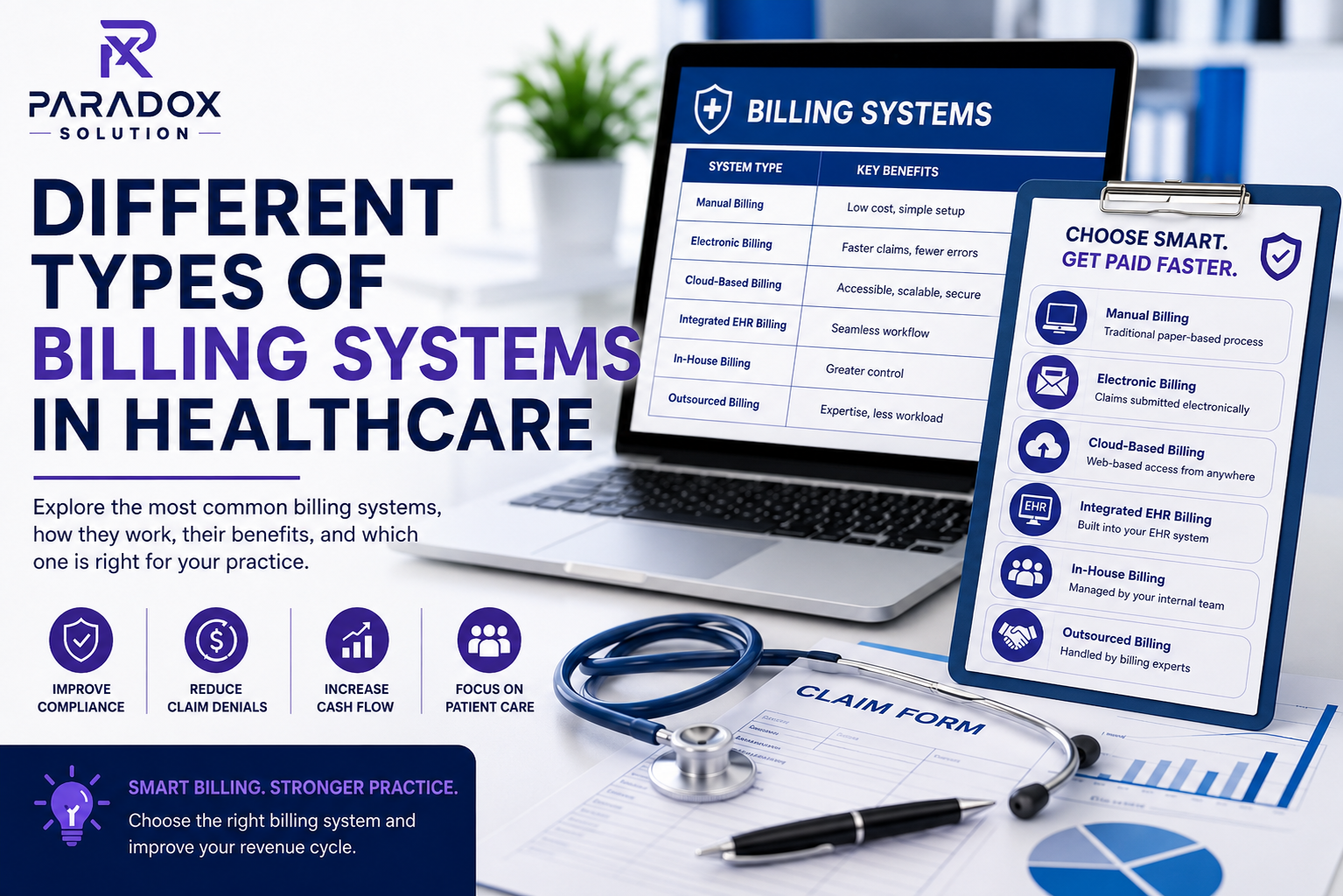
Different Types of Billing Systems in Healthcare
Running a successful medical practice takes more than providing great patient care. The way you bill insurance companies and patients directly affects your cash flow, claim approval rate, and overall financial health. Understanding the different types of billing systems in healthcare helps you choose a process that saves time, reduces billing mistakes, and keeps revenue moving consistently.
Whether you manage a small family clinic, a growing specialty practice, or a large healthcare organization, the billing system you use should match your workflow and patient volume. Some practices still rely on traditional methods, while others have moved to cloud based automation that speeds up reimbursements and improves accuracy. In this guide, we will explain every major billing system, compare their strengths and weaknesses, discuss real world use cases, and help you decide which option fits your organization best.
Why Healthcare Billing Systems Matter
Billing is much more than sending invoices.
Every patient visit creates financial information that must move through several stages before payment arrives. A good billing system helps practices:
-
- Submit accurate claims
-
- Reduce coding mistakes
-
- Track unpaid claims
-
- Speed up reimbursements
-
- Improve patient satisfaction
-
- Meet payer compliance requirements
-
- Maintain complete financial records
Even small billing errors can delay payment for weeks or months.
What Is a Healthcare Billing System?
A healthcare billing system is the process and software used to create, manage, submit, and monitor medical claims for services provided to patients.
It connects several important functions, including:
-
- Patient registration
-
- Insurance verification
-
- Medical coding
-
- Charge entry
-
- Claim submission
-
- Payment posting
-
- Denial management
-
- Patient billing
-
- Financial reporting
Modern systems combine many of these functions into one platform.
Main Different Types of Billing Systems in Healthcare
Healthcare organizations use several billing models depending on their size, specialty, and financial goals.
Comparison Table
| Billing System | Best For | Automation Level | Cost | Complexity |
|---|---|---|---|---|
| Manual Billing | Small clinics | Low | Low | High workload |
| Electronic Billing | Most practices | Medium | Moderate | Easy |
| Cloud Based Billing | Growing practices | High | Subscription | Low |
| Integrated EHR Billing | Hospitals and large groups | Very High | Higher | Medium |
| Outsourced Billing | Busy practices | Very High | Percentage based | Very Easy |
| In House Billing | Organizations with billing teams | Medium to High | Staff dependent | Medium |
1. Manual Billing System
Manual billing is the oldest billing method.
Staff members prepare claims using paper forms or simple spreadsheets before submitting them to insurance companies.
Although some very small clinics still use manual billing, it has become uncommon.
Advantages
| Pros | Explanation |
|---|---|
| Low startup cost | Minimal software investment |
| Easy for very small practices | Works with limited patient volume |
| Full control | Everything stays inside the practice |
Disadvantages
| Cons | Impact |
|---|---|
| Slow claim processing | Delayed payments |
| More human errors | Increased denials |
| Time consuming | Heavy staff workload |
| Limited reporting | Harder financial analysis |
Real World Example
A solo physician seeing fewer than fifteen patients each day may manage manual billing temporarily, but growth quickly makes the process inefficient.
2. Electronic Billing System
Electronic billing replaces paper claims with digital claim submission.
Today, this is considered the standard across healthcare.
Claims move electronically through clearinghouses before reaching insurance companies.
Benefits
-
- Faster reimbursement
-
- Lower claim rejection rates
-
- Better claim tracking
-
- Less paperwork
-
- Improved compliance
Typical Workflow
| Step | Action |
|---|---|
| Patient Visit | Services documented |
| Medical Coding | CPT and ICD codes assigned |
| Claim Creation | Electronic claim generated |
| Clearinghouse Review | Errors identified |
| Insurance Submission | Claim sent electronically |
| Payment Processing | Reimbursement received |
Electronic billing dramatically reduces delays compared to paper claims.
3. Cloud Based Billing Systems
Cloud based billing has become one of the fastest growing options.
Instead of installing software on office computers, practices access billing through secure internet platforms.
Why Many Practices Prefer Cloud Systems
-
- Automatic updates
-
- Remote access
-
- Better security
-
- Lower hardware costs
-
- Easier backups
-
- Faster implementation
Advantages and Challenges
| Advantages | Challenges |
|---|---|
| Accessible anywhere | Internet required |
| Automatic software updates | Monthly subscription |
| Strong data backup | Vendor dependency |
| Easy scalability | Staff training |
For growing practices, cloud billing often provides the best balance between flexibility and affordability.
4. Integrated Electronic Health Record Billing Systems
Many Electronic Health Record systems include built in billing.
Instead of entering patient information twice, clinical documentation flows directly into billing.
Major Benefits
-
- Fewer duplicate entries
-
- Better coding accuracy
-
- Faster charge capture
-
- Improved communication
-
- Reduced administrative work
Example
After a physician completes patient documentation, diagnosis codes automatically move into the billing module, reducing manual work.
5. In House Billing Systems
Some healthcare organizations maintain their own billing department.
Everything from coding to collections stays inside the organization.
Best For
-
- Medium practices
-
- Large physician groups
-
- Hospitals
-
- Multi specialty clinics
Pros and Cons
| Pros | Cons |
|---|---|
| Greater control | Higher staffing costs |
| Immediate communication | Requires ongoing training |
| Internal oversight | Software expenses |
| Custom workflows | Staff turnover challenges |
6. Outsourced Medical Billing
Instead of hiring internal billing staff, practices partner with professional billing companies.
The billing company manages claims from submission through payment collection.
Benefits
-
- Lower staffing burden
-
- Experienced billing specialists
-
- Better denial management
-
- Faster collections
-
- Access to reporting
Possible Drawbacks
-
- Monthly service fees
-
- Less direct control
-
- Need for strong communication
-
- Vendor selection matters
Real Practice Example
A busy orthopedic clinic with increasing claim denials hired an experienced billing company. Within several months, claim turnaround improved because certified billing specialists focused on correcting coding issues before submission.
Billing Systems by Practice Size
| Practice Type | Recommended Billing System |
|---|---|
| Solo Practice | Cloud based billing |
| Family Clinic | Electronic billing |
| Specialty Practice | Integrated billing |
| Large Medical Group | In house billing |
| Hospital | Enterprise integrated system |
| Rapidly Growing Clinic | Outsourced billing or cloud platform |
Features Every Modern Billing System Should Include
Not every billing platform offers the same functionality.
Here are features worth looking for.
| Feature | Why It Matters |
|---|---|
| Electronic claim submission | Faster reimbursements |
| Eligibility verification | Fewer insurance surprises |
| Payment posting | Accurate financial records |
| Denial management | Recover lost revenue |
| Patient statements | Better collections |
| Reporting dashboard | Financial visibility |
| Audit tracking | Compliance support |
| Security controls | Patient privacy |
Cost Comparison
Actual pricing varies depending on practice size and software provider.
| Billing Option | Typical Cost Structure |
|---|---|
| Manual | Minimal software cost but high labor |
| Electronic Software | Monthly subscription |
| Cloud Platform | Monthly per provider or user |
| Integrated System | Higher implementation cost |
| Outsourced Billing | Percentage of collections |
Remember that the cheapest option is not always the most profitable if it causes delayed payments or denied claims.
Common Billing Challenges
Every billing system faces obstacles.
| Challenge | Solution |
|---|---|
| Coding mistakes | Regular staff education |
| Claim denials | Review before submission |
| Missing documentation | Strong provider communication |
| Delayed payments | Daily claim monitoring |
| Insurance changes | Verify eligibility early |
How to Choose the Right Billing System
Every practice has different priorities.
Ask these questions before making a decision.
Patient Volume
A solo practice has different needs than a hospital.
Budget
Consider both startup costs and long term expenses.
Staff Experience
Choose software that matches your team’s skill level.
Integration
Can it connect with your Electronic Health Record?
Reporting
Does it provide useful financial reports?
Support
Responsive customer service can save hours of frustration.
Signs Your Current Billing System Needs Improvement
If you notice these problems, it may be time to upgrade.
-
- Frequent denied claims
-
- Slow reimbursements
-
- Heavy manual data entry
-
- Billing staff overwhelmed
-
- Poor reporting
-
- Rising accounts receivable
-
- Increasing patient billing complaints
These warning signs often point to outdated processes rather than isolated mistakes.
Practical Tips to Improve Billing Performance
Technology alone will not solve every billing problem.
Successful practices also focus on consistent processes.
Verify Insurance Before Every Visit
Coverage changes happen frequently.
Review Claims Before Submission
Catching mistakes early saves time later.
Monitor Key Performance Indicators
Track metrics like:
| KPI | Target |
|---|---|
| Clean Claim Rate | Above 95% |
| First Pass Acceptance | Above 90% |
| Days in Accounts Receivable | Under 40 days |
| Denial Rate | Under 5% |
Train Staff Regularly
Coding rules and payer requirements change often.
Review Financial Reports Monthly
Good reporting helps identify revenue problems before they become serious.
Future Trends in Healthcare Billing
Healthcare billing continues to evolve.
Several trends are shaping the future.
-
- Artificial intelligence assisted claim review
-
- Better automation
-
- Real time eligibility verification
-
- Predictive denial management
-
- Improved patient payment options
-
- Greater interoperability between healthcare systems
-
- Stronger cybersecurity protections
Practices adopting modern technology while maintaining strong billing oversight will likely see better financial performance over time.
Final Thoughts
Choosing among the different types of billing systems in healthcare is not simply about buying software. It is about creating a billing process that supports your patients, your staff, and your long term financial success.
For smaller practices, a cloud based or electronic billing system often provides the right mix of affordability and efficiency. Larger organizations may benefit from integrated platforms or dedicated in house billing teams. Practices that struggle with staffing or persistent claim denials may find outsourcing to experienced billing professionals delivers a better return.
Before making any decision, evaluate your patient volume, budget, workflow, reporting needs, and future growth plans. The right billing system should reduce administrative work, improve claim accuracy, and help your practice collect revenue more consistently.
Frequently Asked Questions
The main types include manual billing, electronic billing, cloud based billing, integrated Electronic Health Record billing, in house billing, and outsourced medical billing. Each option serves different practice sizes and operational needs.
Most small practices benefit from cloud based or electronic billing systems because they reduce paperwork, improve claim accuracy, and require less upfront investment than traditional systems.
Outsourcing can be a smart choice for practices with limited staff, frequent claim denials, or growing patient volumes. It allows billing specialists to manage claims while the practice focuses on patient care.
A strong billing system should offer electronic claim submission, insurance verification, payment posting, denial management, reporting tools, patient billing, security features, and integration with Electronic Health Records.
Improving billing performance starts with verifying insurance before visits, submitting accurate claims, monitoring key performance indicators, training staff regularly, and using a modern billing system that supports automation and detailed reporting.