
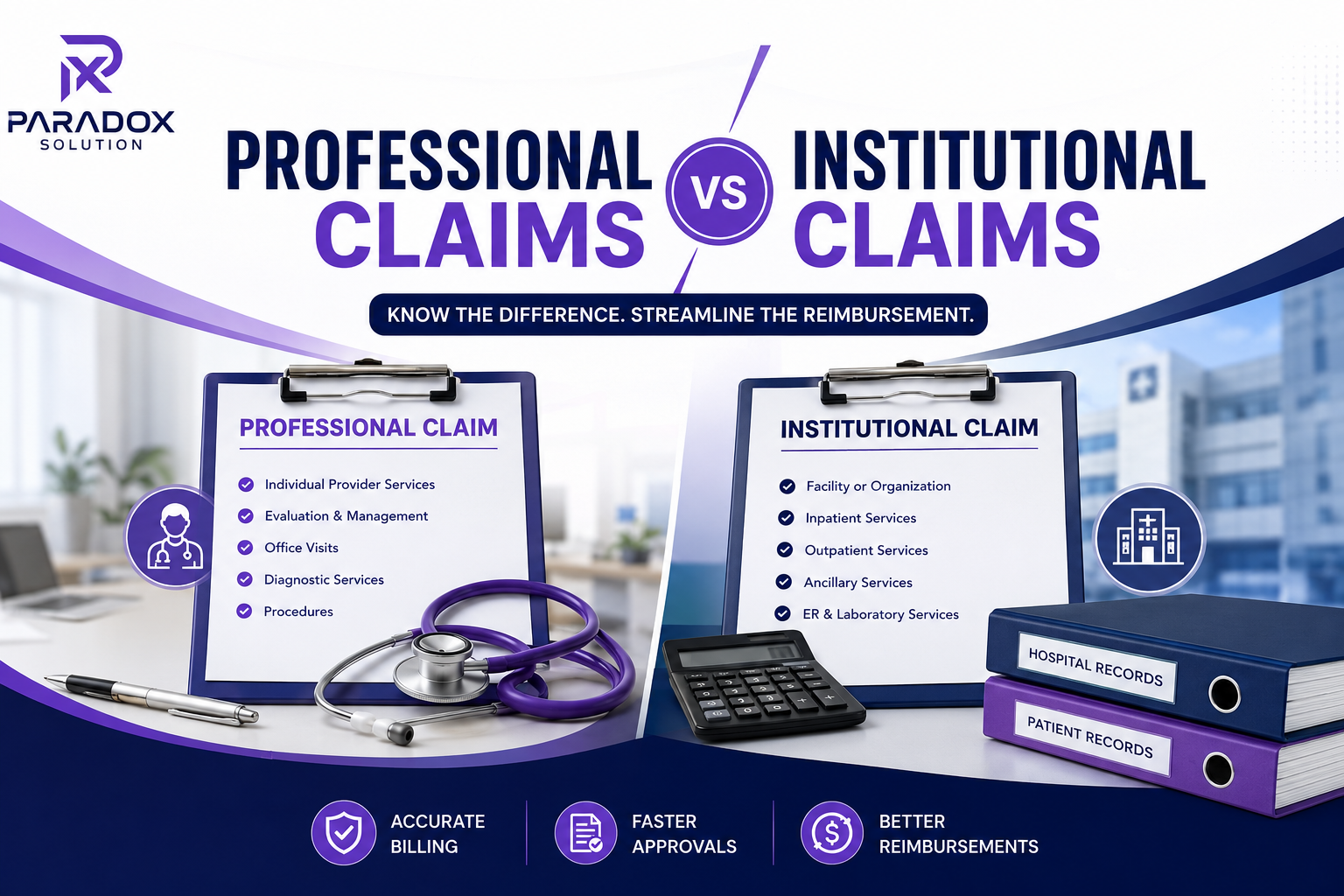
Professional Claims vs Institutional Claims: A Complete Guide for Healthcare Providers
Running a healthcare practice means dealing with much more than patient care. Billing is one of those behind the scenes processes that can either keep your revenue flowing or create endless headaches. One of the first concepts every provider, biller, and practice manager should understand is professional claims vs institutional claims. While they may seem similar, they serve different purposes and follow different billing rules.
Knowing which claim type to submit can reduce denials, speed up reimbursements, and improve your practice’s financial health. Whether you own a private clinic, manage a specialty practice, work in medical billing, or oversee a hospital revenue cycle, understanding these claim types will save time and money.
This guide explains everything in plain English, shares practical examples from real billing situations, and gives you actionable advice that you can actually use.
Why Understanding Claim Types Matters
Medical billing is not simply sending a bill to an insurance company.
Every claim tells a story about the care a patient received. If the wrong type of claim is submitted, insurers may reject it immediately. That means delayed payments, extra administrative work, frustrated staff, and sometimes unhappy patients.
Choosing the correct claim type helps you:
-
- Reduce claim denials
-
- Get paid faster
-
- Improve cash flow
-
- Stay compliant with payer requirements
-
- Reduce billing errors
-
- Build a healthier revenue cycle
Many billing mistakes happen because staff members confuse provider billing with facility billing.
What Is a Professional Claim?
A professional claim is submitted for services performed by an individual healthcare provider.
These claims are commonly used by:
-
- Physicians
-
- Nurse practitioners
-
- Physician assistants
-
- Physical therapists
-
- Mental health professionals
-
- Chiropractors
-
- Independent specialists
The provider bills for their professional expertise rather than the facility where care happened.
Examples include:
-
- Office visits
-
- Annual physical exams
-
- Specialist consultations
-
- Telehealth appointments
-
- Minor procedures
-
- Follow up care
Professional claims are typically submitted using the CMS 1500 claim form.
What Is an Institutional Claim?
Institutional claims are submitted by healthcare facilities rather than individual providers.
These facilities may include:
-
- Hospitals
-
- Skilled nursing facilities
-
- Rehabilitation centers
-
- Home health agencies
-
- Hospice organizations
-
- Outpatient surgery centers
These claims include charges related to the facility itself.
Examples include:
-
- Hospital room charges
-
- Emergency department visits
-
- Laboratory services
-
- Imaging
-
- Operating room fees
-
- Pharmacy services
-
- Medical supplies
Institutional claims are generally submitted using the UB 04 claim form.
Professional Claims vs Institutional Claims: Side by Side Comparison
| Feature | Professional Claim | Institutional Claim |
|---|---|---|
| Submitted by | Individual provider | Healthcare facility |
| Standard form | CMS 1500 | UB 04 |
| Covers | Professional services | Facility services |
| Billing focus | Provider expertise | Facility resources |
| Common users | Clinics and physician offices | Hospitals and medical centers |
| Payment basis | Provider fee schedule | Facility reimbursement |
| Typical codes | CPT and HCPCS | Revenue codes plus CPT and HCPCS where applicable |
Understanding the Difference Through a Real Example
Imagine a patient breaks their wrist.
First, they visit a hospital emergency department.
The hospital submits an institutional claim covering:
-
- Emergency room
-
- X rays
-
- Medical supplies
-
- Nursing care
-
- Facility charges
The orthopedic surgeon submits a separate professional claim for:
-
- Examination
-
- Diagnosis
-
- Fracture treatment
-
- Follow up evaluation
Although the patient experienced one visit, two completely different claims may be submitted.
This often surprises patients who receive separate bills.
CMS 1500 vs UB 04 Forms
These two forms look very different because they collect different information.
| CMS 1500 | UB 04 |
|---|---|
| Individual provider information | Facility information |
| Provider NPI | Facility NPI |
| CPT procedure codes | Revenue codes |
| Diagnosis codes | Diagnosis plus accommodation details |
| Office based billing | Hospital and facility billing |
Understanding which form applies is one of the first skills every medical biller learns.
What Information Appears on a Professional Claim?
Professional claims generally include:
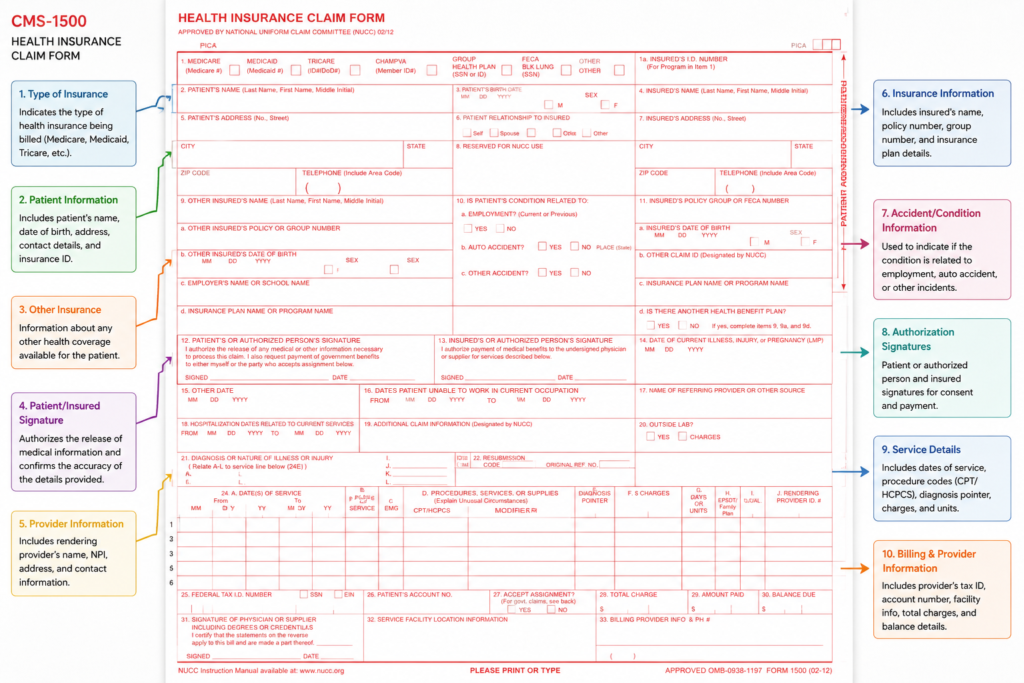
Accuracy matters because even a small typo can delay payment.
What Information Appears on an Institutional Claim?
Institutional claims usually contain additional facility details.
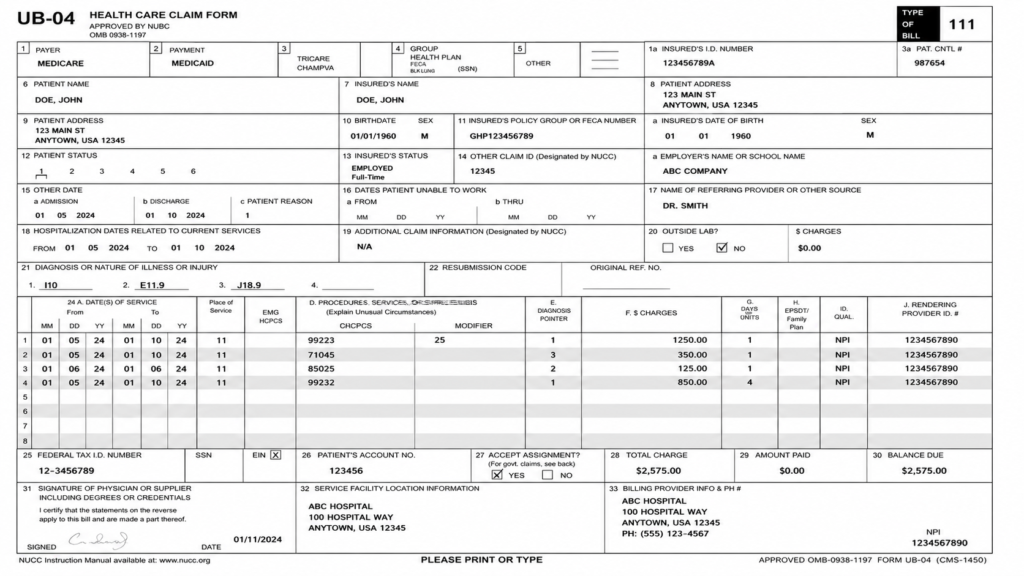
Hospitals submit much more detailed billing because they provide many different services during one patient stay.
Common Coding Differences
| Professional Claims | Institutional Claims |
|---|---|
| CPT codes | Revenue codes |
| HCPCS codes | HCPCS codes |
| ICD diagnosis codes | ICD diagnosis codes |
| Place of service codes | Type of bill codes |
Professional claims emphasize the provider’s work.
Institutional claims emphasize the facility resources used.
Common Billing Mistakes
Even experienced practices occasionally make these mistakes.
Using the Wrong Claim Form
Submitting a CMS 1500 instead of a UB 04 often leads to automatic rejection.
Incorrect Place of Service
Insurance companies compare the location with the services billed.
Mismatch equals denial.
Missing Provider Information
An incorrect NPI can stop payment completely.
Coding Errors
Incorrect CPT or diagnosis coding creates unnecessary delays.
Duplicate Billing
Sometimes both the provider and facility accidentally bill the same service incorrectly.
Routine internal audits help prevent this.
Denials That Often Happen
| Reason | Professional Claim | Institutional Claim |
|---|---|---|
| Invalid provider | Common | Less common |
| Coding mismatch | Very common | Common |
| Missing documentation | Common | Common |
| Duplicate service | Common | Common |
| Incorrect facility information | Rare | Common |
Understanding denial trends helps billing teams improve over time.
Which Providers Use Professional Claims?
Professional claims are commonly submitted by:
-
- Family physicians
-
- Cardiologists
-
- Dermatologists
-
- Dentists
-
- Physical therapists
-
- Occupational therapists
-
- Behavioral health providers
-
- Independent laboratories
-
- Nutritionists
Even providers working inside hospitals may submit separate professional claims depending on payer rules.
Which Organizations Use Institutional Claims?
Institutional claims are common for:
-
- Acute care hospitals
-
- Children’s hospitals
-
- Cancer centers
-
- Inpatient rehabilitation facilities
-
- Long term care facilities
-
- Skilled nursing facilities
-
- Dialysis centers
-
- Hospice agencies
These organizations bill for facility based care rather than individual provider services.
How Insurance Companies Process Each Claim
Professional claims often move through systems focused on provider reimbursement.
Institutional claims go through additional reviews because hospitals bill for many services during one encounter.
This is one reason hospital claims often take longer to process.
Cost Example
The table below shows how two claims may exist for one patient visit.
| Service | Professional Claim | Institutional Claim |
|---|---|---|
| Emergency physician evaluation | Yes | No |
| Hospital emergency room | No | Yes |
| X ray interpretation | Yes | No |
| Radiology department | No | Yes |
| Nursing care | No | Yes |
| Physician consultation | Yes | No |
Patients often assume they were billed twice when they actually received two different categories of services.
Best Practices for Billing Teams
Successful billing departments usually follow consistent processes.
Verify Insurance Early
Insurance verification before the appointment prevents many downstream problems.
Review Documentation
The medical record should support every billed service.
Train Staff Regularly
Billing rules change frequently.
Ongoing education helps reduce avoidable mistakes.
Perform Internal Audits
Monthly reviews can identify trends before they become expensive problems.
Track Denials
Repeated denial reasons usually point to a process that needs improvement.
Checklist Before Submitting Any Claim
| Checklist Item | Completed |
|---|---|
| Patient information verified | ✔ |
| Insurance verified | ✔ |
| Correct claim type selected | ✔ |
| Provider information accurate | ✔ |
| Diagnosis supports procedure | ✔ |
| Documentation complete | ✔ |
| Coding reviewed | ✔ |
| Claim checked for duplicates | ✔ |
Many practices use a checklist like this to reduce preventable denials.
When Both Claim Types Are Needed
Some patient encounters require both claim types.
Examples include:
-
- Hospital surgery
-
- Emergency department visits
-
- Inpatient admissions
-
- Outpatient hospital procedures
-
- Same day surgery
In these situations:
-
- The physician bills professional services.
-
- The hospital bills facility services.
Both claims are valid because they represent different parts of the patient’s care.
Choosing the Right Medical Billing Partner
If your practice outsources billing, ask these questions before signing an agreement.
| Question | Why It Matters |
|---|---|
| Do you handle both claim types? | Prevents billing gaps |
| What is your denial rate? | Shows billing quality |
| How often are claims audited? | Improves accuracy |
| Do you provide reporting? | Helps monitor revenue |
| What specialties do you support? | Experience matters |
The cheapest billing company is not always the most cost effective.
A partner with strong quality controls often improves collections enough to justify a higher fee.
Final Thoughts
Understanding professional claims vs institutional claims is one of the foundations of successful medical billing. While the difference may seem technical at first, it becomes much clearer when you think about who is providing the service. Individual healthcare providers bill for their professional expertise, while healthcare facilities bill for the resources, equipment, staff, and services they provide.
Getting this distinction right reduces denied claims, speeds reimbursement, improves compliance, and creates a smoother experience for both staff and patients. Whether you manage a small physician office or oversee billing for a large healthcare organization, investing time in proper claim education pays dividends through fewer errors and a stronger revenue cycle.