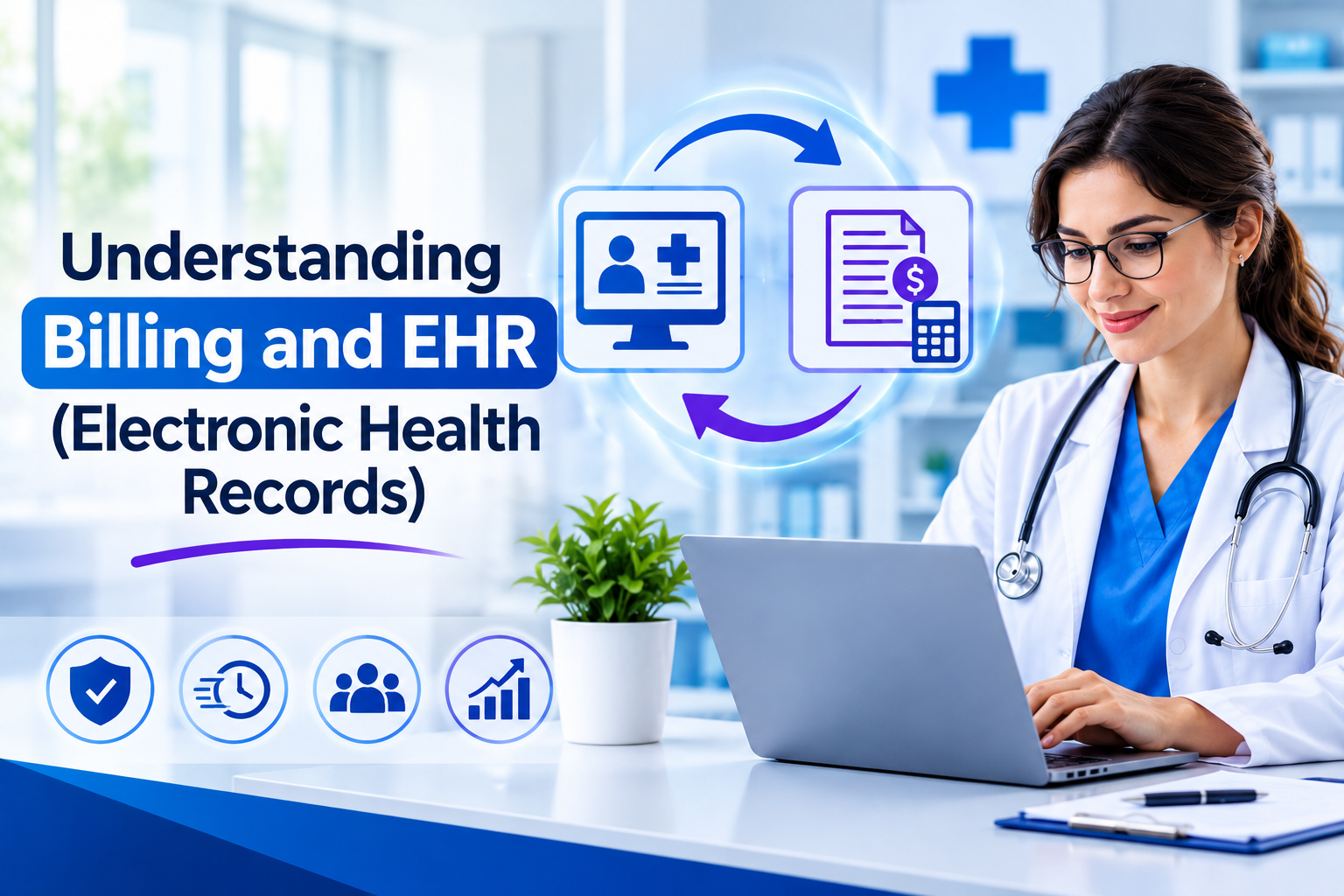
Understanding billing and electronic health records (EHR) starts with one simple idea. Every patient visit creates two streams of information: the clinical story and the financial story. An EHR holds the clinical record, and medical billing turns that record into a claim that gets paid.
When the two systems work together, providers spend less time on paperwork and get paid faster. When they do not, errors pile up and revenue slips away. This guide explains how billing and EHR systems connect, what benefits you can expect, and which challenges to plan for.
Quick answer: Understanding billing and electronic health records (EHR) means knowing that the EHR stores a patient’s clinical data, while billing uses that data (diagnoses, procedures, and insurance details) to create claims and collect payment. Linking the two reduces errors, speeds up reimbursement, and improves the patient experience.
Understanding Billing and EHR Integrations
A billing and EHR integration is a connection that lets clinical data flow into the billing process without manual re-entry. A doctor documents a visit, the system picks up the diagnosis and procedure codes, and a claim is prepared for the insurer. The same data can also feed patient statements and reports.
Some clinics use an all-in-one platform where billing is a built-in module. Others connect a separate billing tool to their EHR through an interface. Either route works, as long as the data moves cleanly between the two.
Here is a simple comparison of the main setups.
| Setup | How it works | Best for | Main drawback |
|---|---|---|---|
| All-in-one EHR with billing module | One system handles charting and billing | Small and mid-size practices | Billing features may be basic |
| EHR connected to a separate billing system | Data moves through an interface or API | Larger or specialty practices | Setup and maintenance cost more |
| EHR with an outsourced billing company | An outside team bills from EHR data | Practices short on staff | Less direct control over the process |
Reducing Paperwork
One of the biggest wins of understanding billing and electronic health records (EHR) together is less paper. When charting and billing share data, staff no longer retype patient details, insurance information, and visit notes into a second system. That saves time and removes a common source of typos.
Digital records also mean fewer printed forms, fewer filing cabinets, and no hunting for a missing chart. Documents can be searched in seconds, which helps during insurance audits and claim appeals.
- Patient demographics are entered once and reused
- Visit notes support the codes used on the claim
- Digital forms and signatures replace paper copies
- Records are easy to find when a payer asks for proof
Resourceful Interoperability
Interoperability is the ability of different health IT systems to exchange and use data. In the context of billing and EHR, it means your charting tool, billing software, lab, pharmacy, and insurance clearinghouse can share information without manual work.
Standards such as HL7 and FHIR make this possible. FHIR, in particular, uses modern web technology, which makes it easier for apps to request and share specific pieces of patient data. In the United States, the 21st Century Cures Act has pushed vendors toward more open data sharing.
For billing, this means eligibility checks, prior authorizations, and claim status updates can happen inside the workflow instead of through phone calls and faxes.
Automation in Billing Processes
When an EHR and billing system are linked, many routine steps can run on their own. Automation handles the repeatable work so staff can focus on exceptions. Common examples include charge capture, code suggestions, claim scrubbing, and payment posting.
Claim scrubbing is especially useful. The software checks a claim for missing fields, mismatched codes, or payer rule violations before it is sent. A clean claim (one with no errors) is far more likely to be paid on the first submission.
- Charge capture: services documented in the chart become billable items automatically
- Eligibility checks: coverage is verified before the visit
- Claim scrubbing: errors are flagged before submission
- Payment posting: insurer remittances are matched to claims
- Denial alerts: rejected claims are flagged for follow-up
Patient Satisfaction Levels
Billing is part of the patient experience, even if it happens after they leave. Clear, accurate bills build trust, while surprise charges and billing mistakes do the opposite. Integrated systems help by showing correct costs, insurance coverage, and balances.
Many platforms also offer patient portals, where people can view statements, pay online, set up payment plans, and see their visit summaries. Fewer billing errors also means fewer confusing phone calls to the front desk.
Tip: Send patients an itemized statement in plain language. Short descriptions and a clear amount due reduce billing questions and late payments.
Improved Analytics
When clinical and financial data live in connected systems, practices can see the full picture. Reports can show denial rates, days in accounts receivable, collection rates, and the most common reasons claims get rejected. These numbers point to specific problems that can be fixed.
Clinical data adds another layer. A practice can compare payer mix, procedure volume, and patient visit trends to plan staffing, pricing, and services. Without integration, this kind of analysis often means exporting spreadsheets and merging them by hand.
| Metric | What it tells you |
|---|---|
| Denial rate | How often payers reject claims |
| Days in accounts receivable | How long it takes to get paid |
| First-pass resolution rate | How many claims are paid without rework |
| Net collection rate | How much of the allowed amount you actually collect |
Challenges in Implementing and Understanding Billing and EHRs
The main challenges in understanding billing and electronic health records (EHR) are cost, data quality, staff training, coding accuracy, and security. These problems are common, but each one has a practical fix.
Upfront and ongoing costs. Software licenses, hardware, setup, data migration, and support add up. Smaller practices should compare total cost over several years, not only the first-year price.
Poor data quality. If patient details, insurance IDs, or codes are entered incorrectly, the error travels through the entire system. Simple front-desk checks and required fields can prevent many problems.
Training and resistance to change. Clinicians and staff may feel slowed down at first. Hands-on training, role-based guides, and a go-live support plan make the switch smoother.
Coding and documentation gaps. Claims rely on accurate ICD-10 diagnosis codes and CPT procedure codes. If a provider’s notes do not support the code chosen, the claim may be denied or audited. Regular documentation reviews and coder feedback help.
Data security and compliance. Health data is sensitive, and systems must follow HIPAA rules in the United States or similar laws elsewhere. Use role-based access, encryption, audit logs, and regular staff reminders about privacy.
Interoperability gaps. Not every system connects smoothly with every other. Ask vendors which standards and clearinghouses they support before you sign a contract.
Key takeaway: Most billing and EHR problems come from people and process, not only software. Good training and clean data habits matter as much as the platform you choose.
Final Words
Understanding billing and electronic health records (EHR) comes down to seeing them as one connected workflow. The EHR captures what happened during care, and billing turns that into payment. When they share data, practices save time, make fewer mistakes, and give patients a clearer experience.
The path is not free of obstacles, but careful vendor selection, solid training, and regular data checks go a long way. Start by mapping how information moves in your practice today, then fix the weakest link first.
Frequently Asked Questions
-
What is the difference between an EHR and medical billing software?
An EHR stores a patient's clinical information, such as history, diagnoses, medications, lab results, and visit notes. Medical billing software uses selected details from that record to prepare claims, track payments, and manage patient balances. Many systems combine both functions in one platform.
-
How does an EHR help with medical billing?
An EHR helps billing by capturing services, diagnoses, and patient details at the point of care. This data can feed directly into claims, which reduces manual entry and coding errors. It also keeps documentation on hand if an insurer asks for supporting records.
-
Why do billing errors happen when EHR and billing systems are not connected?
When systems are separate, staff must re-enter data by hand. That increases the chance of typos, missed charges, and mismatched codes. Each mistake can lead to a denied claim, a delayed payment, or a confused patient.
-
Is understanding billing and electronic health records (EHR) important for small practices?
Yes. Small practices often have limited staff, so lost time and denied claims hurt more. A connected setup lets a small team handle charting, billing, and patient statements with less effort.
-
What is interoperability in healthcare billing?
Interoperability is the ability of different systems to exchange and use data accurately. In billing, it lets an EHR, clearinghouse, payer, and patient portal share information such as eligibility, claim status, and payments without manual steps.
-
Can EHR data be used for revenue cycle analytics?
Yes. When clinical and billing data are connected, practices can track denial rates, collection rates, payer trends, and days in accounts receivable. These insights help find revenue leaks and improve planning.
-
What should I look for when choosing an EHR with billing features?
Look for ease of use, claim scrubbing, eligibility checks, clearinghouse support, patient portal options, strong reporting, and HIPAA-compliant security. Also ask about training, support, and total cost over time.