
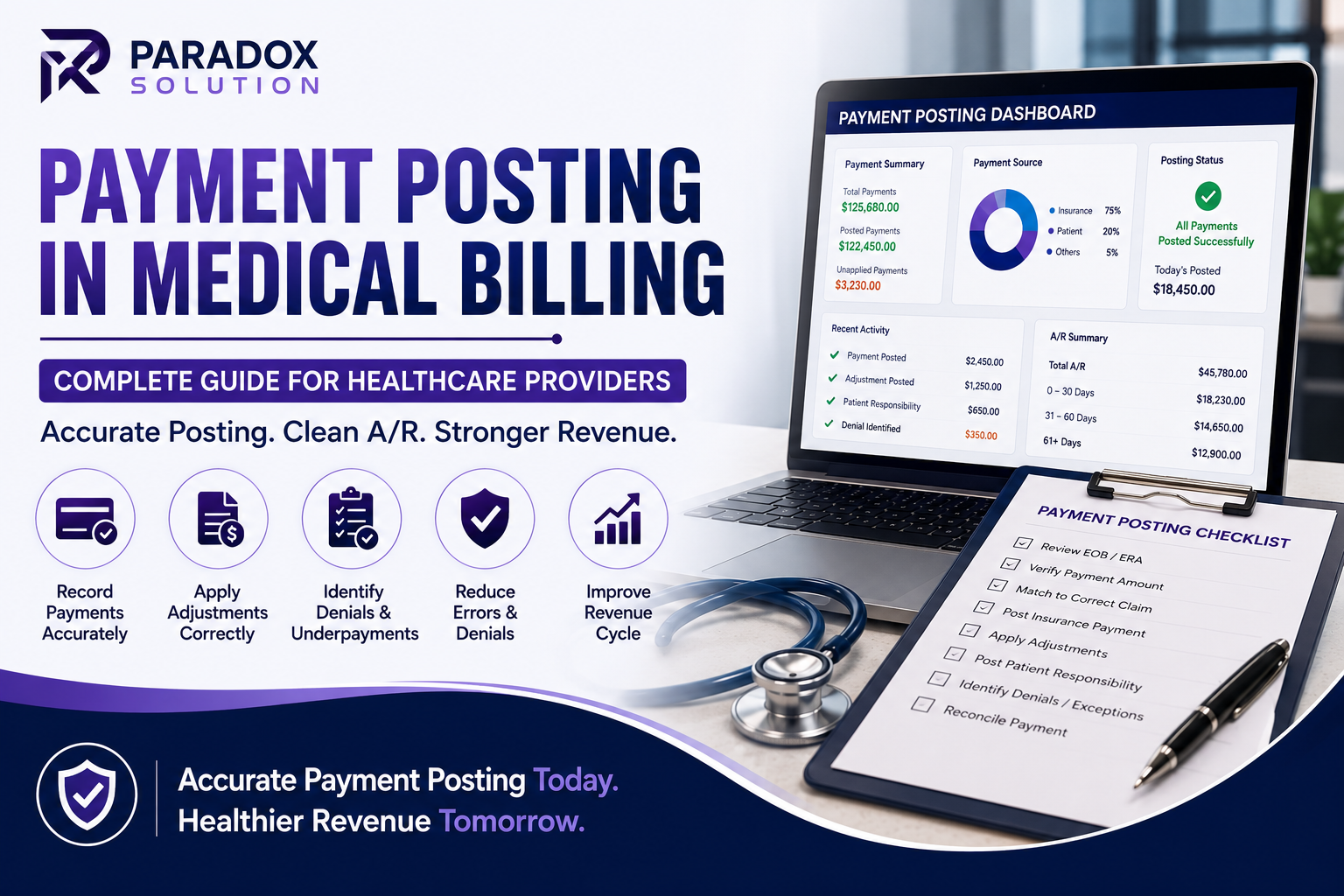
What Is Payment Posting in Medical Billing?
Payment posting in medical billing is the process of recording insurance payments, patient payments, contractual adjustments, and remaining balances in a healthcare provider’s billing system after a claim has been processed.
It is an important part of the medical billing and revenue cycle management (RCM) process. Payment posting tells a practice what the insurance company actually paid, what amount was adjusted, what the patient owes, and whether any part of the claim needs further follow-up.
For example, if a provider bills $500 and the insurance payer allows $350, pays $280, and assigns $70 to the patient, the billing team must accurately record each amount. If the payment is posted incorrectly, the patient’s balance and the practice’s accounts receivable (A/R) can become inaccurate.
Why Is Payment Posting Important in Medical Billing?
Payment posting is more than entering a payment into software. It provides an accurate picture of the financial outcome of submitted claims.
Proper payment posting helps healthcare practices:
-
- Maintain accurate patient balances
-
- Track insurance reimbursements
-
- Apply contractual adjustments correctly
-
- Identify denied claims
-
- Detect underpayments
-
- Track patient responsibility
-
- Maintain accurate A/R
-
- Reconcile daily deposits
-
- Identify unpaid claims
-
- Improve overall revenue cycle performance
When payments are posted late or incorrectly, billing teams may have difficulty determining which claims still require action.
How Does the Payment Posting Process Work?
The payment posting process in medical billing generally follows several steps.
1. Receive the Payment
Payments may come from insurance companies, government payers, patients, or other sources.
Common payment methods include:
-
- Electronic Funds Transfer (EFT)
-
- Electronic Remittance Advice (ERA)
-
- Paper checks
-
- Credit card payments
-
- Patient portal payments
2. Review the EOB or ERA
The billing specialist reviews the Explanation of Benefits (EOB) or Electronic Remittance Advice (ERA).
These documents provide important information such as:
-
- Amount billed
-
- Allowed amount
-
- Insurance payment
-
- Contractual adjustment
-
- Deductible
-
- Copayment
-
- Coinsurance
-
- Patient responsibility
-
- Denial or adjustment information
The payment should not be posted based only on the check or deposit amount. The remittance details should also be reviewed.
3. Match the Payment to the Correct Claim
The payment must be matched to the correct:
-
- Patient
-
- Date of service
-
- Provider
-
- Claim
-
- Procedure
This becomes especially important when an insurance company sends one payment covering multiple claims.
4. Post the Insurance Payment
The actual amount paid by the insurance company is entered into the practice management or billing system.
The payment may need to be allocated across individual procedures depending on how the payer processed the claim.
5. Apply Contractual Adjustments
A contractual adjustment represents an amount that the provider is not allowed to collect because of the applicable payer agreement.
For example:
| Claim Detail | Amount |
|---|---|
| Billed Amount | $500 |
| Allowed Amount | $350 |
| Insurance Payment | $280 |
| Contractual Adjustment | $150 |
| Patient Responsibility | $70 |
The actual amounts and adjustment treatment depend on the payer’s adjudication and the provider’s contractual terms.
6. Post Patient Responsibility
If the payer assigns an amount to the patient, such as a deductible, copayment, or coinsurance, that amount should be posted to the patient’s account according to the EOB or ERA.
7. Identify Denials and Exceptions
Payment posting can also reveal claims that were not paid as expected.
Examples include:
-
- Claim denials
-
- Partial payments
-
- Zero-dollar payments
-
- Non-covered services
-
- Authorization issues
-
- Eligibility problems
-
- Coding-related adjustments
-
- Duplicate claim issues
These claims should be routed to the appropriate denial or A/R team for investigation.
8. Reconcile the Payment
The total amount posted should match the actual payment received.
For example, if an EFT deposits $10,000 into the practice’s account, the claims included in that payment should reconcile to the $10,000 deposit.
What Is the Difference Between an EOB and ERA?
An EOB is an Explanation of Benefits that shows how an insurance company processed a claim. An ERA is an Electronic Remittance Advice that provides similar information electronically.
| EOB | ERA |
|---|---|
| Explanation of Benefits | Electronic Remittance Advice |
| May be paper or electronic | Electronic transaction |
| Often reviewed manually | Can be electronically imported |
| Shows payment and adjustment details | Contains standardized payment information |
Many modern billing systems can use ERA files to automate routine payment posting.
What Is ERA Payment Posting?
ERA payment posting uses electronic remittance information to post insurance payments into a medical billing system.
A typical process looks like this:
Insurance processes claim → ERA is generated → ERA is received → Payment is matched → Payment is posted → Adjustments are applied → Patient balance is updated
Automated posting can save considerable time, especially for practices with high claim volumes.
However, automation does not mean every transaction should be accepted without review. Exceptions, unusual adjustments, unmatched payments, and unexpected reimbursement should still be investigated.
Common Payment Posting Errors
Payment posting errors can create problems throughout the revenue cycle.
Posting to the Wrong Patient
A payment may accidentally be applied to the wrong patient account.
Incorrect Date of Service
When a patient has several recent visits, a payment may be posted to the wrong encounter.
Incorrect Contractual Adjustment
An incorrect adjustment can make financial reports and A/R balances inaccurate.
Incorrect Patient Responsibility
If the deductible, copayment, or coinsurance amount is posted incorrectly, the patient may receive an inaccurate statement.
Unapplied Payments
Payments that cannot immediately be matched to a claim should be investigated rather than left unresolved.
Missing Denial Information
If denial information is not captured correctly, a claim may remain unpaid without timely follow-up.
How Does Payment Posting Affect A/R?
Accurate payment posting is directly connected to accounts receivable management.
Once a claim is paid, the billing team needs to know whether:
-
- The claim was paid in full
-
- The payer underpaid
-
- The claim was denied
-
- The patient owes money
-
- A secondary payer should be billed
-
- Additional follow-up is required
Incorrect payment posting can make an A/R report look better or worse than it actually is.
For example, if a $1,000 claim is posted as fully paid when $200 is actually still outstanding, the practice may fail to follow up on that $200.
How Can Practices Improve Payment Posting Accuracy?
Healthcare providers can improve payment posting by creating a standardized workflow.
Post Payments Promptly
Delayed posting can make patient accounts and A/R reports outdated.
Reconcile Payments Regularly
Compare posted transactions with bank deposits, checks, and EFTs.
Monitor Unapplied Cash
Unapplied payments should be investigated and resolved promptly.
Review Exceptions
Automated posting should be monitored for unusual or unmatched transactions.
Audit Posted Payments
Regular audits can identify recurring errors and training opportunities.
Track Denials and Underpayments
Payment posting data can help identify patterns that require additional A/R follow-up.
Manual vs. Automated Payment Posting
| Manual Posting | Automated Posting |
|---|---|
| More data entry | Less repetitive data entry |
| Usually slower | Usually faster |
| Higher risk of repetitive-entry errors | Can reduce routine-entry errors |
| Useful for exceptions | Useful for high-volume transactions |
| Requires more staff time | Requires proper system setup |
For many practices, a combination of automation and experienced billing staff provides the best results.
When Should a Practice Outsource Payment Posting?
A practice may consider outsourcing payment posting when it experiences:
-
- High claim volume
-
- Delayed payment posting
-
- Growing A/R
-
- Frequent posting errors
-
- Large unapplied payment balances
-
- Limited billing staff
-
- Difficulty processing ERAs
-
- Inconsistent payment reconciliation
A medical billing company can manage payment posting as part of a broader RCM service. Before selecting a billing partner, practices should evaluate its experience, accuracy controls, reporting, turnaround time, security practices, and denial-management capabilities.
Payment Posting Best Practices
For a reliable payment posting workflow, healthcare practices should:
-
- Post payments promptly.
-
- Review every EOB or ERA carefully.
-
- Match payments to the correct patient and claim.
-
- Apply adjustments accurately.
-
- Verify patient responsibility.
-
- Monitor denials and underpayments.
-
- Resolve unapplied payments.
-
- Reconcile payments regularly.
-
- Audit posting accuracy.
-
- Use automation while reviewing exceptions manually.
These practices help keep the billing system accurate and make A/R follow-up more effective.
Frequently Asked Questions
Payment posting in medical billing is the process of recording insurance payments, patient payments, adjustments, and remaining balances in a healthcare billing system.
It helps practices maintain accurate patient accounts, A/R reports, reimbursement records, and financial information.
An ERA, or Electronic Remittance Advice, is an electronic transaction that provides information about how an insurance payer processed a claim.
Yes. Many billing systems support automated ERA payment posting. However, exceptions and unusual transactions should still be reviewed.
Yes. Accurate payment posting allows billing teams to compare actual reimbursement with expected reimbursement and investigate potential underpayments.