
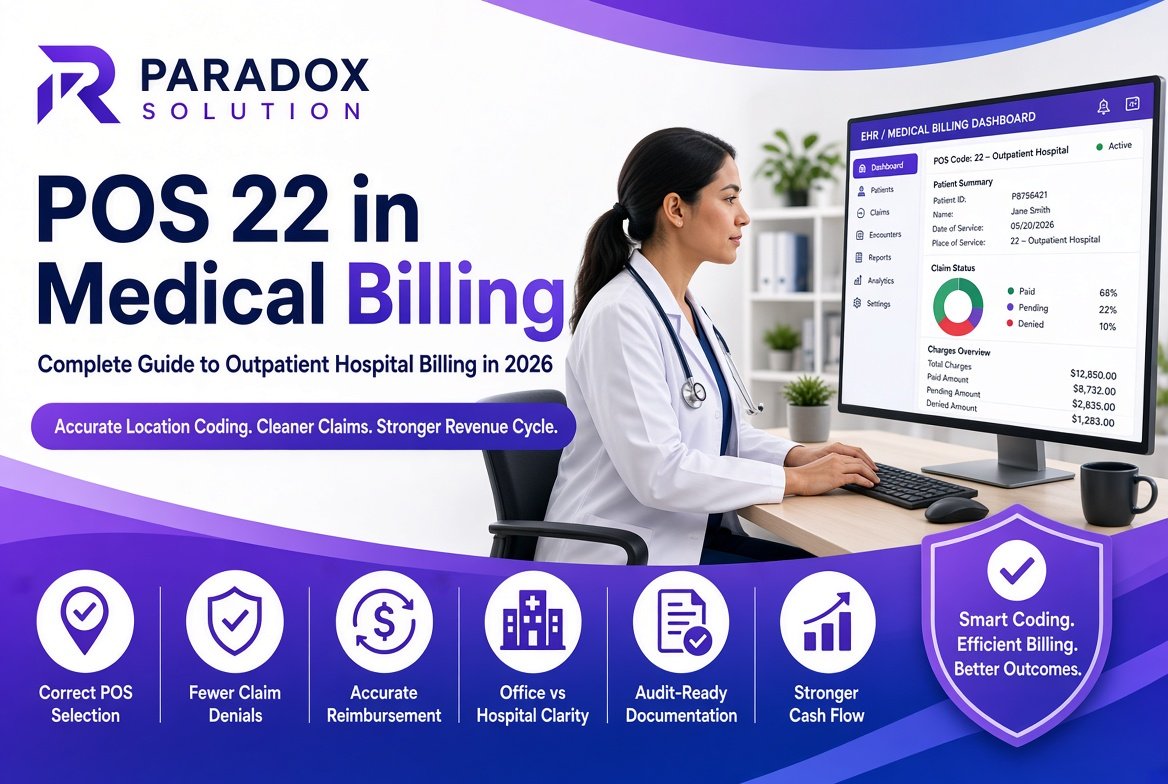
Healthcare reimbursement depends on more than just choosing the correct CPT and ICD-10 codes. The Place of Service (POS) code also plays an important role in how a claim is processed and reimbursed. One of the most commonly misunderstood codes is POS 22, which identifies services provided in an outpatient hospital setting.
For healthcare providers, medical billing teams, and revenue cycle managers, using the correct POS code is essential. A simple location coding error can lead to claim denials, incorrect reimbursement, payment delays, or unnecessary claim rework.
As more healthcare services move into hospital outpatient departments, understanding POS 22 in medical billing has become increasingly important. This guide explains what POS 22 means, when to use it, how it differs from other POS codes, how it can affect reimbursement, and how billing teams can avoid common errors.
What Is POS 22 in Medical Billing?
POS 22, Outpatient Hospital, is a Place of Service code used on professional healthcare claims when services are provided in an outpatient hospital setting.
In simple terms, POS 22 tells the payer that the patient received care at a hospital outpatient department but was not admitted as an inpatient.
Examples can include outpatient specialty clinics, hospital based diagnostic departments, infusion centers, outpatient surgery departments, and other hospital outpatient locations.
When a physician provides professional services in this setting, the physician or other qualified healthcare professional generally submits a professional claim for their services. The hospital may separately submit a facility claim for the resources and services provided by the facility.
This distinction is important because facility and non facility settings can be reimbursed differently.
Why Is POS 22 Important?
Place of Service coding helps insurance companies determine where a service was performed. Payers use this information when applying reimbursement rules, coverage policies, claim edits, and payment methodologies.
Using POS 22 correctly can help:
- Support accurate reimbursement
- Reduce claim denials
- Prevent incorrect payments
- Maintain accurate billing records
- Support documentation during audits
- Reduce unnecessary claim corrections
- Improve overall revenue cycle performance
For medical billing companies and healthcare organizations, POS verification should be part of the normal claim review process rather than something addressed only after a denial occurs.
When Should POS 22 Be Used?
POS 22 should generally be reported when a covered professional service is performed in a hospital outpatient department and the patient has not been admitted as an inpatient.
Common examples include:
- Hospital outpatient specialty visits
- Outpatient cardiology services
- Oncology and infusion services
- Hospital outpatient surgery
- Outpatient diagnostic services
- Hospital based rehabilitation
- Certain outpatient procedures
- Services provided in hospital outpatient departments
The most important consideration is the actual place where the service was provided and the applicable payer requirements.
A provider may work at several locations during the same week. A physician who sees one patient in a private office and another patient in a hospital outpatient department may need to report different POS codes for those encounters.
POS 22 vs POS 11: What Is the Difference?
One of the most common POS coding mistakes is confusing POS 22 with POS 11.
POS 11 represents an office setting, while POS 22 represents an outpatient hospital setting.
| Category | POS 11: Office | POS 22: Outpatient Hospital |
|---|---|---|
| Setting | Physician or professional office | Hospital outpatient department |
| Facility involvement | Generally no separate hospital facility claim | Hospital may bill facility services separately |
| Payment methodology | Non facility considerations may apply | Facility setting considerations may apply |
| Common example | Independent physician office | Hospital outpatient clinic |
| Admission | Not applicable | Patient is not admitted as inpatient |
The same physician and even the same CPT code can have different payment implications depending on the reported POS.
This is why billing staff should never select POS 11 simply because it is the provider’s usual location.
POS 22 vs POS 21
POS 22 should also be distinguished from POS 21, Inpatient Hospital.
The major difference is the patient’s status.
With POS 22, the patient is receiving outpatient care and has not been formally admitted as an inpatient.
With POS 21, the service is associated with an inpatient hospital setting.
For example, a patient receiving an outpatient procedure at a hospital may have a claim reported with POS 22. If the patient has been formally admitted as an inpatient, the appropriate POS may instead be POS 21, depending on the service and applicable billing rules.
Billing teams should verify the patient’s status rather than assuming that every service performed inside a hospital should use POS 22.
How POS 22 Can Affect Reimbursement
POS coding can directly affect how a payer processes a professional claim.
When services are provided in a facility setting, the professional component may be reimbursed differently from services performed in a non facility setting. The hospital may also submit a separate claim for facility services.
Incorrect POS reporting can therefore create several problems.
For example, reporting POS 11 when a service was actually performed in a hospital outpatient department may result in incorrect payment. On the other hand, incorrectly reporting POS 22 for a service performed in an independent physician office can cause reimbursement issues or claim edits.
The financial impact may include:
- Underpayments
- Overpayments
- Claim denials
- Payment delays
- Incorrect patient balances
- Additional claim corrections
- Payer recoupments
Because of these risks, POS accuracy should be treated as both a coding issue and a revenue cycle issue.
Documentation Requirements for POS 22
Accurate documentation is an important part of supporting POS coding.
The medical record and billing information should be consistent and should support the location where the service was provided.
Depending on the service and payer requirements, documentation may include:
- Date of service
- Rendering provider
- Service location
- Patient status
- Services performed
- Diagnosis information
- Medical necessity
- Relevant clinical documentation
Billing teams should also compare information across the EHR, scheduling system, provider location records, and claim before submission when appropriate.
A mismatch between the documented location and the POS code can create unnecessary questions during payer review.
Common POS 22 Billing Mistakes
1. Using POS 11 Instead of POS 22
This often happens when a provider works at multiple locations. If the billing system automatically defaults to POS 11, staff may overlook the actual service location.
2. Assuming Every Hospital Owned Practice Uses POS 22
Hospital ownership alone does not necessarily determine the correct POS code. The billing team should verify the actual setting and applicable payer requirements.
3. Ignoring Patient Admission Status
An outpatient encounter can become more complicated when a patient is admitted. Billing teams should verify the patient’s status and the timing of services before submitting claims.
4. Relying on Old Billing Rules
Payer policies and coding requirements can change. Billing teams should regularly review current payer guidance instead of relying entirely on historical practices.
5. Failing to Coordinate Professional and Facility Billing
Hospital outpatient services may involve both professional and facility claims. Poor coordination can create inconsistencies between the two billing processes.
How to Reduce POS 22 Denials
A strong billing process can prevent many POS related claim problems before they reach the payer.
Healthcare organizations should consider the following practices:
Verify the service location: Make sure the actual location of the encounter matches the POS reported on the claim.
Use claim scrubbing: Automated claim validation can identify potential POS inconsistencies before submission.
Review provider locations: Maintain accurate provider location information in the billing and practice management systems.
Train billing staff: Regular education helps staff understand the difference between office, outpatient hospital, inpatient, and other POS codes.
Audit claims: Periodic internal audits can identify recurring POS errors and help prevent future problems.
Monitor denials: Analyze POS related denials to determine whether the problem comes from documentation, system configuration, payer policy, or staff workflow.
How Paradox Solution Supports Medical Billing Accuracy
Managing medical billing across multiple providers, locations, specialties, and payers can become complicated quickly. Place of Service errors are just one part of the larger revenue cycle challenge.
Paradox Solution helps healthcare organizations improve their medical billing operations through reliable revenue cycle support designed around accuracy, timely claim submission, denial prevention, and consistent follow up.
Our medical billing services can support healthcare practices with:
- Medical coding and billing support
- Eligibility and benefits verification
- Claims submission and follow up
- Denial management
- Payment posting
- Accounts receivable management
- Insurance verification
- Claim review and correction
- Revenue cycle management support
Our team works to identify billing issues early so providers can spend less time dealing with administrative problems and more time focusing on patient care.
If your organization is experiencing recurring denials, delayed payments, or billing inconsistencies, reviewing your POS coding process can be a good place to start.
Final Thoughts
Understanding POS 22 in medical billing is essential for providers, coders, billers, and revenue cycle teams working with hospital outpatient services.
POS 22 indicates that professional services were provided in an outpatient hospital setting. Because the place of service can influence claim processing and reimbursement, selecting the correct code is an important part of accurate medical billing.
The best approach is to verify the actual service location, confirm patient status, maintain appropriate documentation, and regularly review payer requirements.
With strong billing processes, regular audits, staff training, and reliable revenue cycle support, healthcare organizations can reduce avoidable POS related errors and improve overall billing performance.
Need help improving your medical billing and revenue cycle process? Partner with Paradox Solution for professional medical billing and RCM support.