Benefits of EHR System in Medical Billing Processing: A Practical Guide
Medical billing depends on accurate patient information, complete documentation, correct coding, and timely claim submission. When these steps are handled manually or through disconnected systems, even a small mistake can lead to a rejected claim, delayed payment, or additional work for the billing team.
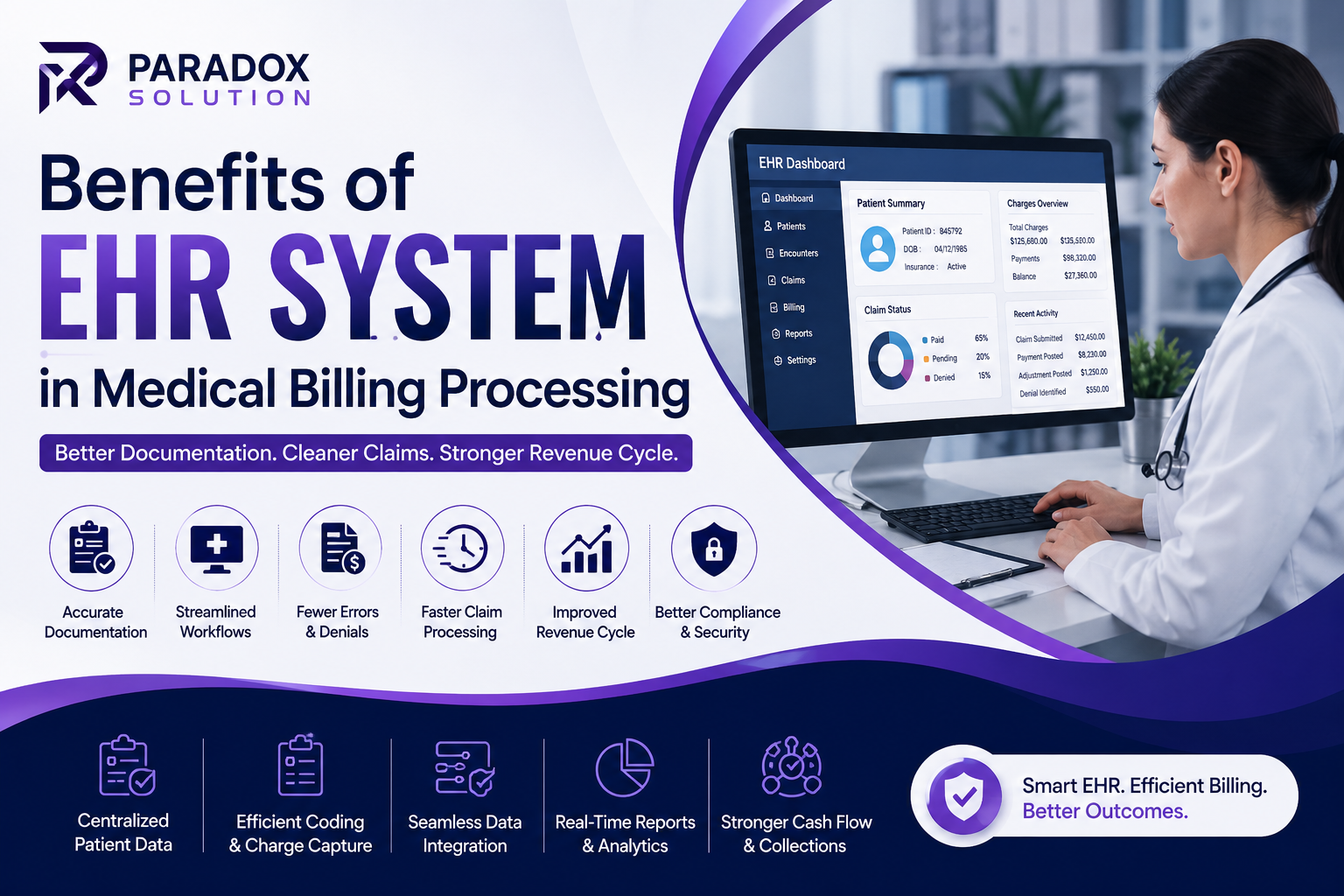
This is where an Electronic Health Record (EHR) system can make a real difference. The benefits of EHR system in medical billing processing go beyond replacing paper charts. A properly configured EHR can connect patient information, clinical documentation, charge capture, coding, and billing workflows.
The Office of the National Coordinator for Health Information Technology (ONC) explains that EHRs can improve practice efficiency, organize patient information, streamline workflows, and support documentation used for accurate coding and billing.
For medical practices, however, the value of an EHR depends on how effectively it is integrated into the overall revenue cycle.
What Is an EHR System in Medical Billing?
An Electronic Health Record is a digital version of a patient’s medical record. It can contain demographics, medical history, diagnoses, medications, provider notes, test results, insurance information, and other clinical data.
From a billing perspective, the EHR provides important information needed to support the claim.
A typical workflow may look like this:
Patient Registration → Eligibility Verification → Documentation → Coding → Charge Capture → Claim Submission → Payment Posting → A/R Follow-Up
When these steps are connected, billing staff may spend less time manually transferring information between systems.
CMS describes EHRs as systems that can automate access to information and streamline clinical workflows while supporting administrative and care-related activities.
How Does an EHR Improve Medical Billing Accuracy?
One of the major benefits of EHR system in medical billing processing is better access to organized patient documentation.
With paper records, billing staff may have to search through files or contact the provider when information is missing or difficult to read. An EHR keeps the patient’s information in a centralized electronic record that authorized users can access.
Billing teams can review information such as:
-
- Patient demographics
-
- Insurance information
-
- Dates of service
-
- Provider documentation
-
- Diagnoses
-
- Procedures performed
-
- Clinical notes
-
- Orders and test results
Complete and legible documentation gives coders and billers better information to work with. ONC specifically notes that EHR documentation can facilitate accurate coding and billing.
However, an EHR does not automatically make every claim accurate. Staff still need to verify the information and make appropriate coding and billing decisions.
Can EHR Systems Reduce Medical Billing Errors?
Yes, EHRs can reduce certain manual errors by limiting repetitive data entry and keeping information organized.
Consider a practice where staff manually enter the same patient information into several systems. Every additional entry creates an opportunity for a typo, incorrect insurance detail, or inconsistent demographic information.
An integrated EHR can allow information to move electronically between connected workflows.
For example, once a patient’s demographic information is entered, it may be available to other authorized functions rather than requiring staff to re-enter it repeatedly.
Still, automation is not a replacement for human review. Incorrect patient information, outdated insurance details, incomplete provider documentation, and incorrect coding can still create billing problems.
How Does an EHR Help With Coding and Charge Capture?
Accurate medical coding starts with appropriate clinical documentation.
An EHR can organize the provider’s documentation so that coders can review the encounter and determine whether the reported services are supported.
Depending on the system, an EHR may provide:
-
- Structured clinical templates
-
- Diagnosis selection
-
- Procedure documentation
-
- Charge capture
-
- Coding assistance
-
- Documentation prompts
-
- Problem lists
-
- Encounter workflows
These features can make the billing process more organized.
But practices should be careful with automated coding suggestions. A code should reflect what is actually documented and supported. Coders and providers should not rely on software alone to determine whether a service is billable.
Does an EHR Help Reduce Claim Rejections and Denials?
An EHR can help reduce some preventable billing problems, particularly when it is properly configured and connected to the billing workflow.
Many claim problems begin before a claim reaches the payer. Missing information, incomplete documentation, incorrect demographics, and coding errors can all create problems.
An EHR can help billing teams identify information that needs attention before submission.
For example, staff may be able to review:
-
- Missing patient information
-
- Insurance details
-
- Provider information
-
- Diagnosis information
-
- Procedure information
-
- Documentation
-
- Charges
This gives the practice an opportunity to correct issues before they become a larger problem.
It is important to remember that an EHR cannot eliminate all denials. Coverage limitations, authorization requirements, medical necessity issues, payer policies, coding mistakes, and other factors can still result in denials.
The EHR is a tool that supports the billing process—not a substitute for experienced denial management.
How Does EHR Technology Improve Revenue Cycle Management?
Revenue Cycle Management (RCM) covers the financial journey of a healthcare encounter from registration through final payment.
An EHR can support several parts of this process.
| RCM Area | Potential EHR Benefit |
|---|---|
| Registration | Centralized demographic information |
| Eligibility | Access to insurance information |
| Documentation | Organized clinical records |
| Coding | Structured encounter information |
| Charge Capture | Recording services performed |
| Claims | Transfer of billing information |
| A/R Follow-Up | Easier access to encounter details |
| Reporting | Better access to practice data |
The biggest advantage is connectivity. When information moves smoothly between clinical and billing workflows, staff can spend less time searching for information and more time resolving actual revenue cycle problems.
ONC reports that EHRs can streamline provider workflows and contribute to practice efficiencies and cost savings.
Can EHRs Make Medical Billing Faster?
Yes. An EHR can reduce the amount of manual work required to move information through the billing process.
Instead of waiting for paper documentation to reach the billing department, authorized billing staff can often access completed encounters electronically.
This can help the team:
-
- Review completed encounters.
-
- Identify missing information.
-
- Verify charges.
-
- Review documentation.
-
- Prepare claims.
-
- Submit claims through connected systems.
-
- Monitor outstanding billing issues.
The goal should not simply be faster claim submission. The goal is accurate claims submitted without unnecessary delay.
A fast claim containing incorrect information can create more work later.
Why Is EHR Interoperability Important for Medical Billing?
Interoperability allows different healthcare systems to exchange information.
A medical practice may use an EHR, practice management system, clearinghouse, laboratory system, pharmacy system, and other platforms. If these systems cannot communicate effectively, staff may have to manually transfer information.
CMS continues to emphasize secure electronic health information exchange and interoperability among providers, payers, EHRs, and other healthcare participants.
For billing teams, better interoperability can make it easier to access information needed to understand an encounter and support the claim.
However, having an EHR does not automatically mean every system will integrate smoothly. Practices should evaluate interfaces, data exchange, reporting, security, and vendor support before selecting a system.
What Are the Limitations of EHRs in Medical Billing?
EHR technology can improve billing workflows, but it does not solve every revenue cycle problem.
A practice can still experience:
-
- Claim denials
-
- Eligibility errors
-
- Coding mistakes
-
- Missing documentation
-
- Incorrect insurance information
-
- Unbilled encounters
-
- A/R delays
-
- Poor denial follow-up
-
- Interface problems
-
- Staff training issues
There can also be documentation challenges. CMS materials have noted concerns around issues such as interoperability, documentation burden, and billing-system performance.
That is why practices should view an EHR as part of a broader billing strategy.
How Can Practices Get the Most From an EHR?
Start by reviewing the complete revenue cycle rather than looking at the EHR in isolation.
Ask where information is being entered manually, where claims are commonly rejected, which documentation problems occur repeatedly, and where billing staff spend the most time.
Then establish regular checks for:
-
- Missing documentation
-
- Incorrect demographics
-
- Insurance changes
-
- Unbilled encounters
-
- Coding issues
-
- Claim rejections
-
- Denial trends
-
- Aging A/R
-
- Unpaid claims
Staff training is equally important. Even a powerful EHR will not deliver its full value if employees do not understand the correct workflow.
Conclusion: Why EHR Matters in Medical Billing
The benefits of EHR system in medical billing processing are most valuable when clinical documentation and revenue cycle workflows work together.
An EHR can improve access to patient information, support complete documentation, reduce repetitive data entry, streamline charge capture, improve workflow efficiency, and provide billing teams with better information for claim processing.
But technology alone does not create a healthy revenue cycle. Accurate documentation, appropriate coding, eligibility verification, claim review, denial management, payment posting, and A/R follow-up remain essential.
For medical practices, the best EHR is not necessarily the one with the most features. It is the system that fits the practice’s workflow, supports accurate information exchange, integrates effectively with billing tools, and helps staff complete their work efficiently.
When implemented and managed properly, an EHR can become an important part of a cleaner, more organized, and more efficient medical billing process.
Frequently Asked Questions
The main benefits include better documentation, improved data accuracy, reduced manual data entry, streamlined charge capture, faster claim processing, and easier access to information needed for revenue cycle management.
Yes. An EHR can help reduce certain preventable errors by organizing patient information, documentation, diagnoses, and charges. However, it cannot eliminate all denials because payer policies, eligibility issues, medical necessity, authorization requirements, and coding errors can still affect claims.
An EHR keeps patient and clinical information organized electronically and can reduce repetitive manual data entry. Billing staff can access documentation and encounter information more easily, which can help identify missing or inconsistent information before a claim is submitted.
Not always. An EHR primarily manages clinical and patient information, while medical billing software focuses on claims, payments, accounts receivable, and other financial workflows. Some modern platforms combine both functions, while others connect an EHR with separate billing or practice management software.
Yes. When properly integrated with billing systems, an EHR can support several stages of the revenue cycle, including registration, documentation, coding, charge capture, claim submission, and A/R follow-up. The results depend on proper system configuration, staff training, and effective billing processes.