
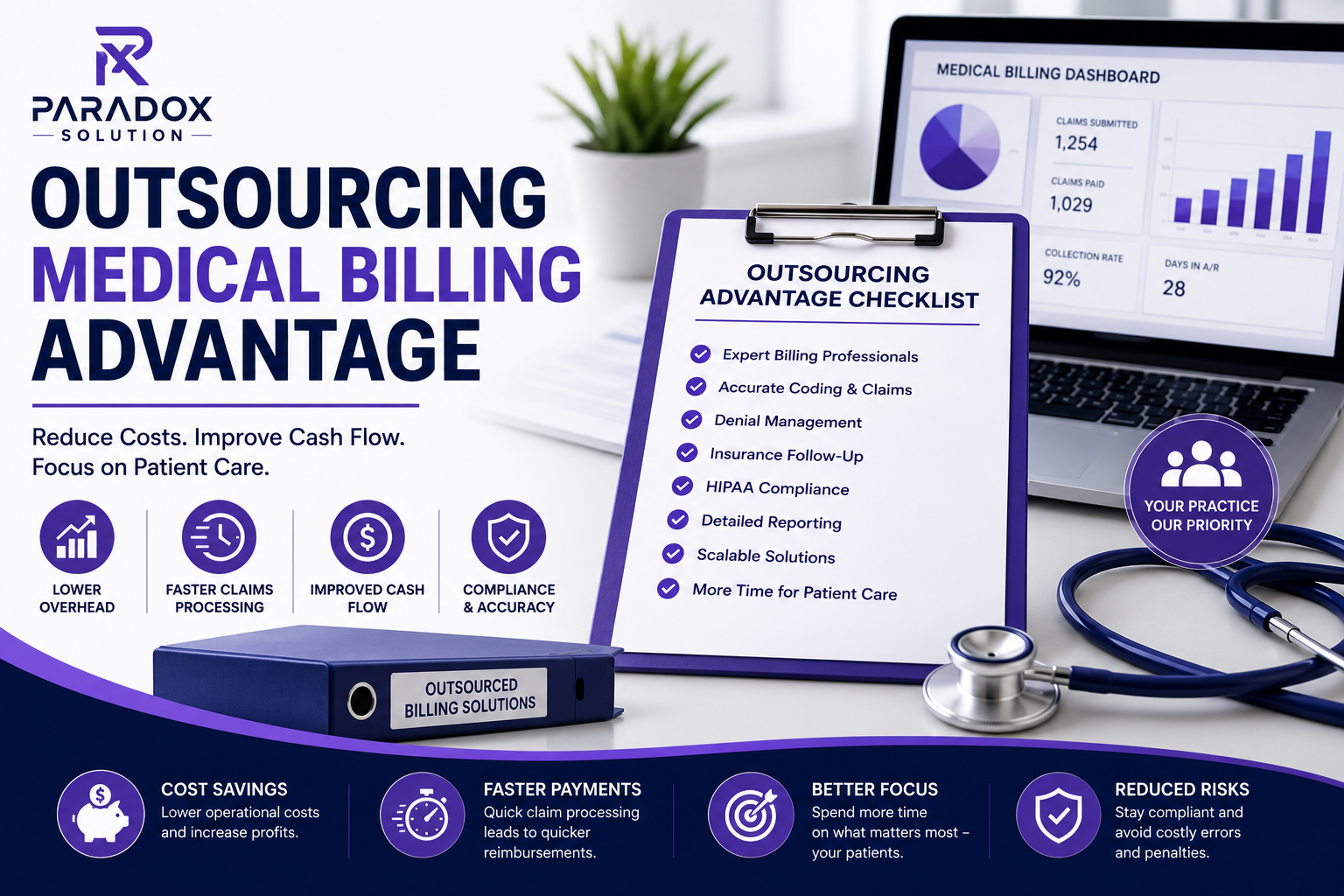
Outsourcing Medical Billing Advantage: Why More Medical Practices Are Making the Switch
Running a successful medical practice is about much more than providing excellent patient care. Every visit creates paperwork, insurance claims, payment follow up, and compliance responsibilities. When billing starts taking too much time, it can slow down your entire practice.
That is why many physicians are discovering the real outsourcing medical billing advantage. Instead of handling claims with an in house team, practices work with experienced billing specialists who manage coding support, claim submission, payment posting, denial management, and insurance follow up. The result is often faster reimbursements, fewer billing mistakes, and more time for patient care.
If you are wondering whether outsourcing is worth the investment, this guide shares practical insights, real examples, and honest advice to help you make the right decision for your practice.
Why Medical Billing Has Become More Challenging
Medical billing has never been simple, but it has become much more demanding over the last several years.
Healthcare providers now deal with changing payer rules, coding updates, prior authorization requirements, compliance expectations, and increasing patient responsibility for payments.
A small mistake can delay reimbursement for weeks or even months.
Many practice owners tell the same story.
They hire great clinical staff, but billing slowly becomes the biggest source of stress because every denied claim means extra work.
Some of the most common challenges include:
| Common Challenge | Impact on the Practice |
|---|---|
| Coding mistakes | Claims get rejected or delayed |
| Missing documentation | Insurance requests additional information |
| Staff turnover | Billing knowledge is lost |
| Slow payment posting | Cash flow becomes unpredictable |
| Insurance follow up delays | Outstanding balances continue growing |
| Compliance updates | Staff need ongoing training |
Instead of spending valuable time solving these problems every day, many providers decide to outsource the entire billing process.
What Does Medical Billing Outsourcing Mean?
Medical billing outsourcing simply means hiring a professional medical billing company to manage some or all of your revenue cycle.
Depending on your needs, the billing company may handle:
-
- Insurance claim submission
-
- Charge entry
-
- Coding review
-
- Payment posting
-
- Denial management
-
- Insurance follow up
-
- Patient billing
-
- Accounts receivable management
-
- Revenue reporting
Some practices outsource everything.
Others only outsource the most time consuming tasks while keeping patient scheduling and front desk operations in house.
How the Billing Process Changes After Outsourcing
| In House Billing | Outsourced Billing |
|---|---|
| Staff manage billing along with other duties | Dedicated billing professionals focus only on revenue cycle |
| Practice pays salaries and benefits | Practice pays a service fee |
| Limited expertise | Team includes billing specialists with multiple specialties |
| Training is ongoing | Vendor handles staff education |
| Technology purchased by practice | Many billing companies provide software and reporting |
This shift allows physicians and office managers to focus on patient care rather than paperwork.
The Biggest Outsourcing Medical Billing Advantage
There is no single benefit that fits every practice.
The biggest advantage depends on your current challenges.
For one clinic, it may be reducing claim denials.
For another, it could be improving cash flow.
For a growing practice, it may simply be saving time.
The key is understanding how outsourcing solves everyday problems that prevent consistent revenue.
Advantage 1. More Time for Patient Care
One of the first things practice owners notice after outsourcing is how much administrative work disappears.
Instead of answering insurance questions all day, staff can focus on helping patients.
Doctors also spend less time discussing unpaid claims or correcting billing mistakes.
Daily Tasks That Can Be Eliminated
| Task | Managed by Billing Company |
|---|---|
| Claim submission | Yes |
| Insurance verification support | Often |
| Claim corrections | Yes |
| Payment posting | Yes |
| Denial follow up | Yes |
| Appeals | Yes |
| Aging reports | Yes |
Many office managers say they finally have time to improve patient scheduling, staff training, and customer service after outsourcing.
Advantage 2. Better Cash Flow
Cash flow keeps every practice running.
Even busy clinics can struggle financially if claims remain unpaid.
Professional billing companies monitor claims every day.
Instead of waiting weeks before checking unpaid claims, they quickly identify problems and contact insurance companies for updates.
Example
Imagine a family medicine clinic submitting 900 claims each month.
If just 5 percent of claims remain unpaid because no one follows up quickly, thousands of dollars may be delayed.
An experienced billing team tracks these claims continuously, helping payments arrive sooner.
Signs Your Cash Flow Needs Improvement
| Warning Sign | Possible Cause |
|---|---|
| Payroll feels stressful | Delayed reimbursements |
| High accounts receivable | Poor claim follow up |
| Frequent denied claims | Coding or documentation issues |
| Slow insurance payments | Inconsistent billing workflow |
| Revenue changes every month | Billing process lacks consistency |
Advantage 3. Fewer Claim Denials
Denied claims cost both time and money.
Every denial requires additional work before payment can be received.
Experienced billing professionals understand payer requirements, documentation expectations, and coding guidelines.
Because they work with claims every day, they often catch mistakes before submission.
Common reasons for denials include:
-
- Incorrect patient information
-
- Missing modifiers
-
- Invalid diagnosis codes
-
- Missing authorization
-
- Duplicate claims
-
- Documentation errors
Reducing even a small percentage of denials can make a noticeable difference in monthly revenue.
How Experienced Billing Teams Reduce Denials
| Billing Practice | Why It Helps |
|---|---|
| Claim review before submission | Finds errors early |
| Eligibility verification | Prevents insurance issues |
| Coding quality checks | Improves claim accuracy |
| Daily denial monitoring | Problems resolved faster |
| Appeal management | Recovers revenue that may be lost |
Advantage 4. Lower Operating Costs
Many practice owners assume outsourcing costs more than hiring employees.
In reality, that is not always true.
An in house billing department includes expenses that are easy to overlook.
These costs often include:
-
- Employee salaries
-
- Payroll taxes
-
- Health benefits
-
- Vacation time
-
- Sick leave
-
- Software licenses
-
- Computer equipment
-
- Office space
-
- Staff training
-
- Continuing education
-
- Recruitment costs
When these expenses are added together, outsourcing can become surprisingly affordable.
Cost Comparison Example
| In House Billing Expense | Outsourced Billing |
|---|---|
| Full time salaries | Included in service fee |
| Benefits | Not required |
| Billing software | Often included |
| Staff training | Included |
| Recruiting new employees | Not required |
| Office equipment | Minimal |
Many small and medium sized practices discover that outsourcing provides predictable monthly costs while reducing unexpected staffing expenses.
Advantage 5. Access to Billing Experts Without Hiring More Staff
Hiring an experienced medical biller is becoming more difficult.
Qualified professionals are in high demand, and keeping them requires competitive salaries, ongoing education, and regular training.
When you outsource, you gain access to an entire team instead of depending on one or two employees.
That team often includes specialists with experience in multiple medical specialties, payer policies, coding updates, denial management, and revenue cycle reporting.
If one team member is unavailable, another continues the work. Your billing process does not stop because someone is on vacation or leaves the company.
In House Team vs Outsourced Team
| Feature | In House Billing | Outsourced Billing |
|---|---|---|
| Number of billing experts | Usually one or two | Full billing team |
| Staff coverage | Limited | Continuous coverage |
| Ongoing education | Practice pays | Billing company provides it |
| Specialty experience | Depends on employees | Often multiple specialties |
| Backup staff | Rare | Usually available |
For growing practices, this added expertise can make billing much more consistent throughout the year.
Advantage 6. Better Revenue Cycle Management
Medical billing is only one part of the revenue cycle.
Revenue cycle management starts when a patient schedules an appointment and continues until the final payment is collected.
When every step works together, practices usually experience healthier cash flow and fewer payment delays.
Professional billing companies often review the entire workflow instead of focusing only on claim submission.
Revenue Cycle Steps
| Step | Why It Matters |
|---|---|
| Patient registration | Accurate patient information reduces errors |
| Insurance verification | Prevents eligibility issues |
| Charge entry | Ensures every service is billed |
| Claim submission | Starts the reimbursement process |
| Payment posting | Keeps financial records current |
| Denial management | Recovers delayed payments |
| Patient statements | Improves patient collections |
| Reporting | Helps identify opportunities for improvement |
A practice may think billing is the problem, but sometimes the real issue starts at patient registration or insurance verification.
An experienced billing partner looks at the entire process.
Advantage 7. Easier Growth Without Hiring More Employees
Many practices eventually reach a point where patient volume increases faster than administrative capacity.
Doctors become busier.
Appointments increase.
Claims increase.
The billing workload doubles.
Instead of hiring another employee every time the practice grows, outsourcing allows billing capacity to grow with patient volume.
This flexibility is especially valuable for practices planning to expand.
Practices That Often Benefit From Outsourcing
| Practice Type | Common Reason |
|---|---|
| Family medicine | Large patient volume |
| Internal medicine | Complex insurance claims |
| Cardiology | High value procedures |
| Orthopedics | Multiple payer requirements |
| Mental health | Frequent authorization needs |
| Physical therapy | High claim volume |
| Urgent care | Fast patient turnover |
Growth becomes much easier when billing no longer limits the practice.
Is Outsourcing the Right Choice for Every Practice?
Not necessarily.
Outsourcing offers many benefits, but every practice has different needs.
Some larger healthcare organizations already have highly experienced billing departments with advanced reporting systems.
In those cases, keeping billing in house may continue to make sense.
For many independent practices, however, outsourcing provides better value and greater flexibility.
When Outsourcing Makes Sense
| Situation | Recommendation |
|---|---|
| Frequent claim denials | Strongly consider outsourcing |
| Limited billing staff | Good option |
| Rapid practice growth | Often beneficial |
| Difficulty hiring experienced billers | Good option |
| Revenue is inconsistent | Worth evaluating |
| Physician spends time solving billing problems | Good option |
Potential Drawbacks You Should Know
Every business decision comes with trade offs.
Understanding them helps you choose the right partner.
Possible Challenges
| Challenge | How to Reduce the Risk |
|---|---|
| Less direct control | Choose a company with clear communication |
| Different workflow | Plan a detailed transition |
| Service quality varies | Check references and reviews |
| Reporting differences | Request customized reports |
| Data security concerns | Verify HIPAA compliance and security policies |
Most of these concerns can be addressed during the selection process.
The key is choosing a billing company with a proven record of transparency and communication.
Questions to Ask Before Choosing a Billing Company
Do not make your decision based only on price.
The lowest fee does not always deliver the best results.
Instead, ask practical questions that reveal how the company works.
Vendor Evaluation Checklist
| Question | Why It Matters |
|---|---|
| How many years have you provided medical billing services? | Shows experience |
| Do you work with my specialty? | Specialty knowledge improves accuracy |
| How do you manage denied claims? | Important for revenue recovery |
| How often will I receive reports? | Helps monitor performance |
| Who will be my contact person? | Improves communication |
| What billing software do you support? | Ensures compatibility |
| How do you protect patient information? | Supports compliance |
| What is included in your service fee? | Prevents unexpected costs |
A trustworthy company should answer these questions clearly without avoiding details.
Real World Example
Imagine two pediatric practices that see about the same number of patients each month.
Practice A
The office manager handles scheduling, insurance verification, billing, payment posting, and denial follow up.
Claims often wait several days before submission.
Denied claims sometimes sit untouched because everyone is busy.
Revenue changes from month to month.
Practice B
The practice outsources billing to an experienced billing company.
Claims are submitted daily.
Denied claims are reviewed immediately.
Monthly reports identify trends before they become serious problems.
The physicians spend more time with patients and less time reviewing unpaid insurance claims.
While every practice is different, this example reflects what many providers experience after improving their billing process.
Common Mistakes Practices Make Before Outsourcing
Many practices wait too long before asking for help.
By the time they consider outsourcing, unpaid claims may have accumulated for several months.
Watch for these warning signs.
| Mistake | Result |
|---|---|
| Waiting until revenue declines | Financial pressure increases |
| Choosing the cheapest vendor | Lower service quality |
| Ignoring performance reports | Problems continue unnoticed |
| Failing to monitor results | Missed improvement opportunities |
| Not discussing expectations | Communication issues develop |
Successful outsourcing begins with clear goals and regular communication.
How to Measure Whether Outsourcing Is Working
Outsourcing should produce measurable improvements, not just reduce your workload.
The best medical practices monitor a few key performance indicators every month. These numbers help you see whether your billing partner is improving collections and keeping claims moving through the revenue cycle.
Monthly Billing Performance Checklist
| Metric | Healthy Goal | Why It Matters |
|---|---|---|
| Clean claim rate | As high as possible | More claims are accepted on the first submission |
| Claim denial rate | Low and improving | Fewer delays and less rework |
| Days in accounts receivable | Lower over time | Faster payments improve cash flow |
| Collection rate | Consistent improvement | More earned revenue is collected |
| Payment turnaround time | Faster each month | Supports predictable income |
| Patient balance collection | Steady improvement | Reduces outstanding balances |
Review these reports with your billing partner every month. If a number starts moving in the wrong direction, ask why and work together on a solution before it becomes a larger issue.
Tips for a Smooth Transition to Outsourced Billing
Changing your billing process does not have to be stressful. A little planning can make the transition much easier.
Before You Make the Switch
| Task | Why It Is Important |
|---|---|
| Organize patient records | Prevents missing information |
| Update insurance details | Reduces claim errors |
| Review outstanding claims | Creates a clean starting point |
| Inform your office team | Everyone understands the new workflow |
| Set reporting expectations | Helps track performance from day one |
| Schedule regular meetings | Keeps communication strong |
Many successful practices begin with weekly meetings during the first month, then move to monthly performance reviews once everything is running smoothly.
Best Practices for Working With an Outsourced Billing Company
Outsourcing is a partnership. The more both sides communicate, the better the results.
Here are a few habits that experienced practice owners recommend:
Share Complete Documentation
Incomplete charts often lead to claim delays. Make sure providers complete documentation promptly after each patient visit.
Respond Quickly to Questions
If the billing team asks for clarification about a diagnosis or procedure, answer as soon as possible. Quick responses keep claims moving.
Review Reports Regularly
Do not file away monthly reports without reading them. They can reveal trends such as increasing denials or slower payer reimbursements before they become major problems.
Stay Updated on Practice Changes
Tell your billing company about new providers, new locations, new services, or changes in insurance contracts. Keeping everyone informed helps avoid billing mistakes.
Common Myths About Medical Billing Outsourcing
Many physicians hesitate because they have heard misconceptions about outsourcing. Let’s separate fact from fiction.
| Myth | Reality |
|---|---|
| Outsourcing is only for large practices | Small and medium practices often benefit the most |
| It always costs more | Many practices lower operating costs after outsourcing |
| You lose complete control | You still make business decisions while the billing company manages daily billing tasks |
| Quality decreases | An experienced billing company often improves accuracy |
| Communication becomes difficult | Good billing companies provide dedicated account managers and regular reporting |
Understanding these facts helps practice owners make informed decisions instead of relying on assumptions.
Final Thoughts
Every medical practice wants the same outcome: excellent patient care supported by a healthy, reliable revenue stream.
The biggest outsourcing medical billing advantage is not simply saving time or lowering expenses. It is creating a billing process that consistently supports the financial health of your practice.
For many independent physicians, outsourcing means fewer claim denials, faster reimbursements, improved cash flow, and less administrative stress. Office staff spend more time helping patients instead of tracking unpaid claims, while providers can focus on delivering quality healthcare.
That said, outsourcing is not a one size fits all solution. The best results come from choosing an experienced billing partner, setting clear expectations, reviewing performance regularly, and maintaining open communication.
If your practice struggles with delayed payments, growing accounts receivable, or increasing billing complexity, outsourcing may be the step that allows your team to work more efficiently and your practice to grow with confidence.
Frequently Asked Questions
The biggest advantage is improved revenue cycle performance. Many practices experience faster claim processing, fewer denials, more predictable cash flow, and more time to focus on patient care.
Yes. Small practices often benefit because they gain access to experienced billing professionals without hiring additional full time employees or investing in expensive billing software and ongoing training.
Most billing companies charge a percentage of collected revenue, although pricing models vary. The total cost depends on your specialty, claim volume, and the services included in the agreement.
It can significantly reduce denials when the billing company has experienced coders, strong quality control processes, and proactive denial management. No company can eliminate every denial, but many practices see meaningful improvements.
Look beyond price. Choose a company with experience in your specialty, transparent reporting, strong communication, proven performance, secure data handling, and positive client references. A reliable partner should be willing to explain their process and answer your questions clearly.