How to Use CPT Modifiers Correctly: A Complete Guide
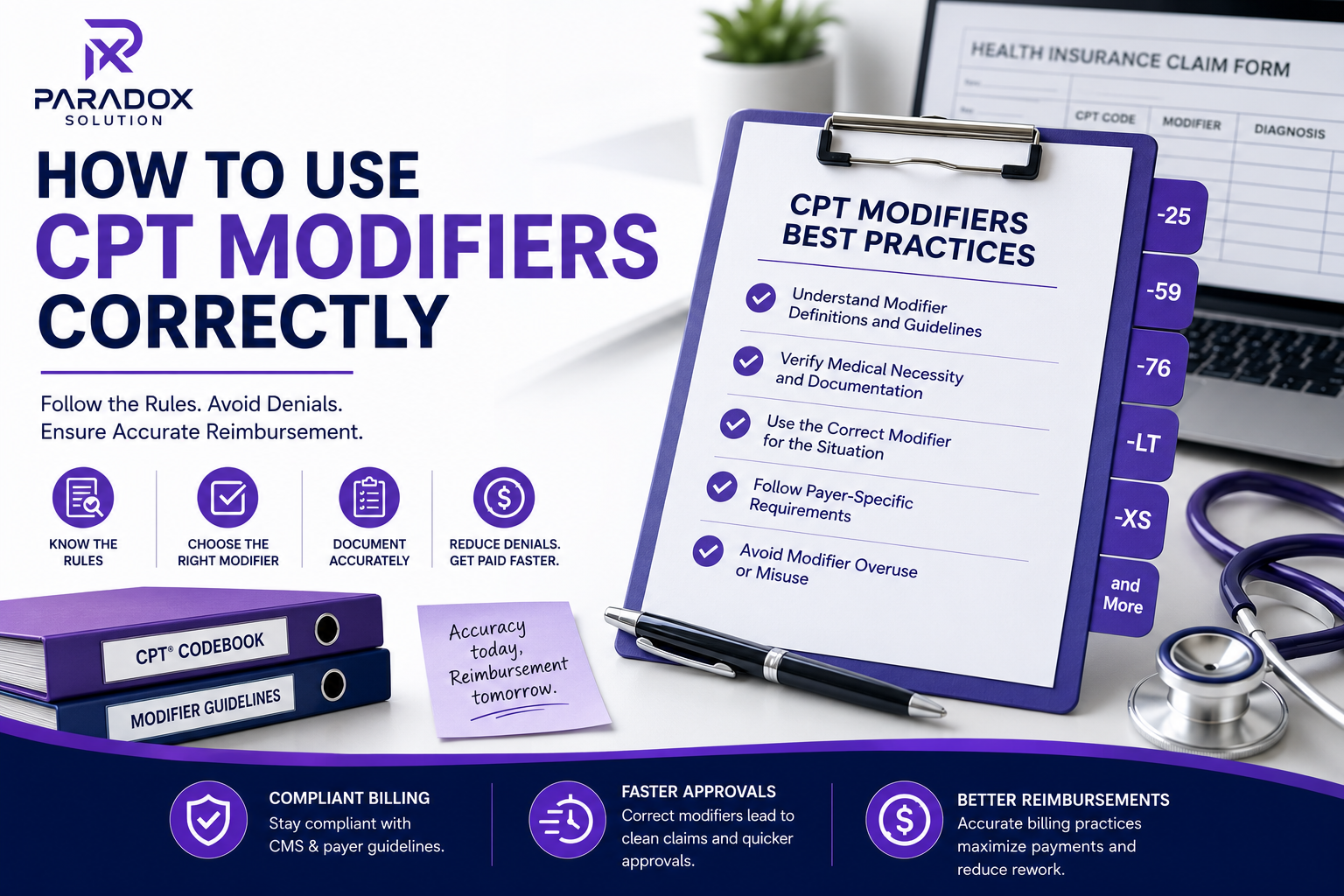
Medical billing is full of small details that can make a huge difference in whether a claim gets paid the first time or comes back with a denial. One of those details is using CPT modifiers correctly. If you’ve ever wondered How to Use CPT Modifiers Correctly: A Complete Guide, you’re in the right place.
Modifiers may look like simple two character codes, but they tell insurance companies an important story about the service you provided. When they’re used correctly, they help prevent claim delays, reduce denials, and ensure providers receive the right reimbursement. When they’re used incorrectly, they can create unnecessary headaches for your billing team and your practice. This guide breaks everything down in plain language, with practical examples, easy to understand tables, and real world advice that you can apply immediately.
What Are CPT Modifiers?
CPT modifiers are two character additions placed after a CPT procedure code. Their purpose is to explain that a service or procedure was performed under special circumstances without changing the procedure code itself.
Think of a modifier as additional context. The procedure remains the same, but the modifier explains something unique about how, when, or why it was performed.
For example:
| CPT Code | Modifier | Meaning |
|---|---|---|
| 99213 | 25 | Significant separately identifiable evaluation and management service |
| 11042 | 59 | Distinct procedural service |
| 45385 | 51 | Multiple procedures |
Without the correct modifier, insurers may assume the services should not be paid separately.
Why CPT Modifiers Matter
Many billing denials happen because modifiers are missing, incorrect, or applied unnecessarily.
Using the correct modifier helps:
-
- Reduce claim denials
-
- Increase first pass claim acceptance
-
- Improve reimbursement accuracy
-
- Demonstrate medical necessity
-
- Avoid compliance issues
-
- Support proper documentation
For most practices, getting modifiers right can improve cash flow without increasing patient volume.
How CPT Modifiers Work
Imagine a patient visits your office for knee pain.
During the visit:
-
- The physician performs an office evaluation.
-
- The patient also receives a joint injection.
The office visit may require Modifier 25 because the evaluation was significant and separately identifiable from the injection procedure.
Without Modifier 25, the payer might bundle both services together and deny payment for the office visit.
Common Categories of CPT Modifiers
Not every modifier serves the same purpose.
| Category | Purpose | Examples |
|---|---|---|
| Evaluation and Management | Office visits | 24, 25, 57 |
| Surgical | Surgery circumstances | 50, 51, 58, 78, 79 |
| Professional Services | Provider role | 26, TC |
| Distinct Services | Separate procedures | 59, XE, XS, XP, XU |
| Anesthesia | Special situations | Various anesthesia modifiers |
Understanding these categories makes modifier selection much easier.
The Most Frequently Used CPT Modifiers
Modifier 25
Probably the most misunderstood modifier.
Use it when:
-
- An office visit is significant
-
- The evaluation goes beyond the usual work for a procedure
-
- Documentation clearly supports both services
Good Example
A patient comes in with severe shoulder pain.
The physician:
-
- Takes a complete history
-
- Performs an examination
-
- Orders imaging
-
- Administers a shoulder injection
Because the evaluation was medically necessary and separate from the injection, Modifier 25 is appropriate.
Modifier 59
Modifier 59 indicates a distinct procedural service.
Use it only when procedures would normally be bundled but deserve separate payment.
Examples include:
-
- Different anatomical sites
-
- Separate incisions
-
- Separate encounters
-
- Different lesions
Always ensure documentation supports the distinction.
Modifier 51
Modifier 51 identifies multiple procedures performed during the same session.
Example:
A surgeon performs:
-
- Procedure A
-
- Procedure B
-
- Procedure C
The highest value procedure is billed first.
Additional procedures may receive Modifier 51 depending on payer rules.
Modifier 26
Used when billing only the professional interpretation.
Example:
A radiologist reads an X ray.
The imaging center owns the equipment.
The radiologist bills with Modifier 26.
TC Modifier
TC stands for Technical Component.
This modifier applies when billing only for:
-
- Equipment
-
- Staff
-
- Facility costs
It excludes physician interpretation.
CPT Modifier Quick Reference Table
| Modifier | Purpose | Common Use |
|---|---|---|
| 25 | Separate evaluation | Office visit plus procedure |
| 26 | Professional component | Physician interpretation |
| TC | Technical component | Imaging equipment |
| 50 | Bilateral procedure | Both sides treated |
| 51 | Multiple procedures | Several procedures same day |
| 52 | Reduced services | Partial procedure |
| 53 | Discontinued procedure | Procedure stopped |
| 58 | Staged procedure | Planned follow up surgery |
| 59 | Distinct service | Separate procedures |
| 76 | Repeat procedure | Same physician |
| 77 | Repeat procedure | Different physician |
| 78 | Return to operating room | Related procedure |
| 79 | Unrelated surgery | Global period exception |
Documentation Always Comes First
Modifiers never replace documentation.
Every modifier should be supported by the medical record.
Documentation should include:
| Documentation Requirement | Why It Matters |
|---|---|
| Medical necessity | Justifies services |
| Separate notes | Supports Modifier 25 |
| Different anatomical site | Supports Modifier 59 |
| Procedure details | Prevents denials |
| Physician signature | Confirms authenticity |
If documentation cannot support the modifier, don’t use it.
Common Modifier Mistakes
Even experienced billing teams make mistakes.
Using Modifier 25 Too Often
Some practices automatically append Modifier 25 to every office visit.
This is a compliance risk.
Use it only when documentation clearly supports a significant evaluation.
Using Modifier 59 Instead of Better Alternatives
Many insurers now prefer the X modifiers.
Always verify payer guidelines.
Forgetting Global Surgery Rules
Procedures performed during the global period may require:
-
- Modifier 58
-
- Modifier 78
-
- Modifier 79
Choosing the wrong one often results in denials.
Missing Documentation
This is one of the biggest reasons claims fail audits.
Every modifier must match what’s documented.
Practical Billing Workflow
A simple workflow can prevent many modifier errors.
| Step | Action |
|---|---|
| Step 1 | Review physician documentation |
| Step 2 | Confirm medical necessity |
| Step 3 | Identify applicable CPT code |
| Step 4 | Determine whether a modifier is needed |
| Step 5 | Verify payer specific rules |
| Step 6 | Submit claim |
| Step 7 | Monitor claim status |
Real World Example
A patient visits a dermatology clinic.
The provider:
-
- Evaluates a suspicious skin lesion.
-
- Performs a biopsy.
-
- Removes an unrelated skin tag.
Billing may include:
-
- Office visit with Modifier 25
-
- Biopsy CPT code
-
- Skin tag removal with appropriate modifier if documentation supports separate payment
Because the physician documented each service separately, reimbursement is more likely to be approved.
Tips to Reduce Modifier Related Denials
Here are practices that consistently improve billing accuracy:
| Best Practice | Benefit |
|---|---|
| Regular coder education | Fewer errors |
| Internal claim audits | Identify trends |
| Updated coding manuals | Better compliance |
| Documentation reviews | Stronger claim support |
| Denial tracking | Continuous improvement |
Small improvements in coding accuracy often lead to meaningful increases in collections over time.
Pros and Cons of CPT Modifiers
| Pros | Cons |
|---|---|
| More accurate reimbursement | Easy to misuse |
| Better claim clarity | Requires detailed documentation |
| Reduced denials | Frequent payer updates |
| Supports compliance | Training required |
| Prevents underpayment | Incorrect use may trigger audits |
How Payer Rules Can Differ
Not every insurance company processes modifiers the same way.
Some payers:
-
- Require specific documentation.
-
- Prefer X modifiers instead of Modifier 59.
-
- Automatically review certain modifiers.
-
- Have unique billing edits.
Always verify payer policies before assuming a modifier will be accepted.
Compliance Tips for 2026
Medical billing standards continue to evolve, and compliance is more important than ever. To stay on the right track:
-
- Follow current CPT coding guidance each year.
-
- Check payer bulletins for modifier updates.
-
- Never add a modifier just to increase reimbursement.
-
- Ensure every billed service is supported by complete documentation.
-
- Perform regular internal audits to catch patterns before they become larger issues.
-
- Keep coding staff trained on annual coding changes and payer specific requirements.
Practices that focus on accuracy instead of shortcuts are generally better positioned for successful audits and consistent reimbursement.
Final Thoughts
Learning How to Use CPT Modifiers Correctly: A Complete Guide is one of the most valuable investments you can make for your medical billing process. While modifiers may seem like small additions to a claim, they play a major role in communicating the circumstances of a service to the payer. The key is to use them thoughtfully, back every modifier with strong documentation, and stay current with coding guidance and payer requirements. A careful, consistent approach helps reduce denials, supports compliance, and improves the overall financial health of your practice.
Frequently Asked Questions
A CPT modifier provides additional information about a procedure or service without changing the original CPT code. It explains special circumstances that may affect reimbursement.
Yes. In some situations, multiple modifiers are appropriate if each one accurately describes the service and is supported by documentation. Always follow payer specific guidelines for modifier sequencing.
Modifier 25 is used when a significant and separately identifiable evaluation and management service is performed on the same day as another procedure. Modifier 59 is used to indicate that a procedure is distinct and should not be bundled with another service.
Common reasons include missing modifiers, incorrect modifier selection, insufficient documentation, billing services that should be bundled, or not following payer specific billing rules.
The best approach is to provide ongoing coder education, review documentation before claim submission, stay current with annual coding updates, monitor denial trends, and conduct regular internal audits to identify and correct recurring issues.